







You wash your face at night expecting that fresh, clean feeling. Instead, a few minutes later, your cheeks feel tight, your forehead feels oddly dry, or your skin seems oilier than it did before. Choosing a cleanser can start to feel like a guessing game, especially when one formula removes everything comfortably while another leaves you wishing you had skipped the wash altogether.
An aloe based cleanser offers a gentler direction, but aloe alone doesn't guarantee a comfortable formula. The quality of the plant material, the surfactants, the final pH, fragrance choices, and the short rinse-off contact time all shape the result. The right product should leave your skin clean without making “squeaky” feel like the definition of success.
Why Your Skin Craves a Gentler Clean
Maya used a sulfate-based foaming cleanser twice daily with hot water. The first wash felt satisfying because her face seemed completely clean. Soon after, though, her cheeks felt tight while she applied moisturizer, and by morning her skin looked dry in some areas but shiny through the T-zone. Rather than scrubbing harder, she needed to examine how the cleanser was formulated and how she used it.
A strong surfactant system can remove more protective oil than the skin comfortably replaces. Frequent washing and very warm water may add to that uncomfortable, rough after-feel. Research comparing cleansing systems explains why surfactant choice and finished-product pH matter more than a botanical name on the front label. Research on cleanser mildness and skin pH

Aloe may contribute a comfortable, lightly hydrating skin feel, but adding aloe to a cleanser alone does not make the product suitable for sensitive skin. Processing freshness also matters. Heat, storage, acidic conditions, enzymes, and microbial fermentation can affect aloe components, so a fresh plant image on the label says little about how well the ingredient was handled. The manufacturer must also manage preservation, pH, and stability throughout the product's shelf life.
Research on aloe preparations has explored uses associated with dryness, discomfort, burns, psoriasis, seborrheic dermatitis, and wound healing. A systematic review found that the clinical evidence was not rigorous enough to establish broad effectiveness, particularly for a specific rinse-off cleanser. The dermatological evidence review on aloe preparations
Clean is not the same as stripped
A cleanser should lift sunscreen, daily grime, excess sebum, and other impurities so water can rinse them away. Tightness is not a reliable sign of better cleansing.
For easily uncomfortable skin, look for a formula that uses a milder cleansing system. Checking the INCI list for surfactants such as cocamidopropyl betaine or decyl glucoside gives you a more useful starting point than choosing a product because “aloe” appears prominently on its front label. Product tolerance still depends on the complete formula.
- After washing: Skin feels fresh rather than papery or stretched.
- A few minutes later: Moisturizer applies smoothly instead of stinging dry patches.
- The next morning: The face feels balanced, not excessively slick or uncomfortable.
The practical principles in this guide to gentle cleansers can help you compare formulas beyond their botanical claims.
Practical rule: If a cleanser leaves your face uncomfortably tight, do not treat that sensation as proof that it removed more impurities. It may be asking too much from your skin barrier.
Understanding How Aloe Works on Your Skin
Two cleansers can list aloe as an ingredient and still behave very differently on the face. One may use recently processed aloe in a mild cleansing base, while another may contain a small amount of older or highly processed extract alongside harsher surfactants. The leaf on the label cannot explain that difference by itself.
During washing, surfactants gather oil and particles so water can rinse them away. The cleansing system must do this without removing more of the skin's protective material than necessary. As noted earlier, the finished product's pH and surfactant choice affect that balance, but aloe adds another question: how well has its gel been preserved from processing through storage?
For background on aloe's composition and traditional uses, see this overview of the miracle of aloe.
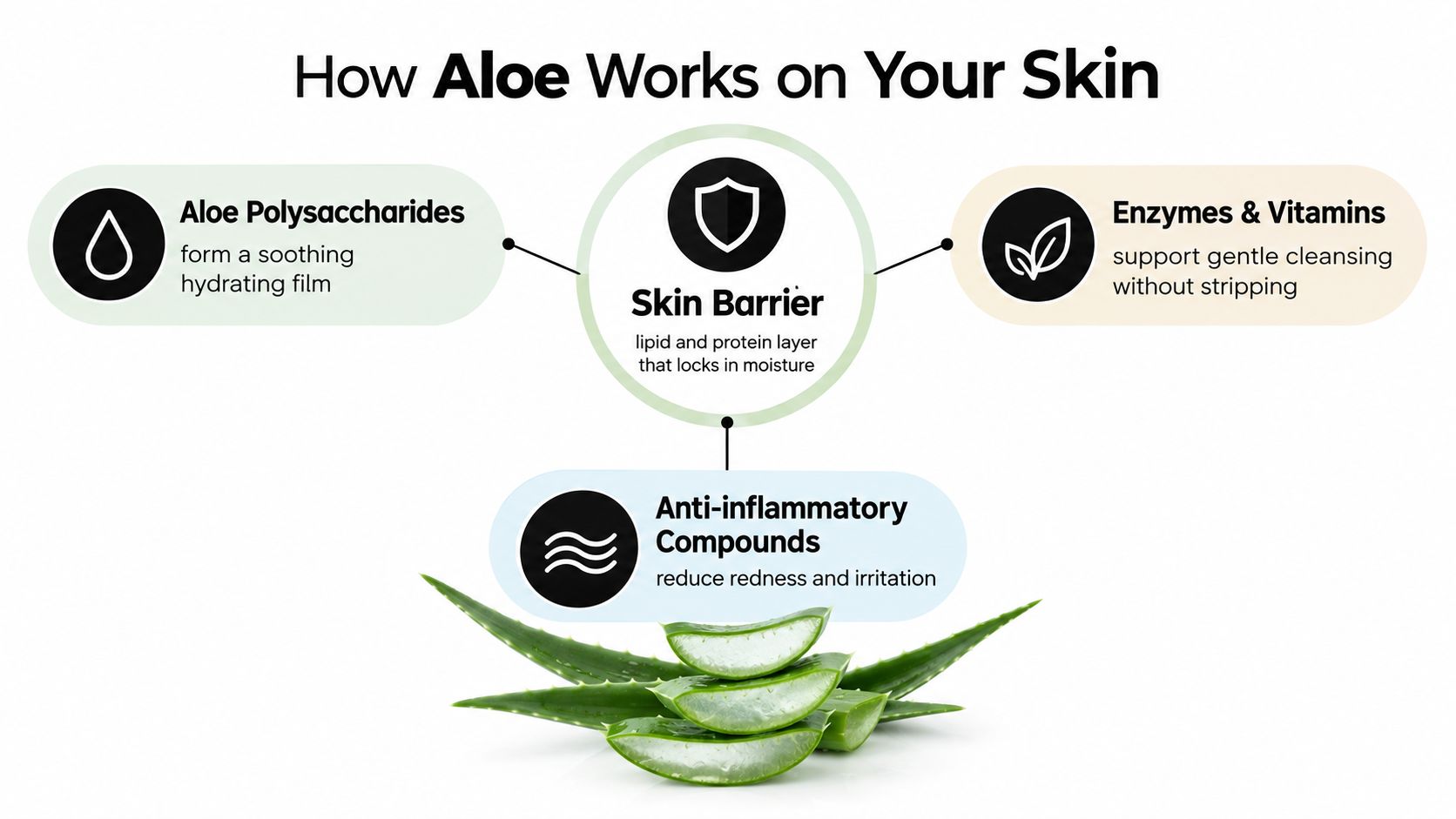
Freshness affects aloe's useful components
Aloe gel contains high-molecular-weight polysaccharides, including acemannan, a partially acetylated mannan associated with the gel's structure and activity. These compounds are sensitive to conditions such as heat, acidic environments, enzymes, extended storage, and microbial fermentation. Processing can therefore change the ingredient before it reaches the bottle. Recent review of aloe polysaccharides and processing stability
A fresh-aloe claim has meaning only when the manufacturer also controls processing, preservation, product pH, and stability throughout shelf life. A cleanser containing aloe is not automatically a fresh or sensitive-skin formula. The ingredient's form and handling matter as much as its presence.
Why rinse-off contact changes expectations
A leave-on gel stays on the skin, while a cleanser is massaged briefly and then rinsed. Even when both products contain aloe, evidence from a leave-on product cannot automatically be applied to a rinse-off cleanser because the contact time and delivered amount are lower.
Aloe based cleanser may contribute to a comfortable, lightly hydrated washing experience, but it should not be described as a treatment for a persistent skin concern. Its practical test is straightforward: it should remove the products and buildup you need to remove without leaving the face uncomfortable afterward.
The complete formula determines that result. Aloe content works alongside surfactants, humectants, emollients, fragrance, essential oils, preservatives, and the way the product rinses. A cleanser can feel silky while its cleansing base still removes too much protective material. A review of cleansing products explains how surfactants may affect barrier components, skin pH, and the lipid film that supports microbial diversity. Review of cleansing products, skin barrier function, and the microbiome
The useful takeaway is simple: aloe quality and cleanser design need to work together.
What to Look for in a Quality Aloe Cleanser
Start with the back label, not the green leaf on the front. “Contains aloe” tells you that aloe is present, but it doesn't tell you how much was used, whether it came from fresh juice or powder, how it was processed, or what else makes up the cleansing base.
Read the aloe story carefully
Look for a clear description of the aloe source and form. A company that explains where it grows the plant, how quickly it processes harvested leaves, and whether the formula uses fresh juice gives you more useful information than a vague botanical reference.
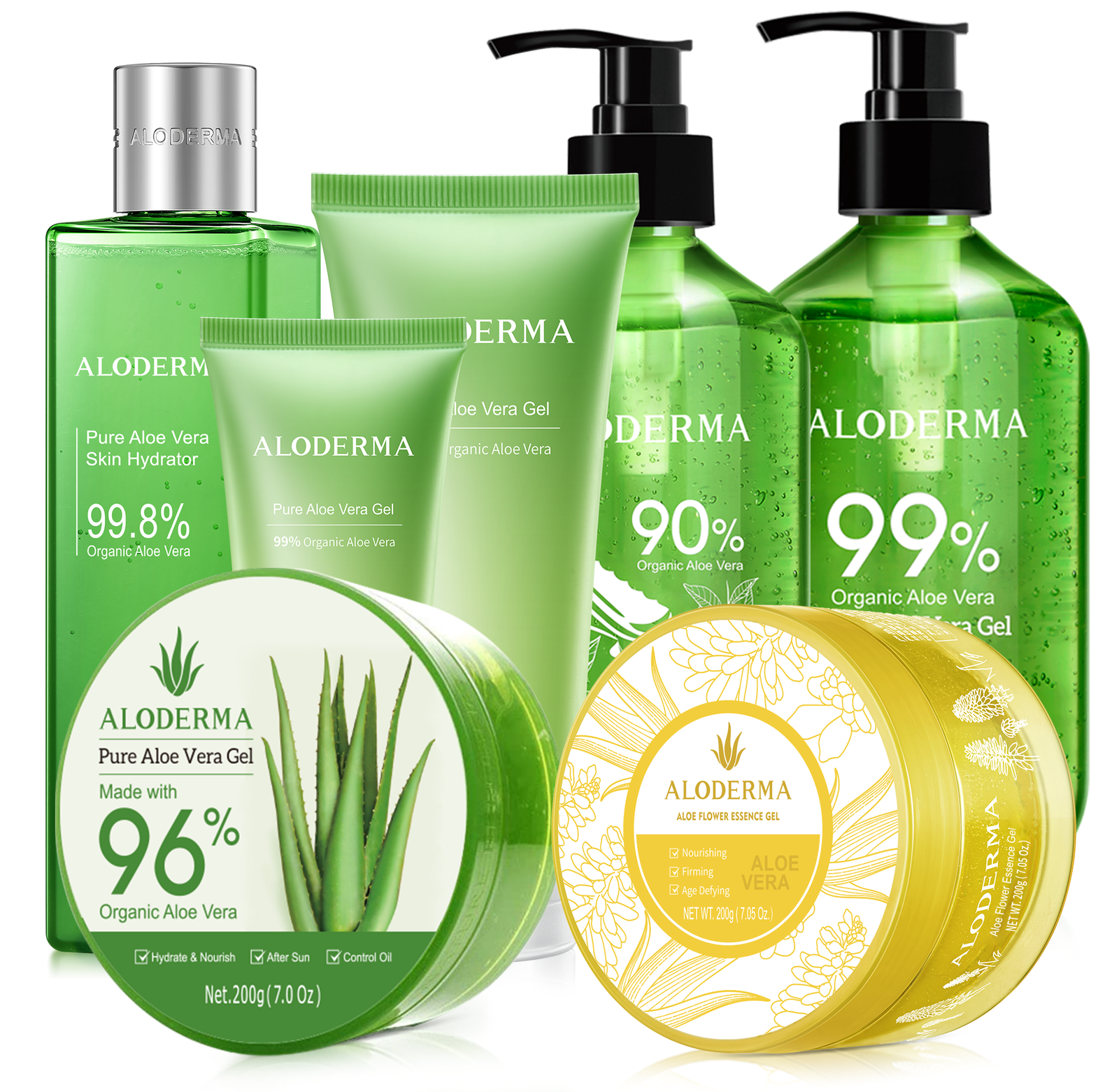
ALODERMA is a fully vertically integrated company that grows its own organic aloe and processes it onsite within 12 hours of harvest to ensure the primary ingredient is the most bioactive and effective aloe vera possible. The company's farm-to-product model covers cultivation, processing, and manufacturing, so the stated timeline isn't just a general freshness slogan. ALODERMA's fresh aloe skin care process
This kind of information helps you ask better questions:
- Aloe form: Is the product based on fresh organic aloe juice, concentrate, powder, or an unspecified extract?
- Processing: Does the brand explain how quickly leaves move from harvest to processing?
- Stability: Does the company control heat, pH, preservation, and storage well enough to protect the finished formula?
- Full formula: What surfactants, fragrance ingredients, essential oils, humectants, and emollients appear alongside aloe?
Judge the cleanser as a complete product
Aloe percentage can help you compare formulas, but it can't predict tolerance by itself. The cleanser still needs a mild surfactant system and a skin-compatible final pH. If you have easily reactive skin, a sulfate-free option may be worth considering, although “sulfate-free” alone isn't proof that every other ingredient will suit you.
Humectants such as glycerin can help the formula attract water, while emollient ingredients may reduce the sense of dryness associated with surfactant contact. Fragrance and essential oils deserve separate attention because naturally sourced ingredients can still be unsuitable for some users.
A good label should make you feel informed rather than pressured. You should be able to identify the product's intended use, review the current INCI list, and understand how much cleanser to use and how thoroughly to rinse.
Choosing the Right Aloe Cleanser for Your Skin Type
Skin type is a starting point, not a permanent label. Your choice can change with climate, sunscreen use, makeup, shaving, exercise, and how your face feels after washing. A person with an oily T-zone may still need a cleanser that doesn't leave the cheeks dry.
For oilier skin, compare a formula designed to create a fresh rinse with one designed to leave more cushioning behind. ALORDERMA's Aloe Oil Controlling Cleanser contains organic aloe vera juice and pairs it with witch hazel and mint. The company presents witch hazel as pore-clarifying and mint as part of the refreshing feel. ALORDERMA's information about aloe for oily skin
That choice may appeal to someone who dislikes a heavy after-feel and wants a cleaner, fresher finish. It shouldn't be evaluated by how intensely tight the skin feels afterward. A “squeaky” finish can be a warning that the formula is removing more comfort than you want.
For dry-feeling or easily uncomfortable skin, a more cushioning cleanser can be a better fit. The Aloe Hydrating Cleanser is described as removing impurities without sulfates, supporting a gentler cleansing approach. Product pages should be checked for the current ingredient list, directions, and packaging before purchase.
Use your post-wash feeling as evidence
Try this simple comparison over several washes:
| What you notice | What it may suggest |
|---|---|
| Skin feels clean and comfortable | The formula may suit your cleansing needs |
| Skin feels tight almost immediately | The surfactant system, water temperature, or washing frequency may be too aggressive |
| Skin feels oily again very quickly | You may be over-cleansing, or the formula may not suit your routine |
| Skin feels dry in some areas and slick in others | Consider a more balanced formula and gentler technique |
For blemish-prone readers, cleansing should remove sunscreen, sebum, and daily buildup without becoming a substitute for a targeted treatment. A rinse-off aloe product can support comfort, but it shouldn't be presented as a proven replacement for established skincare ingredients or professional guidance. Dermatology guidance also cautions that disrupting the outer barrier can affect the environment around commensal bacteria and may contribute to compensatory oil-gland activity. Practical dermatology guidance on cleansing and oily skin
Debunking Myths About Natural Skincare Ingredients
“Natural” describes an ingredient's origin. It doesn't describe the finished product's tolerance.
Aloe can be well tolerated in a properly processed formula, yet topical users have also reported burning, itching, rash, eczema, contact dermatitis, and hypersensitivity. Historical reviews associate some reactions with contaminants in inadequately purified whole-leaf or latex material, including compounds such as aloin and barbaloin. Properly processed inner-leaf gel is a different material, but the distinction shows why processing and plant fraction matter. Clinical evidence and safety information on topical aloe
The whole formula matters
A cleanser with fresh aloe may still contain fragrance, essential oils, preservatives, or a surfactant system that doesn't suit your skin. A product can feel cooling for a moment and still cause discomfort later, particularly if your barrier is already stressed.
This is why ingredient literacy is more useful than a simple natural-versus-synthetic judgment. When you want a broader guide to simplifying personal-care formulas, Sphagnum Botanicals on clean formulas offers another perspective on ingredients shoppers may choose to avoid.
Plant-based” is a description of origin, not a promise that every skin type will respond the same way.
Patch testing gives you a practical safeguard. Apply a small amount behind the ear or on the inner wrist, then watch for burning, itching, rash, or other persistent discomfort before using the cleanser across your face. People with known sensitivities to related plants in the Liliaceae family may want to be especially cautious.
Building a Safe and Effective Daily Routine
A comfortable routine doesn't need many steps. Begin with lukewarm water, use a small amount of cleanser, and massage gently rather than scrubbing. Rinse thoroughly, then pat your face dry with a clean towel.
The order matters less than the technique and the response you get from your skin. If your face feels tight after washing, reduce water temperature and pressure first, then reassess the formula and frequency. Someone who wears sunscreen or makeup may need a more thorough evening cleanse, while a lighter morning wash may be enough on a quiet day.
A simple routine checklist
- Patch test first. Try the new cleanser on a small area before full facial use.
- Wash gently. Use lukewarm water and avoid rubbing around the eyes.
- Rinse completely. Leftover cleanser can contribute to discomfort.
- Pat, don't drag. Press a clean towel against the skin.
- Moisturize when needed. A lightweight moisturizer can help maintain comfort after cleansing.
- Introduce consistency. Give your routine time to show whether the cleanser leaves your skin balanced, rather than changing several products at once.
A toner isn't mandatory for everyone, but you can add one if your skin tolerates it and the formula serves a clear purpose. Moisturizer is often the more important follow-up when cleansing leaves you feeling dry. If burning, itching, or a visible rash persists, stop the product instead of trying to push through it.
The most reliable aloe based cleanser is not the one with the strongest botanical claim. It's the one that combines thoughtfully processed aloe with a mild cleansing base, sensible pH, transparent labeling, and a routine you can follow without discomfort.
ALODERMA offers fresh organic aloe cleansers for different everyday preferences. Visit ALODERMA to compare the current formulas and choose a cleanser that fits your skin's comfort and cleansing needs.