







Your cheeks feel tight after cleansing, the office air is dry, and the face mist beside your keyboard looks tempting. You spray, enjoy the coolness, then wonder why your skin still feels uncomfortable once it dries.
A hydrating face mist for sensitive skin can be a useful refreshing step, but it isn't a complete moisturizer. The most practical approach is to check the ingredients first, introduce the formula cautiously, and mist, then seal with moisturizer when your skin needs help holding on to water.
Ingredients That Make a Mist Hydrating and Gentle
Judge a mist by its first five ingredients, not just its front label. Those ingredients offer a useful starting point, although they can't tell you the exact concentration, finished pH, or how your skin will respond.
Start with the liquid base. Water isn't automatically a poor ingredient, but if you're specifically shopping for an aloe-based formula, look for Aloe Barbadensis Leaf Juice near the top rather than treating a small aloe addition as the same thing.
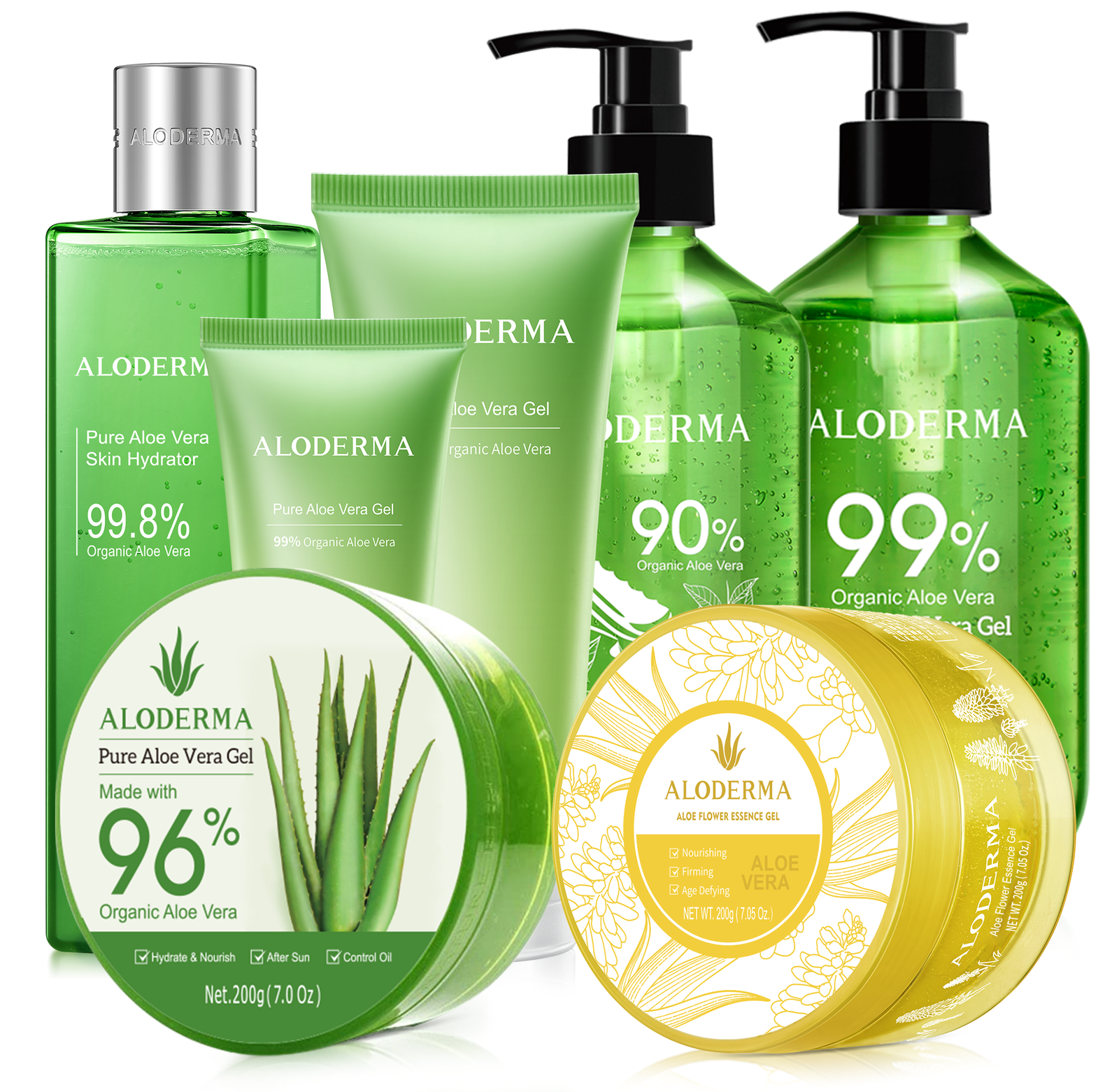
At ALODERMA, we're a fully vertically integrated aloe vera company. We grow all our own organic aloe vera, process the leaves, and manufacture onsite within 12 hours of harvest, with the aim of ensuring that the primary ingredient in every product is the most bioactive and effective aloe vera possible, as explained in our farm-to-formula account. That describes our sourcing and processing approach, not a guarantee that every formula will suit every reader.
Mist ingredients by role and sensitivity
| Ingredient | What it does | Why it suits sensitive skin | Watch for |
|---|---|---|---|
| Aloe Barbadensis Leaf Juice | Delivers water and a cooling, soothing feel | Lightweight and available in fragrance-free formulas | Low label position or concentrate instead of fresh juice |
| Glycerin | Draws and holds water in the outer skin layer | Often comfortable at modest levels | A tacky finish at higher levels |
| Sodium Hyaluronate | Binds water at the skin surface | Adds light, non-greasy hydration | Still needs a well-balanced formula and appropriate moisturizer |
| Panthenol | Supports water retention and smooths skin feel | Common in gentle formulas | Individual sensitivity is still possible |
| Squalane | Acts as a light emollient and helps limit surface water loss | Can soften without a heavy finish | Check the plant source if that matters to you |
| Allantoin | Smooths and comforts the skin's feel | Low odor and commonly used in gentle products | Don't assume it cancels out an irritating fragrance |
| Essential oils | Add scent and aroma | Not gentle for everyone | Choose an option without them if aromatic products bother you |
Humectants are water-binding ingredients, including glycerin, sodium hyaluronate, and panthenol. You don't need every one of them in a single bottle. A comfortable finish matters more than collecting a long list of fashionable ingredients.
For the sealing step, Neutralyze's guide to comparing moisturizers for sensitive, blemish-prone skin offers another resource for thinking about moisturizer texture and ingredient choices.
Shopping shortcut: An aloe-first base, a straightforward humectant blend, and no added fragrance are a useful shortlist, not proof of universal gentleness.
Before buying, copy the first five ingredients into a phone note. Compare their roles with the table, then check the full list for scent ingredients you already know your skin dislikes.
How Common Sensitive Skin Changes Your Mist Choice
You finish washing your face and notice tightness around your mouth. Then a scented toner touches your cheeks and stings. It's understandable to start wondering whether every new product will feel the same way.
You're not alone in describing your skin as sensitive. A 2024 State of Skin Sensitivity report found that 71% of global consumers identified themselves as having sensitive skin, according to Mordor Intelligence, citing Aveeno's study. That figure reflects self-identification, not confirmation through consistent clinical testing.
The useful question isn't whether you fit a broad label. It's what happens, when it happens, and which products are involved.
Recognize your everyday pattern
A commuter might feel comfortable outdoors but tight after spending the afternoon beside office heating. A runner might notice that products sting when applied immediately after sweating. Another reader might tolerate a simple lotion well but dislike nearly every strongly scented spray.
These experiences don't call for identical shopping decisions. Occasional dryness may make a mist an enjoyable extra, while repeated discomfort calls for a more cautious, simplified routine. Our guide to understanding sensitive skin can help you describe that pattern more clearly.
If you want individualized guidance rather than another trial-and-error purchase, the Longevity Medical Institute skin health treatments page provides context for a professional skin-health consultation.
Ask yourself before buying
- Is there a repeatable trigger? Note whether discomfort follows fragrance, cleansing, exercise, or a particular environment.
- How quickly does it begin? Immediate stinging deserves more caution than wishing your skin felt less dry later.
- Does it settle when you stop? Don't keep reapplying a product that repeatedly makes your face uncomfortable.
If a mist quickly stings or leaves you tighter, stop using it. For your next shortlist, favor fragrance-free formulas with little or no volatile alcohol rather than assuming the sensation means the product is working.
What Research Shows a Face Mist Can Do
A mist can add short-term surface wetness and softness, but it isn't a substitute for moisturizer. The evidence supports a modest role, not the idea that spraying more often automatically produces lasting hydration.
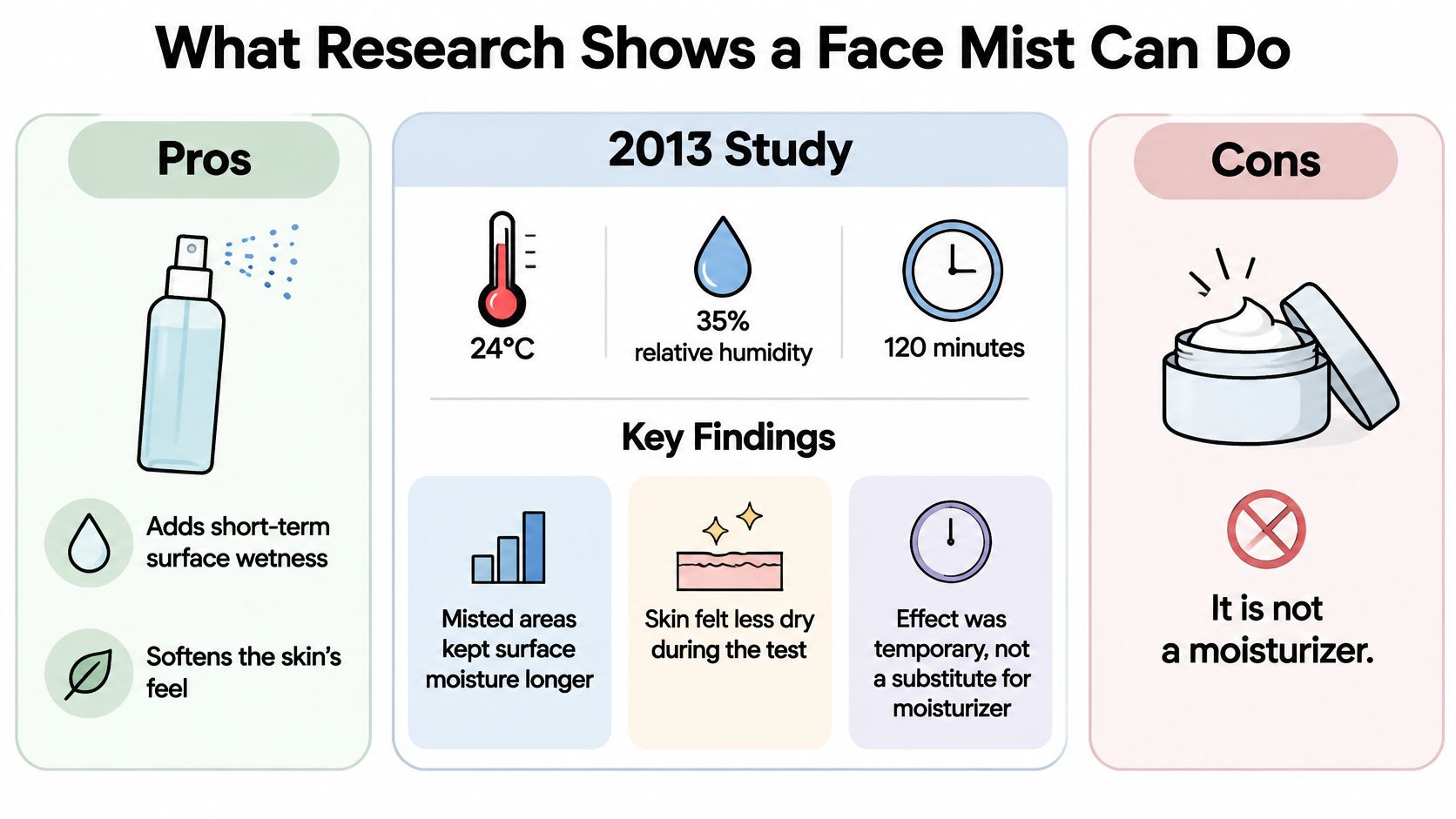
In a 2013 study conducted at 24°C and 35% relative humidity over 120 minutes, mist-exposed areas maintained initial transepidermal water loss levels, while untreated areas showed significant decreases after an hour, according to the Skin Research and Technology study account. The mist-exposed forehead and cheek also showed greater skin distension, interpreted as temporary softening or hydration of the outer layer.
Transepidermal water loss, or TEWL, measures water moving out through the skin. The pattern above shouldn't be simplified into a claim that mist repaired the barrier or reduced water loss. The measurements were more specific than that.
The same study account describes a 2015 investigation involving eight healthy Japanese women aged 45.5 ± 3.2 years, tested during winter and summer. Mist increased skin conductance near the outer eye corner in winter, but not every change was statistically significant.
The illustration summarizes the temporary nature of the effect; its simplified outcome labels shouldn't be read as additional measured findings.
Keep expectations proportionate
Think of wiping a dry windowsill with a damp cloth. It looks refreshed immediately, but that visible wetness doesn't tell you how long moisture will remain. Skin is more complex, yet the distinction between wetting a surface and retaining water is useful.
What a mist can offer
- Quick refreshment: A light application can feel cooling.
- Temporary softness: Surface hydration may improve how the outer layer feels.
- Convenient application: A spray can fit easily into an existing routine.
What these studies don't establish
- Moisturizer replacement: They don't demonstrate superiority over an occlusive cream.
- Lasting results: Short observations don't prove long-term benefits.
- Universal tolerance: A tested mist system doesn't validate every retail formula.
Our guide to how to hydrate skin places that refreshing step within a broader routine. Judge your mist by how comfortable your face feels later, not only by the pleasant moment immediately after spraying.
How to Use a Mist in Your Daily Routine
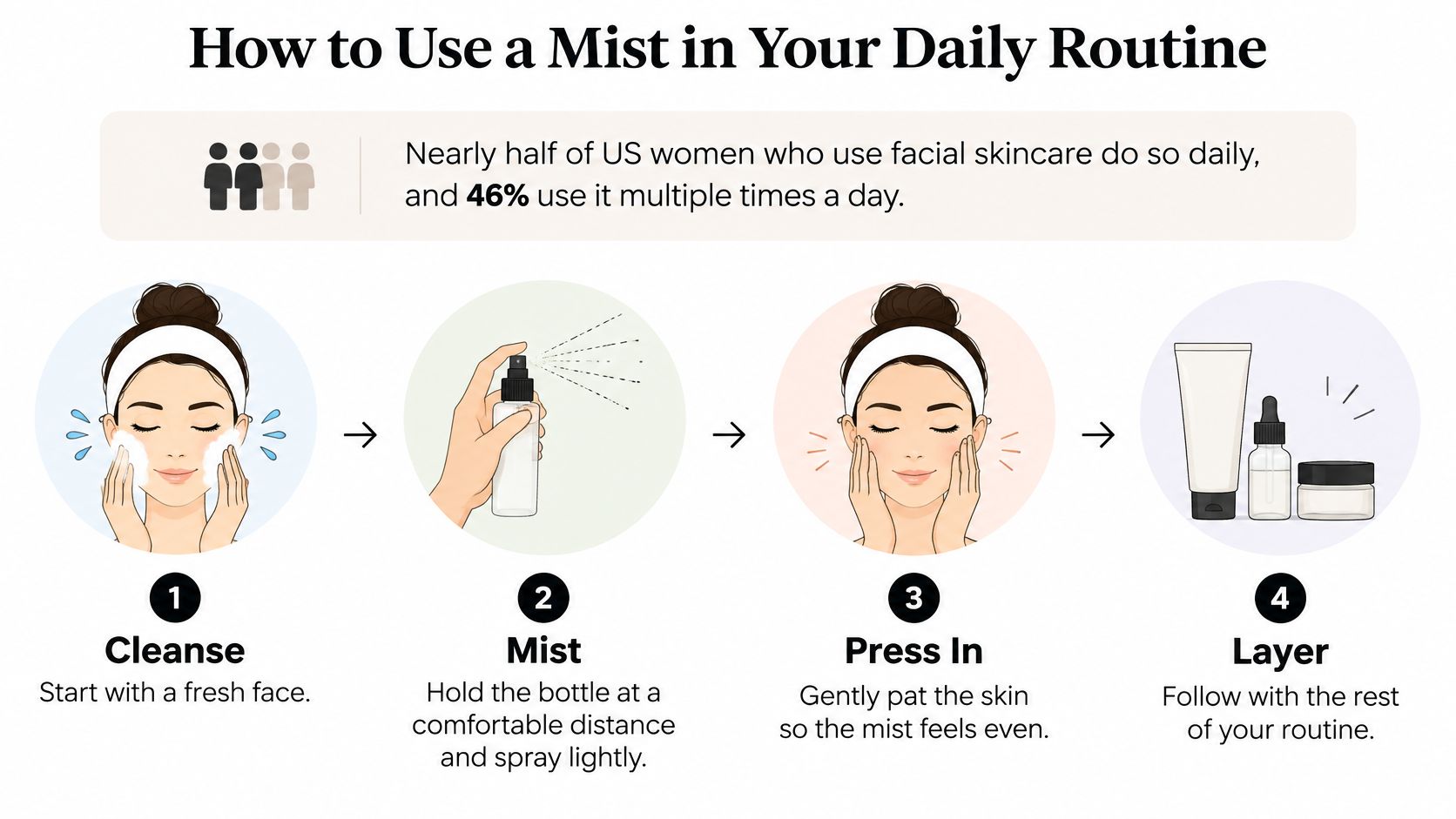
A mist should fit your routine, not create a need for constant reapplication. In a 2025 U.S. beauty-buyer study, 49% of women used facial skincare daily and 46% used it multiple times per day, according to The Benchmarking Company as reported by Grand View Research.
The useful habit is mist, then seal. Dermatology guidance summarized by NBC Select's face-mist guide explains that plain water-based sprays can evaporate quickly and potentially leave skin feeling drier, while humectants and a suitable moisturizer help make the step more useful.
A gentle application sequence
- Cleanse without scrubbing. Rinse thoroughly and pat until your face is just damp. You're preparing a comfortable surface, not trying to make it squeaky clean.
- Apply a light, even layer. Hold the bottle far enough away that droplets spread rather than hit one spot in a stream. Keep your eyes closed, avoid the eye area, and don't inhale the spray.
- Let it settle briefly. You don't need to rub. If droplets pool, use less next time rather than massaging a wet layer repeatedly.
- Apply moisturizer while slightly damp. Choose a familiar, fragrance-free formula. The aim is to leave your face comfortable after the visible water disappears.
- Reapply only when useful. If dry air makes your skin uncomfortable again, reassess whether you need moisturizer rather than repeatedly soaking your face.
This visual offers a simplified routine. If you prefer to press the mist in, use clean hands and a light touch rather than friction.
Mist frequency and follow-up by situation
There isn't a proven universal spray schedule. Use these practical cues instead of treating the bottle as a timer.
| Situation | Mist frequency | Follow-up |
|---|---|---|
| Dry, heated office | A light midday application if needed | Apply moisturizer before the dampness disappears |
| Air-conditioned flight | Only when skin feels dry, not automatically | Use a richer cream if your usual lotion isn't enough |
| Wearing a face covering | A light application before putting it on | Let a thin moisturizer layer settle before covering |
| Hot, humid day | A light application if it feels pleasant | Follow with a light gel moisturizer |
| Tight skin after cleansing | Apply during your post-cleansing routine | Follow promptly with moisturizer |
Don't chase comfort with more spray if each application leaves your face tighter.
Use mist before sunscreen or makeup, let it settle, and continue with those products. Avoid spraying over already-set makeup or relying on mist to refresh a sunscreen film; follow the sunscreen's own reapplication directions.
Never spray onto broken or freshly treated skin. If stinging persists, stop rather than trying to cover the sensation with another layer.
Formula Features That Make a Mist Gentler
A gentle mist should feel controlled from the first spray through the dry-down. That involves the finished formula, its acidity, and the nozzle, not whether the bottle contains a familiar botanical.
Finished pH and the dry-down
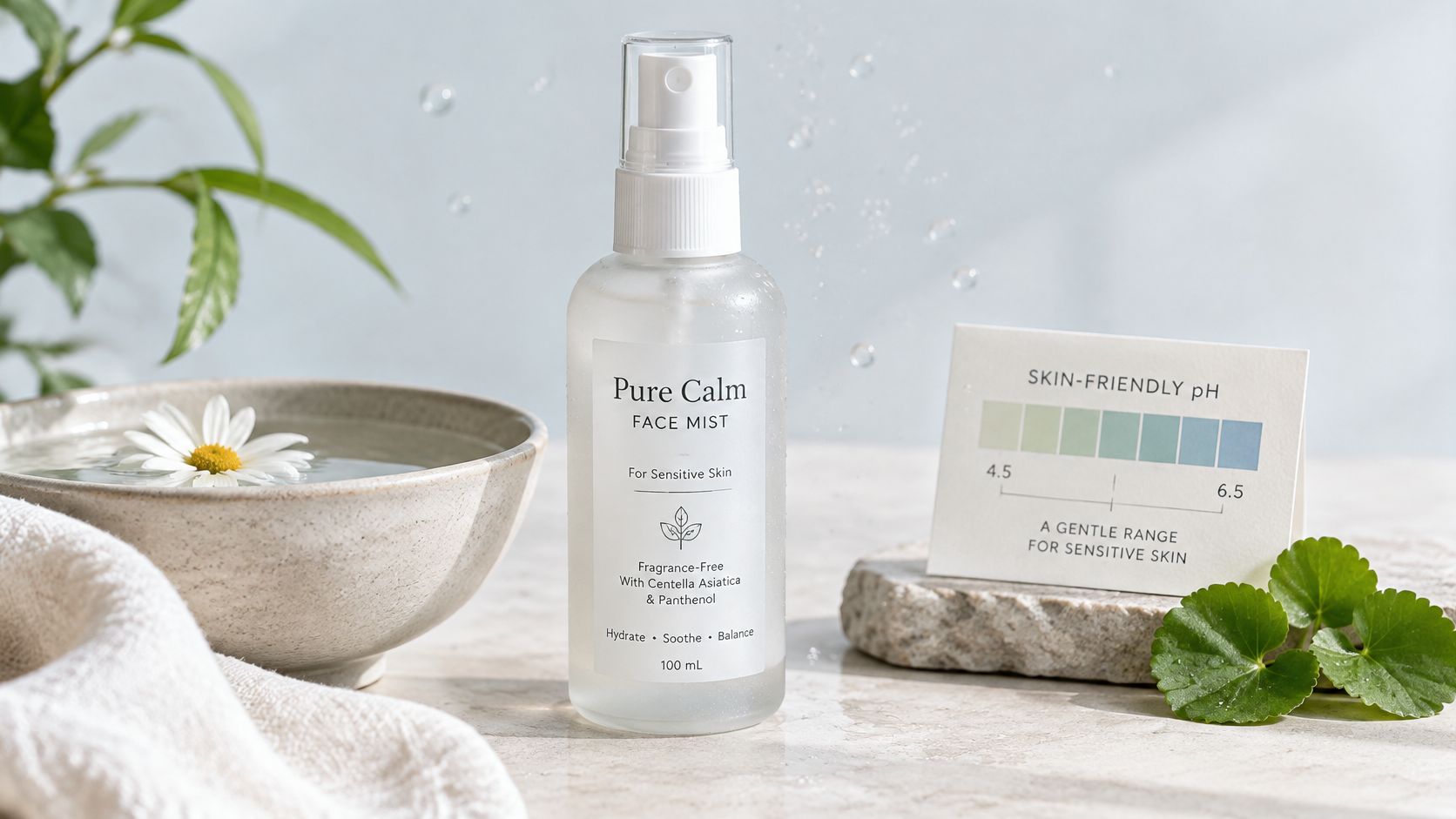
Sensitive-skin formulation research described pH 4.5 to 6.5 as acceptable for cutaneous compatibility, with one tested formula showing no significant deterioration in hydration or TEWL over six hours, as discussed in this skin-barrier assessment paper. This is a useful formulation reference, not a promise that every product within that range will feel comfortable.
You can't determine finished pH from ingredient names alone. If a brand publishes it, use that information alongside tolerability testing. If it doesn't, don't guess from the presence of an acid near the end of the list.
Volatile alcohol also needs context. A fast-drying formula may feel pleasantly weightless to one person but sting or leave another person tight. Ingredient position provides a screening clue, but it doesn't disclose an exact concentration.
A humectant blend at modest levels can avoid a sticky finish. A small amount of a suitable film-forming ingredient may also help slow evaporation without turning a light spray into a heavy coating. For combination skin, that balance can matter more than how rich the product feels immediately.
The image below illustrates a pH check, not confirmation of a particular product's tested pH.
The nozzle is part of the experience
A well-tuned garden hose nozzle produces soft, even coverage. A poorly adjusted one sends a concentrated stream into one spot. Face-mist packaging has a similar practical distinction: uniform droplets are easier to control than spluttering jets and visible runoff.
Avoid creating a cloud you breathe in. Spray in a ventilated space, keep the nozzle away from your eyes, and stop if the mechanism sputters or leaks.
Use this feel-based checklist when comparing product information:
- Published pH: Look for a finished-product value rather than an ingredient-based guess.
- Comfortable dry-down: Notice tightness as well as stickiness.
- Controlled delivery: Favor even coverage without pooling.
- Transparent testing: Human tolerability information is more useful than a gentle-sounding product name.
Patch Testing and Safety Checks Before Daily Use
A water-rich botanical spray needs more than appealing ingredients. The FDA's microbiological safety guidance explains that cosmetics can become harmful when contaminated with bacteria or fungi, and identifies inadequate preservation, storage conditions, and consumer dilution as relevant risks.
That's why natural, clean, and preservative-free aren't substitutes for a well-protected formula. Preservation helps keep a product suitable for repeated use; an unfamiliar preservative name isn't automatically a reason to reject it.
Label checks before you buy
| Check | Good sign | Red flag |
|---|---|---|
| Ingredient order | Aloe Barbadensis Leaf Juice near the top when choosing an aloe-based mist | Aloe is absent despite prominent aloe marketing |
| Preservation | A clear ingredient list and transparent preservation information | Preservative-free claims without an explanation of product protection |
| Fragrance | Fragrance-free, with no aromatic ingredients you already dislike | Parfum or multiple essential oils in a product intended for highly reactive users |
| Alcohol | Little or no volatile alcohol | Alcohol denat. near the top when fast-drying products bother you |
| Storage and expiry | Intact packaging, storage directions, and expiry or period-after-opening information | Unmarked packaging or prolonged warm, damp storage |
| Certification | A verifiable USDA Organic or ECOCERT mark | Only broad natural or clean language |
Certification addresses particular standards, not guaranteed personal tolerance. Our explanation of organic skincare certifications describes USDA Organic and ECOCERT, but even a certified product deserves the same careful introduction.
Introduce the formula gradually
An at-home test can reveal an obvious reaction, but it can't guarantee that full-face use will be comfortable. Treat the following as a cautious introduction, not a diagnostic test.
- Choose a small area. Use intact skin on the inner forearm or behind the ear. Avoid areas that are already uncomfortable.
- Repeat a light application. Try a small amount daily over several days rather than covering a large area immediately.
- Observe both early and delayed changes. Check soon after application and again the next morning for stinging, redness, tightness, or swelling.
- Move cautiously toward facial use. If the first area stays comfortable, test a small jawline area over a couple of days before applying across your face.
- Stop for persistent discomfort. Burning, redness, or swelling is a reason to discontinue use and seek professional advice, not to increase exposure.
Our guide to patch testing skincare offers additional help with introducing a new product patiently.
Storage habit: Keep the original bottle closed, away from heat and shower steam, and don't add water.
Don't share your mist or transfer it into an unlabeled bottle. Those small conveniences make it harder to preserve the product's protection and track how long it has been open.
Choosing Your Mist and Starting Your Patch Test
The best choice is a mist you can evaluate clearly and use comfortably. A short ingredient list you can read beats a long one full of unknowns, and a mild formula you'll use consistently beats a stronger one that stings.
Keep this simple decision path beside your shopping list.
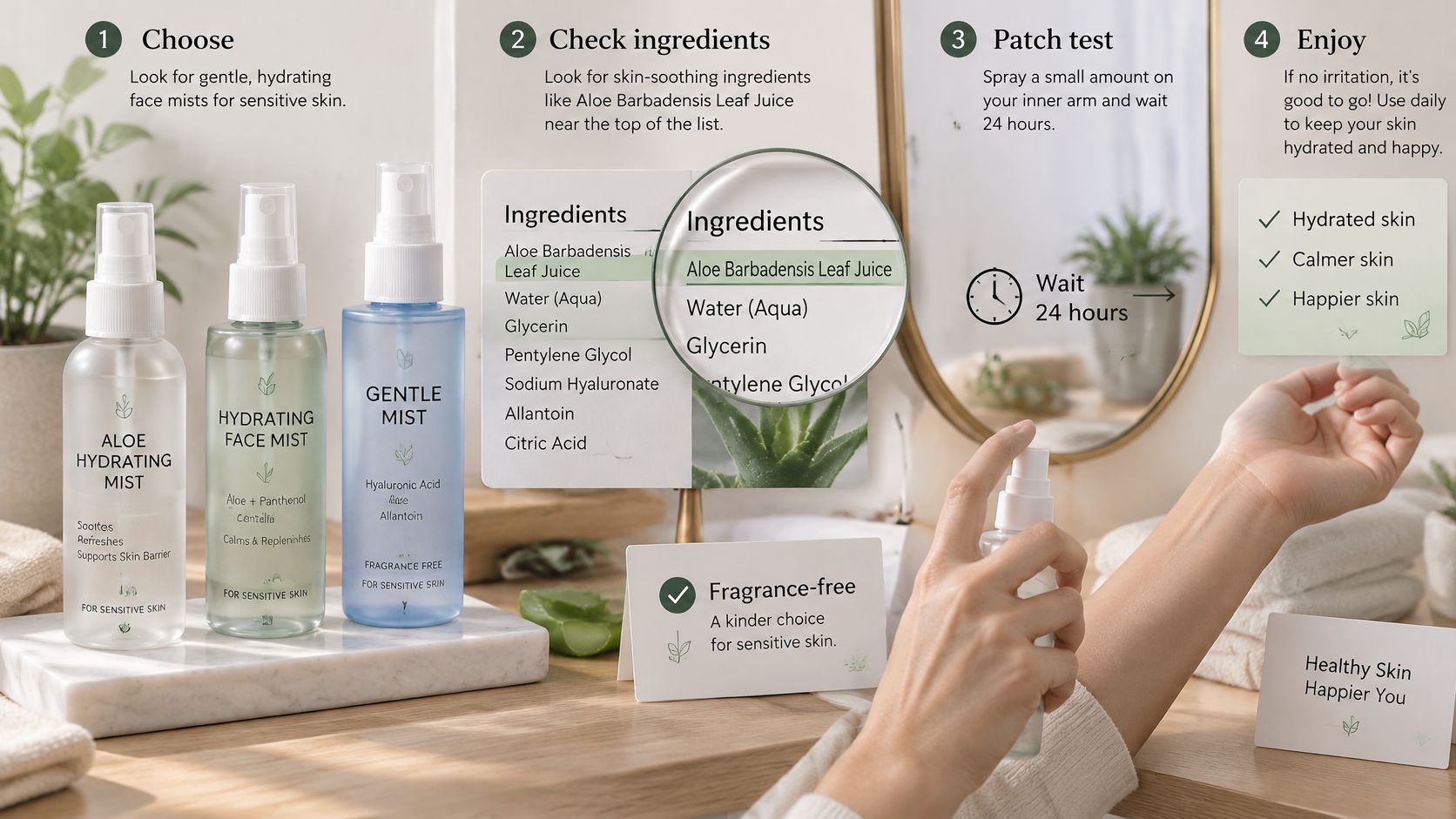
- Shortlist by formula: Look for an aloe-rich base if that's your preference, useful humectants, and a fragrance profile your skin is likely to tolerate.
- Match your actual day: A desk-side refresh and a post-cleansing step serve different purposes. Make room for the moisturizer your environment calls for, since a mist refreshes the surface rather than sealing water in.
- Check product protection: Review preservation information, packaging, storage directions, and the full ingredient list.
- Compare the complete purchase: Consider price alongside formula transparency, not just bottle size or front-label promises.
Our Aloe Botanical Hydrating Mist costs $14.99 USD. Before buying, check its current listing and full ingredient information rather than assuming that an aloe-based product is automatically fragrance-free.
ALODERMA grows aloe on its own plantations and processes it on-site within 12 hours of harvest, with aloe as the primary ingredient and formulas built on at least 95% naturally derived ingredients, as described on our fresh aloe skincare page. Fresh sourcing is a useful filter when you shortlist, but your own small-area test still decides whether a formula earns daily use.
If you'd like a visual companion while considering your routine, you can watch this video.
Pair your chosen mist with a familiar, fragrance-free moisturizer. Tonight, start with the small-area test; reserve the couple-of-days jawline stage for after that first area remains comfortable. Let the product earn a place in your routine through a calm, comfortable dry-down.
ALODERMA offers fresh organic aloe-based skincare, including a lightweight mist for a refreshing hydration step. Visit ALODERMA to review ingredient information, choose a formula that fits your routine, and begin with a small-area test before full-face use.