



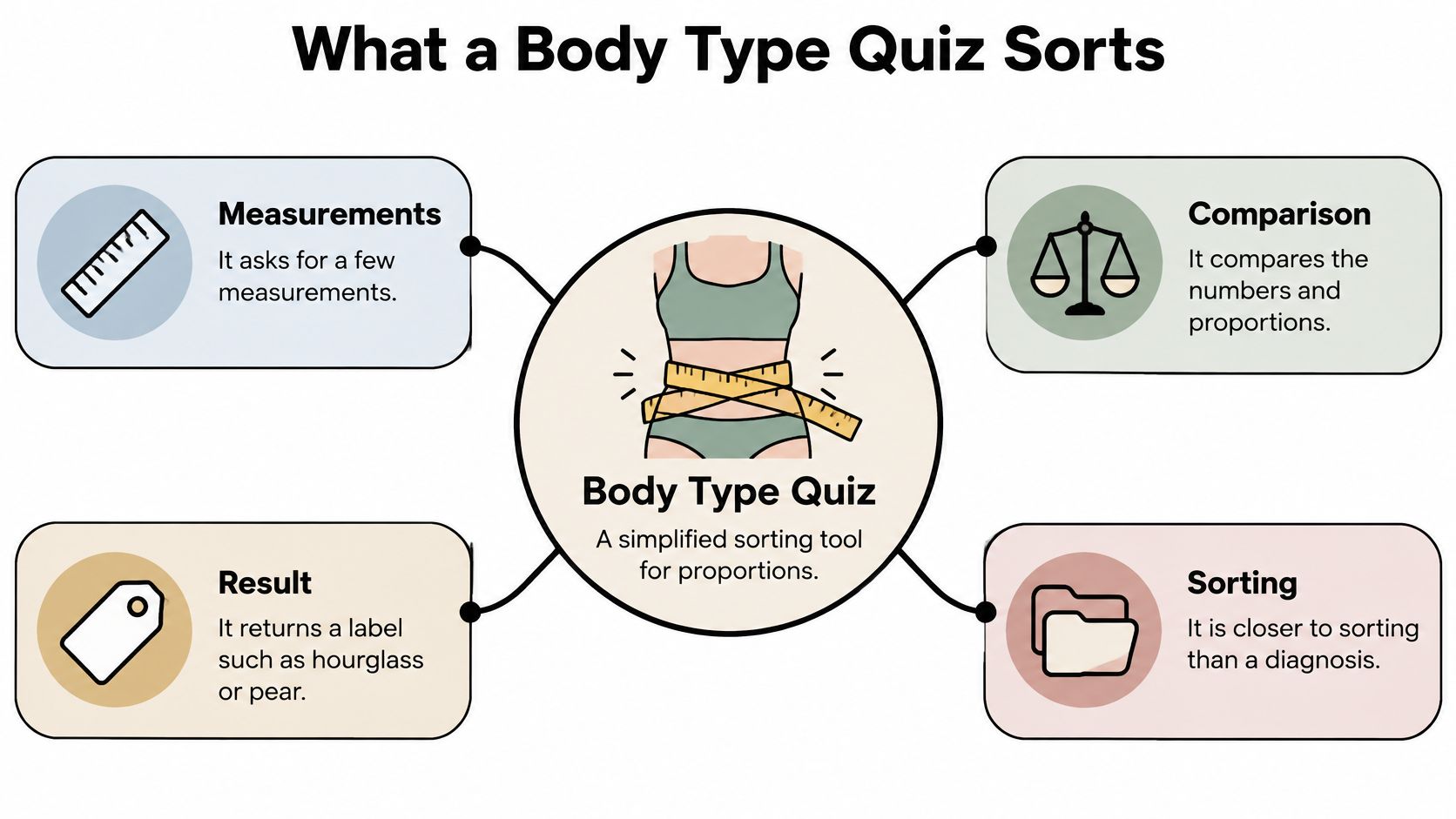
A body type quiz sorts proportions from three circumferences, bust or chest, waist, and hips, and the older three-part physique score rates each part from 1 to 7, with 444 marking a relatively balanced build. The result is a descriptive shape, not a fixed identity.
So why does a second calculator disagree when your tape, your jeans, and your body have not changed since breakfast? Most quizzes sell the idea that one nickname is the true you. The gap is simpler. They are sorting tools with different cutoffs, and a small change in how you hold the tape can push you over a line.
Think of sorting fruit. Two apples can both be round and still need different bowls. Your bust, waist, and hips work the same way. The useful question isn't "which box am I allowed to live in?" It is "which proportions should my clothes respect this season?"
Keep the three numbers. Read the label as a starting point for fit. If a runner-up sits within an inch, you didn't fail the test. The tests failed to show you their thresholds.
What a Body Type Quiz Sorts
What does a body type quiz sort: your identity, or the way your proportions relate to one another? It compares measurements and returns a label such as hourglass or pear. The label can help you think about clothing fit, but it does not define who you are.
A quiz may also draw on older language about physique. William H. Sheldon and colleagues formalized somatotyping in 1940, describing endomorphy as relative roundness, mesomorphy as muscularity, and ectomorphy as linearity or leanness. Each component was scored from 1 to 7. A 444 represented a relatively balanced physique; combinations such as 711, 171, and 117 described pronounced differences among the three components.
Sheldon's research used a large sample of male college students and treated physique as a continuous range, rather than three fixed boxes, as Encyclopaedia Britannica's somatotype entry explains. Clothing labels work differently: a ClothME's body shape guide uses shape categories to help describe outlines for fit. Either kind of label is a shorthand, not a verdict.
A quiz describes shape, not worth. It cannot tell you your personality or decide which clothes you deserve to feel comfortable in.
Skin has its own set of questions. A skincare quiz for personalized skin-type recommendations focuses on your skin, not your silhouette.
Measure Three Points and Read Your Label
A what is my body type quiz should show its math. Weight alone can't do that job, because two people at the same scale number can have completely different outlines. You need three circumferences, then a few comparisons you can check by hand.
Take the three circumferences
Wikipedia's overview of female body shape treats bust or chest, natural waist, and hips as the usual inflection points. Measure over light clothing, keep the tape level, and don't dig it into soft tissue. Repeat each one and average if the readings don't match.
- Bust or chest. Wrap the tape around the fullest point, level across the back, snug but not tight. A sports bra that compresses you will shrink this number and invent a new shape.
- Natural waist. Find the smallest section just above the navel, usually where you bend to the side. Don't use the waistband of your jeans if it sits lower.
- Hips. Circle the widest part of the buttocks, tape horizontal, feet together. If pockets or a phone live in those jeans, take them out first.
- Write all three down in inches before you open any calculator. The quiz should not be the only place those numbers exist.
- Retake only when the method changes, not because you disliked the nickname.
Read the gaps and the ratio
A clothing-fit classification paper defines labels by relative widths, not by identity. A rectangle has bust and hips fairly balanced and a less pronounced waist. An hourglass has balanced shoulder and hip widths with a clearly narrower waist. A pear has hips or thighs visually wider than the shoulders. An inverted triangle has shoulders wider than the widest hip or thigh area.
Another calculator in that same discussion uses explicit cutoffs: a difference of no more than 1 inch between bust and hips for a near-balance condition, and waist differences of at least 9 or 10 inches in one hourglass rule. Those are house rules, not laws of nature. A second site can move the line by an inch and relabel you without your body changing.
Then turn two of the numbers into a proportion. Calculator.net's body type calculator shows the waist-to-hip mechanic plainly: divide waist by hips. A 34-inch waist and a 40-inch hip give 0.85. The ratio lets a smaller frame and a larger frame compare shape instead of arguing about absolute inches. In a style quiz it describes how defined the waist looks next to the hips. It is not a verdict on attractiveness.
Circumference still isn't body composition. If you want to see how tape, scales, and other methods differ, it helps to compare body composition measurement methods before you treat a quiz label as a training plan.
Maya's near miss
Maya measures 36 inches at the bust, 29 at the waist, and 38 at the hips. Her waist is smaller than both the upper and lower numbers, the pattern often tied to an hourglass. Her waist-to-hip ratio is about 0.76 (29 divided by 38). Her bust-to-hip gap is 2 inches, so a calculator that demands a 1-inch near-balance will call her a near miss. Her waist drop is 7 inches from the bust and 9 inches from the hips, so a rule that wants 9 or 10 inches on both sides may hesitate too.
If two labels sit within an inch, keep both. Write primary and runner-up, and don't retake until your tape method changes.
Mini self-check: write your three numbers, your ratio, and your primary label. If the runner-up is one inch away, keep it. If the quiz also asks for high hip or abdomen, expect a different label, because those points catch a high hip shelf or a fuller middle that bust, waist, and hip had smoothed over.
| Category | Extra clue | Easy way to picture it |
|---|---|---|
| Hourglass | Balanced shoulders and hips with a clearly narrower waist | Curve both above and below a defined waist |
| Bottom hourglass | Hourglass waist with relatively fuller lower curve | Defined waist, more ease needed below |
| Top hourglass | Hourglass waist with relatively fuller upper curve | Defined waist, more ease needed above |
| Rectangle | Bust and hips close, waist not much smaller | A fairly straight line from shoulder to hip |
| Oval | Abdomen or midsection fuller than bust and hips | Fullest through the middle |
| Triangle | Hips wider than bust, lower-body emphasis | Weight of the outline sits low |
| Inverted triangle | Shoulders or bust wider than hips | Weight of the outline sits high |
| Spoon | Fullness just below the high hip | Hip shelf where skirts and pockets pull |
| Diamond | Full midsection with narrower bust and hips | Wider through the middle than at either end |
Use the extra-clue column after the bust, waist, and hip steps. Find the row that matches your strongest clue, then confirm it with the picture in the last column. If two rows both fit, you are between labels, which is a normal place to stand.
Nine Shapes When Four Labels Feel Wrong
Four tiles, pear, apple, rectangle, and hourglass, leave a lot of people feeling unseen. You try on the word, the skirt still bites, and you assume the quiz knows you better than your own mirror. It doesn't. It only asked three questions.
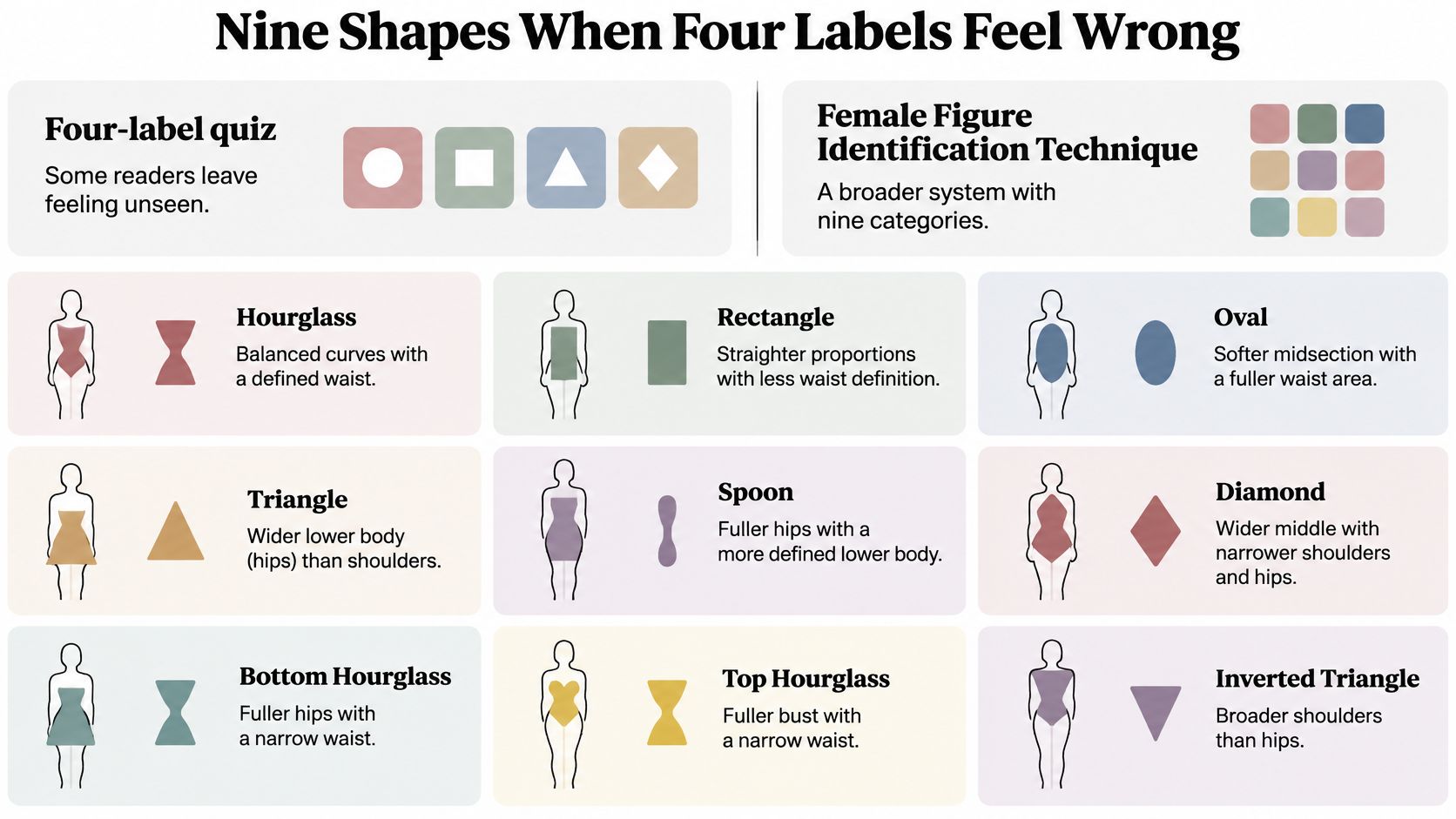
Research using the Female Figure Identification Technique, described in this Springer clothing study, lists nine categories: hourglass, rectangle, oval, triangle, spoon, diamond, bottom hourglass, top hourglass, and inverted triangle. The system compares bust, waist, high hip, abdomen, and hip. Add a high-hip or abdomen question and a settled three-point label can move, because the new point catches a shelf the first quiz never measured.
Four portraits past the basic four
A bottom hourglass keeps the defined waist and carries more of the curve below, so trousers need ease through the seat even when the waist looks neat. A top hourglass keeps that waist with more of the curve above, which is why a blazer that fits the bust can hang empty at the hip.
A spoon puts fullness on the outer hip just below the high hip. The waistband feels fine, then a pencil skirt grabs the shelf where a phone would sit. A diamond is fullest through the middle, with narrower bust and hips. That is more specific than calling every fuller middle an apple or an oval, and it explains why a dress that skims the ribs still pulls at the waist.
A 3D anthropometric study of 815 women split its own sample into 30.3% top hourglass, 32.2% regular hourglass, and 37.5% bottom hourglass. Those three shares add to 100% of that method and that group. They are not a world census, and they are not a ranking of which curve is better. If your friend got a different label from a different site, the method changed, not your worth.
The win is a closer description, not a rarer identity.
Once the outline is clearer, styling gets practical instead of personal. Cedar & Lily Clothier's styling guide is one place to test how a label behaves in real garments, then keep only the ideas that feel good when you sit down.
Clothes and Workouts That Follow Your Proportions
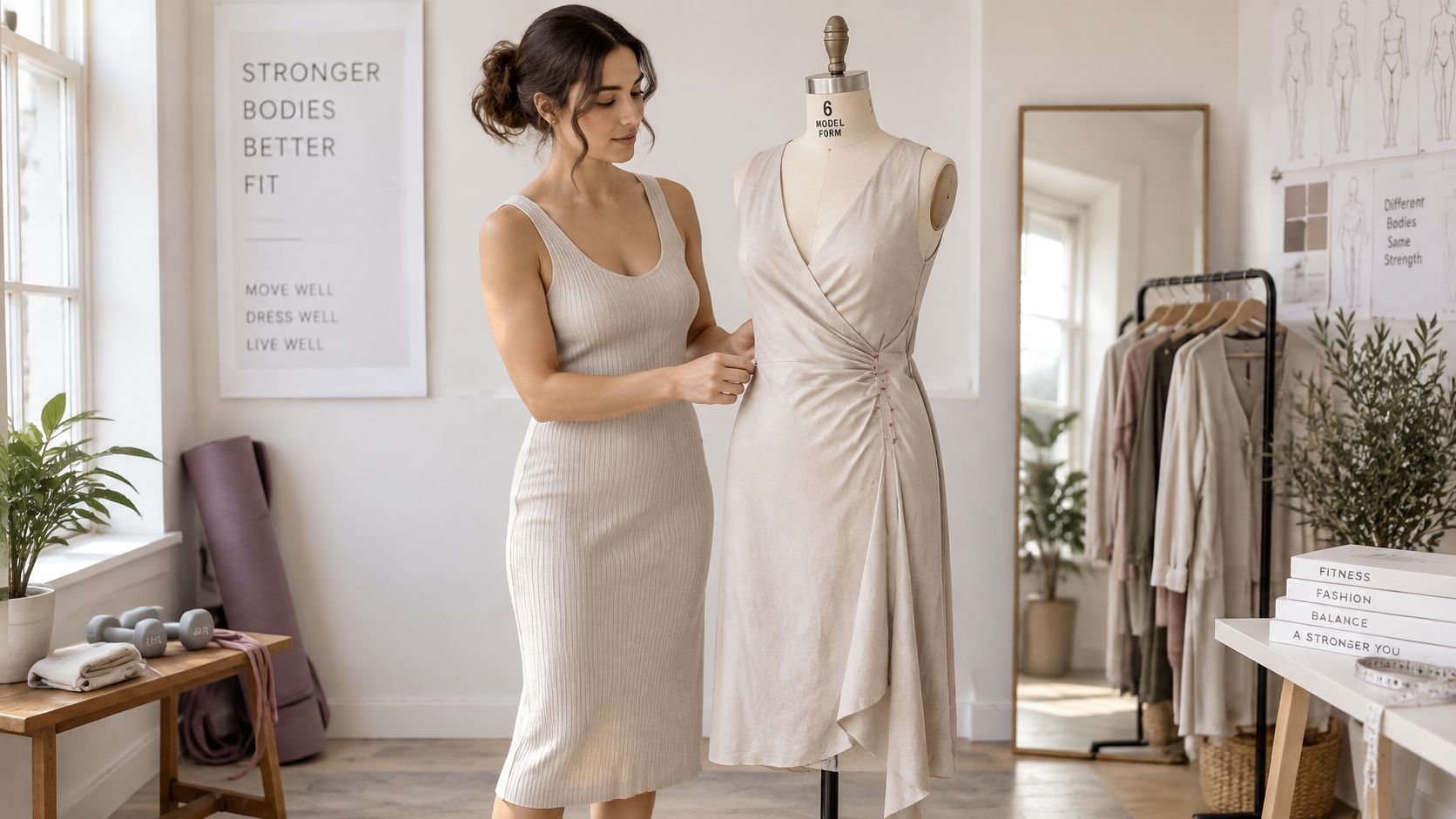
A label that can't survive a tailor's tape isn't ready to run your closet. The kinder move is to negotiate with fabric at the place your numbers already named.
One clothing move per proportion
Defined waist. Choose a waist seam or a wrap. A sack that ignores the tape feels like it belongs to someone else, even when the size tag matches.
Hips or thighs wider than the shoulders. Look for thigh room and a waist you can take in. A 29-inch waist still wants a closer middle when the hip is 38, or the pants will either gap at the back or pinch when you sit.
Shoulders wider than the hips. Start at the shoulder seam and let the hip be loose. If the seam sits past your shoulder bone, the whole outfit reads heavy before you button it.
Quiet waist. Add shape with a seam, a tie, or a jacket edge. You don't have to wait for your torso to supply a curve the pattern never cut.
Fullness at the middle. Prioritize a comfortable rise and a fabric that doesn't cling only at the waistband. Ease there feels like relief after lunch, not like hiding.
Training as a preference
Old body-type diet myths assign a personality along with the outline. Skip that. A more linear, ectomorph-leaning frame may enjoy extra sets of strength work because muscle is the goal you chose, not because a quiz handed you a temperament. A more muscular, mesomorph-leaning frame may like steady load jumps from week to week. A rounder, endomorph-leaning frame may prefer mixed strength and easy cardio because that mix is enjoyable to repeat.
Change the plan when energy, sleep, or how clothes fit change. A new nickname from a fresh photo is not a reason to throw out a week that felt good.
A short look at how designers talk through proportion can make the clothing moves less abstract.
When Results Shift and Skin Still Needs Comfort
Could two body-type quizzes give you different labels from the same measurements? Yes. A few inches or a different cutoff can move a result from one category to another, even when your body has not changed.
A quiz sorts proportions into labels; it does not measure worth or decide what clothes should feel comfortable. Treat the result as a starting point for fit, then check the measurements behind it.
Why the label moved
Quizzes can use different questions, measurement points, and boundaries. One may compare your waist with your hips, while another also asks about your shoulders or high hips. If your measurements sit near a cutoff, a small difference in where the tape rests can change the label.
A shifted result does not mean you failed the quiz. It means the boundary between labels is doing the sorting.
For a useful comparison, measure at the same points and keep the tape level without pulling it tight. If you repeat a measurement, use the same method both times. Age, pregnancy, hormones, disability, and ordinary weight changes can also alter proportions, so an older label may no longer describe your current fit needs.
Body-shape labels describe proportions. They are not medical diagnoses or rankings of which shape is healthier.
Comfort where fabric rubs
Skin comfort depends on how an area feels, not on its silhouette. A waistband or collar that rubs may leave skin feeling irritated; dry forearms or shins may feel better with a richer layer. Choose care around those sensations rather than a body-shape nickname.
ALODERMA's Skin Care Questionnaire gives personalized recommendations for your specific skin type. For areas that feel sensitive where clothing touches, read about aloe vera for sensitive skin.
Choose a Fit Rule and a Simple Aloe Routine
Keep the primary shape, the runner-up, and the three inches. Then write one fit rule in a sentence you can take shopping. Maya's rule is simple: pants must fit a 38-inch hip and be adjustable at a 29-inch waist. Ignore any quiz line that ranks shapes or promises a personality. A label that flatters you by insulting someone else isn't a styling tool.
Match aloe to how skin feels
Leave the silhouette behind when you pick what goes on skin. Judge the day instead. Tight after washing, shiny by noon, or sore where a collar sat, those are the clues.
We are a fully vertically integrated aloe vera company. We grow all of our own organic aloe vera, and we process our aloe vera and manufacture onsite within 12 hours of harvest so the primary ingredient in every one of our products is the most bioactive and effective aloe vera possible. On our site you'll find the Skin Care Quiz and an Our Ingredients section, so you can read what is in the bottle before you buy.
Formulas stay at least 95% naturally derived, with organic certifications, plant-based essential oils, and cruelty-free standards. You can shop on Aloderma.com or on Amazon. A short routine built from that fresh aloe is enough for most weeks: a gentle cleanser, a watery toner or serum when skin feels tight after washing, and a pure aloe gel or lightweight hydrator where waistbands and collars rub, with a richer cream only on places that still feel dry at night. The body skin care routine lays out that order without asking your shape to vote.
Save the fit sentence in your phone. Let the Skin Care Quiz, not the body-shape nickname, choose the bottle.
ALODERMA grows, processes, and bottles its own organic aloe so everyday comfort can stay simple while your clothes follow the inches you measured. If a waistband rubs or skin feels tight after you wash, a fresh-aloe gel, toner, or light cream is a calmer next step than another body-shape nickname. Visit ALODERMA to take the Skin Care Quiz, read ingredients, and pick a routine that matches how your skin feels today.