



You've just washed your face, but your cheeks already feel stretched when you smile. Beside your usual foaming wash, an aloe vera cleansing cream promises a softer finish. Before you swap bottles, it helps to know what really makes a cleanser comfortable: not just aloe, but the cleansing agents, pH, and supporting ingredients in the finished formula.
What an Aloe Vera Cleansing Cream Is
An aloe vera cleansing cream is a rinse-off facial cleanser with a cream or lotion texture. It combines aloe vera leaf juice or another aloe preparation with cleansing agents that help water carry away oil, dirt, and everyday residue. Some formulas use fresh aloe juice as their base; others add aloe to a mainly water-based formula.
Think of it as a gentle hand wash with moisturizing ingredients built in, rather than a kitchen degreaser. The aim isn't to remove every trace of your skin's natural oils. It's to wash away what you don't need while leaving your face comfortable.
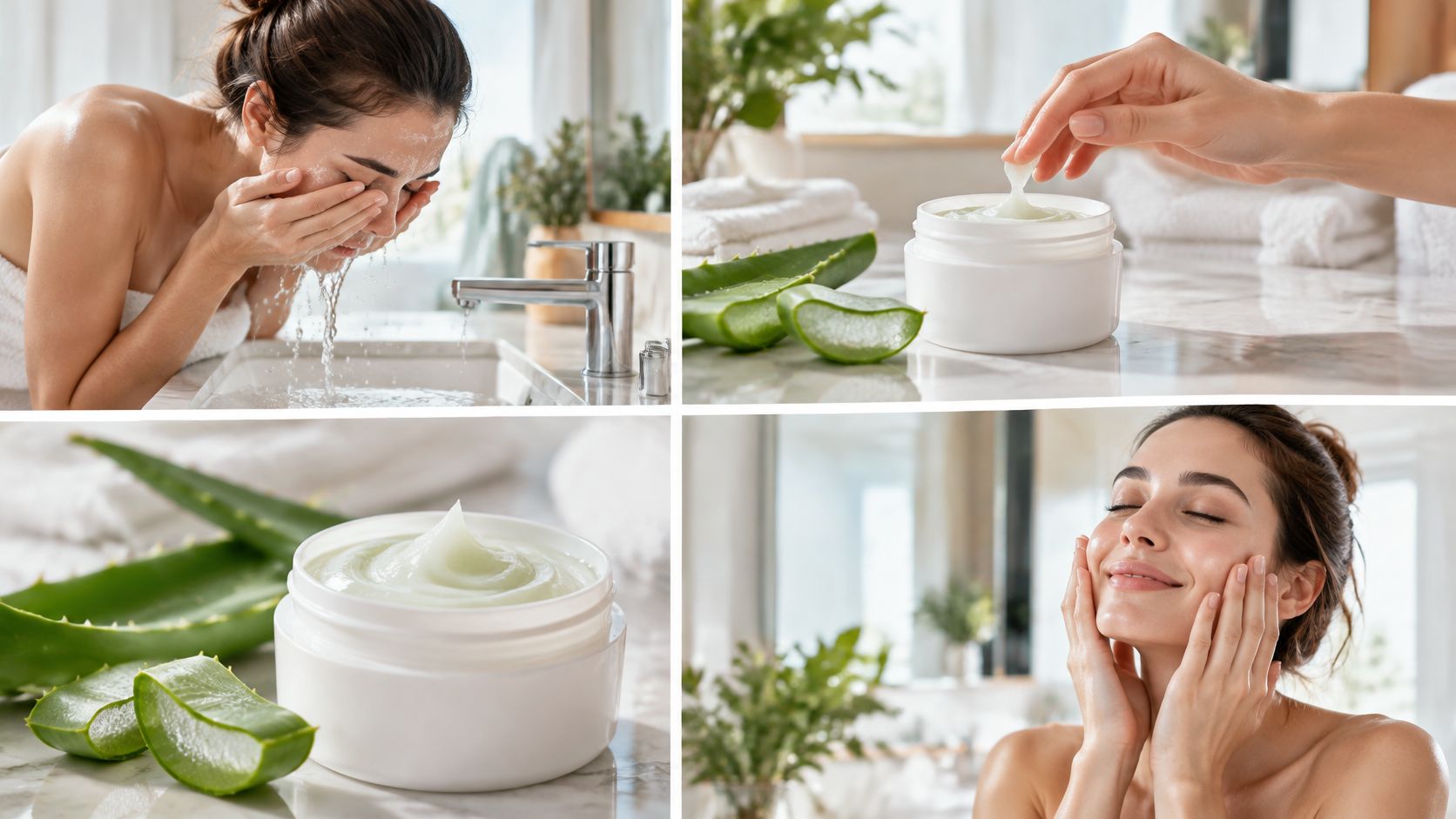
The bathroom routine may look familiar, but the cleansing cream and the cream you apply afterward have different jobs.
Aloe-containing isn't always aloe-based
An aloe leaf pictured on a bottle doesn't tell you how much aloe is inside. An aloe-based cleanser places aloe near the beginning of its ingredient list, while an aloe-containing cleanser may include it much farther down. Neither placement, by itself, proves that the cleanser will suit your skin.
Cream textures are useful starting points for dry, sensitive, normal, and combination skin. Oilier faces may prefer a lighter aloe gel cleanser, especially when a richer texture leaves an unwanted coating. Make sure it's a gel cleanser, not a leave-on moisturizing gel.
A useful self-test: After washing with your current cleanser, can you smile comfortably, or do your cheeks feel stretched?
A cleansing cream should cleanse, rinse away, and support comfort. Aloe does supporting work during that wash, not the work of a leave-on moisturizer.
Benefits for Sensitive, Oily and Combination Skin
Say Daniel has a shiny nose and forehead but dry cheeks. He wants a cleanser that removes the oil without making the rest of his face feel like paper. Choosing the strongest wash for his oiliest area would overlook what his cheeks need.
Aloe can contribute to hydration and comfort. A dermatology review of topical aloe describes reduced water loss and improved surface hydration with aloe-containing topical preparations, but those findings don't automatically establish the same benefit for a rinse-off cleansing cream. Contact time, aloe quality, and the complete formula matter.
Give the supporting ingredients some credit
Most cleanser goes down the drain quickly. That's why compatible humectants, lipids, and lightweight emollients matter alongside aloe. A comfortable wash comes from the combination, not from asking a botanical ingredient to do everything.
Daniel could start with a mild cream cleanser across his whole face. If his cheeks feel good but his forehead feels coated, he could use less product there or try a lighter cleanser on the T-zone. Separate products are an option, not a requirement; our guide to face wash for combination skin can help him weigh that choice.
- Sensitive skin: Prioritize mild non-soap cleansing agents and minimal fragrance rather than choosing by texture alone.
- Oily skin: Look for a lighter cream or gel cleanser that removes residue without aiming for a squeaky finish.
- Combination skin: Judge the dry and oily areas separately, then adjust the amount or format where needed.
- Dry skin: Favor a comfortable rinse-off finish and follow with enough leave-on moisture.
A cleanser's job is deliberately modest. It removes unwanted material and helps make the next steps comfortable; it doesn't need to transform your skin to earn its place on the bathroom shelf.
How It Compares with Gel, Foam and Oil Cleansers
Compare cleansers by post-rinse tightness, residue, lipid support, and texture, not by how much they foam. The descriptions below are starting points for shopping, not promises that every product in a category behaves identically.
Cleanser formats compared on the same criteria
| Cleanser Type | Typical Feel After Rinsing | Best Fit | Watch For |
|---|---|---|---|
| Aloe vera cleansing cream | Soft and comfortable, rarely tight with a well-balanced formula | Dry, sensitive, combination and normal skin | Needs a thorough rinse; check pH and surfactants; often offers more emollient support |
| Aloe gel cleanser | Light and cool, can feel slightly tight | Oily or blemish-prone skin | Lower lipid support; check the surfactant blend |
| Foaming gel cleanser | Clean, can feel tight if alkaline | Very oily skin in humid climates | Harsh surfactants can leave skin tight; foam doesn't establish mildness |
| Oil cleanser | Rich, with little residue after a full wash | Heavy makeup or sunscreen | Usually needs a second cleanse to finish removal; check how completely it emulsifies |
A foaming cleanser isn't automatically harsh, and a creamy cleanser isn't automatically mild. Foam describes what happens when you work the cleanser with water. It doesn't tell you whether the finished product will leave your cheeks comfortable.
Match the format to the task
For dry or sensitive skin, start with a cream when comfort is your main goal. For very oily skin in humid weather, a mild foaming gel may feel easier to rinse clean; our guide to face cleanser for oily skin offers another way to assess that choice.
Heavy makeup or water-resistant sunscreen may call for an oil cleanser first, followed by a gentle cream or gel if needed. If you're comparing solid oil-cleansing formats, you can browse HiBAR cleansing bars from Fillaree and check the removal directions before deciding whether the format suits your routine.
A fresh, cool sensation may make a gel enjoyable to use. It isn't proof that the cleanser cleans better or supports your skin better.
Every format can carry a natural label. Choose by how the formula performs on your face, not by the category's reputation.
Ingredients and Label Checks Before You Buy
Read the ingredient list like a recipe, starting at the top. Ingredients generally appear in descending order of predominance until the 1% threshold, below which they may appear in any order, as explained in ALODERMA's cleanser label guide. That makes placement useful, but it doesn't let you calculate an exact aloe percentage.
Say you're comparing bottles with nearly identical aloe illustrations. Aloe leaf juice near the beginning gives you more evidence of an aloe-led base than aloe near the end. But don't assume you can work backward from the preservative's position to determine the amount.
Read the recipe, not just the featured ingredient
The entire cleansing system deserves attention. In a clinical study of a soap-free cleansing lotion, a formula containing mild surfactants and emollients preserved skin-barrier function across several skin types after 30 days. That's evidence about a complete tested formula, not a guarantee for every lotion or plant-based cleanser.
Ingredient roles and what to check on the label
| Ingredient | What It Does | What to Check on the Label |
|---|---|---|
| Fresh aloe vera leaf juice | Hydrating base that helps bind water | Listed in the first few ingredients |
| Water | Carrier for the cleansing system | May follow aloe when aloe forms the main base |
| Mild non-soap surfactants, such as lauryl glucoside | Lift oil and dirt so they rinse away | Named cleansing agents rather than relying on a natural claim; check for sodium lauryl sulfate |
| Humectants, such as glycerin | Attract and hold water | Look for their presence; early placement can be useful but isn't a performance guarantee |
| Emollients, such as squalane or shea butter | Supplement lipids and soften the skin's feel | Look for them in cream-style formulas |
| Preservatives | Help protect the product from microbial contamination | Named and disclosed, not automatically avoided |
| Fragrance or essential oils | Add scent and may affect sensitive skin | Clear disclosure, including named essential oils |
Preservatives aren't a red flag by themselves. A water-containing botanical cleanser needs appropriate protection, and a jar that smells fresh isn't proof that it's adequately preserved. Likewise, the presence of glycerin doesn't tell you how much will remain after washing.
A quick shopping checklist
Use these checks before letting the front label make the decision:
- Aloe placement: Is aloe leaf juice near the beginning?
- Concentration: Does the brand disclose the aloe percentage rather than leaving you to guess?
- Cleansing agents: Are the surfactants named, with a mild system rather than an aggressive degreasing promise?
- Finished-product pH: Is it disclosed or supported by testing?
- Scent ingredients: Are fragrance and essential oils clearly identified?
- Preservation: Can you see the preservative ingredients?
- Relevant testing: Did testing assess irritation, post-wash tightness, or barrier effects, rather than only general hydration?
- Sourcing: Does the company explain where its aloe grows and how it's processed?
Also check whether directions describe a brief rinse-off wash or extended contact. Leaving a cleanser on longer doesn't make it a better moisturizer.
At the end of a tiring evening, that checklist can prevent an expensive guess. If one cream relies on botanical imagery and vague gentleness claims while another names its cleansing agents and provides meaningful testing details, the second gives you a stronger basis for choosing.
Patch Testing and Allergy Precautions
Natural doesn't mean reaction-free. The National Center for Complementary and Integrative Health's aloe vera overview notes that topical aloe can occasionally cause burning, itching, or rash. A rinse-off product limits contact, but your skin still encounters aloe, preservatives, fragrance, and cleansing agents.
Look for preparation details, including whether the aloe comes from inner-leaf gel or a whole-leaf preparation. Those descriptions provide useful transparency, but neither replaces testing the finished product on your own skin.
Try a small area first
A home patch test is a cautious introduction, not a guarantee or a diagnostic test.
- Choose a discreet area. Apply a small amount to the inner forearm or behind the ear, avoiding already irritated skin.
- Use it as a cleanser. Add water and rinse as directed rather than leaving a rinse-off formula under a covering.
- Watch before expanding use. Look for discomfort or visible changes after rinsing and over the following days.
- Introduce facial use cautiously. If the area remains comfortable, begin gently and watch how your face responds.
Our guide to patch testing skincare can help you plan a careful introduction.
Stop if burning, stinging, or swelling persists or spreads. Rinse with lukewarm water and ask a pharmacist or clinician for advice.
Don't keep applying a product to see whether your skin gets used to discomfort. Introduce only one new product at a time so that, if something feels wrong, you have a clearer idea of what changed.
How to Use an Aloe Vera Cleansing Cream Step by Step
Start with a mild formula, then use a gentle technique. A controlled cleanser comparison published in the International Journal of Cosmetic Science found greater visual dryness with a pH 4.7 cleanser than with a pH 6.7 cleanser on several assessment days. Lower pH alone therefore isn't a reliable shortcut to a gentler wash; the surfactants and supporting ingredients matter too.
Use this visual as a reminder of the basic sequence.
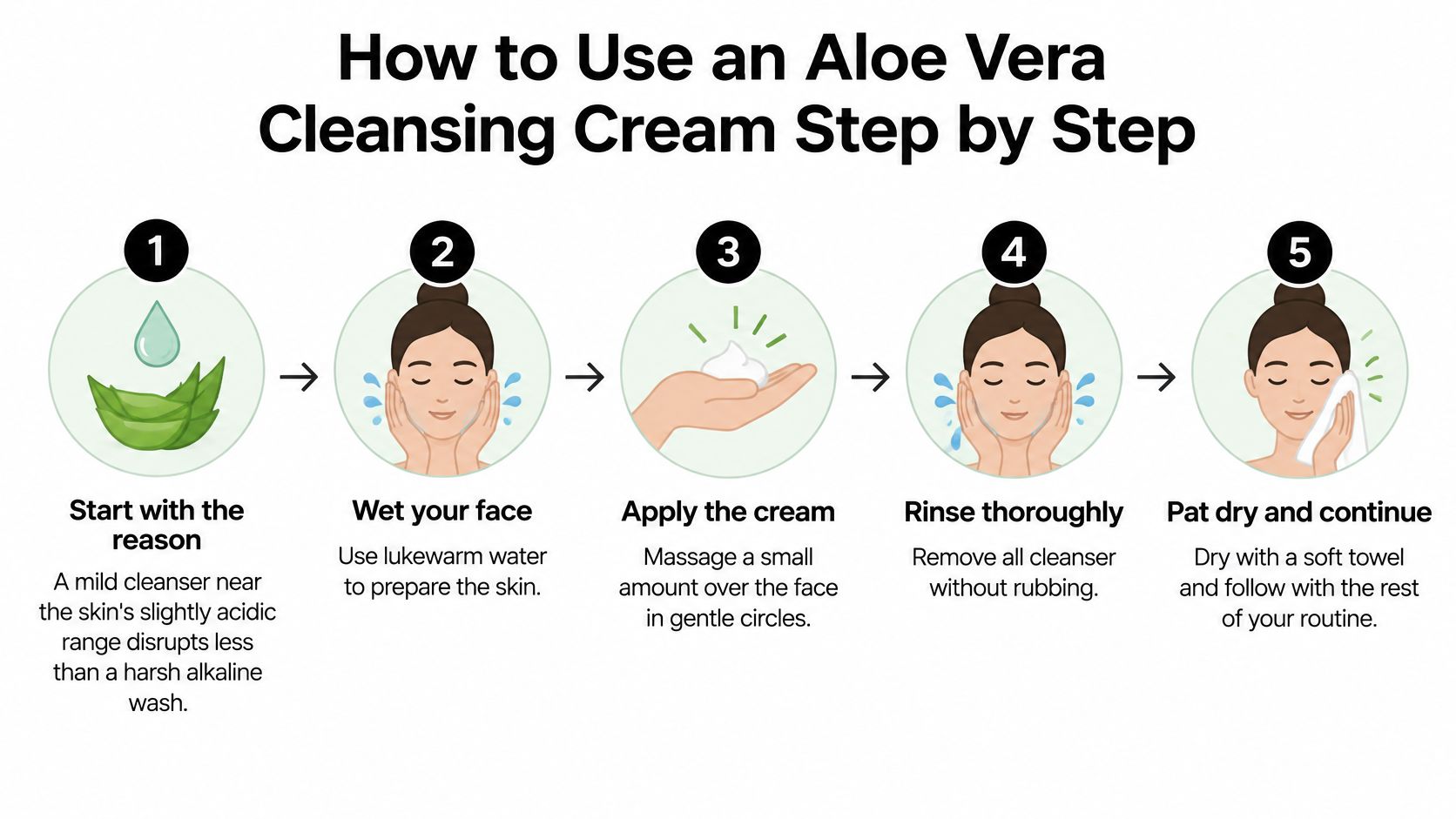
A comfortable washing sequence
- Prepare with lukewarm water. Wet your hands and face unless the cleanser specifically calls for dry application. Avoid hot water, which can make an already uncomfortable wash feel worse.
- Start with a small amount. Spread enough cleanser to let your fingertips glide without dragging. Don't assume a larger handful will remove stubborn makeup more effectively.
- Massage gently. Work across the cheeks, nose, chin, and jawline using your fingertips. If the cream is designed for dry application, start dry instead; don't scrub with a cloth or keep massaging to chase a squeaky sensation.
- Add water and rinse completely. Loosen the cream with wet fingertips, then rinse around the nose, hairline, and jaw. A slippery patch may be leftover cleanser, not extra hydration.
- Pat rather than rub. Use a clean, soft towel and leave the skin slightly damp. Repeated rubbing adds friction your face doesn't need.
- Continue with leave-on hydration. Apply your chosen moisturizer or other hydrating step promptly. Don't wait for your cheeks to feel stretched before deciding they need support.
For another visual reference, the video can accompany your routine check.
Check comfort beyond the bathroom
Say Maya changes her cleanser and keeps everything else stable. Instead of judging by foam, she notices whether her cheeks feel comfortable while getting dressed and later at her desk.
That's a useful observation, not a promised result. If tightness continues, reconsider the cleanser, washing frequency, and moisturizer rather than increasing the amount or massage time.
Frequently Asked Questions About Aloe Vera Cleansing Cream
Can it irritate sensitive or easily reactive skin?
Yes, even a cream marketed as gentle can feel uncomfortable on your skin. Stop and rinse if stinging persists, and seek advice rather than repeatedly testing a product that causes swelling or spreading discomfort.
Do I need to remove sunscreen or makeup first?
For light daily residue, your cleanser may be enough if its directions support that use. For heavy or water-resistant products, use a suitable makeup remover or oil cleanser first, then a gentle wash if needed; don't compensate by scrubbing harder.
Can I use it morning and night?
You can if the product is intended for that schedule and your skin remains comfortable. If your cheeks become tight by midday, reassess the formula, frequency, and leave-on hydration rather than automatically switching to a lighter gel.
Is natural the same as gentle?
No. A plant-derived ingredient can still be unsuitable for your skin, and a cream's soft texture doesn't reveal how its cleansing agents behave.
Shopping priority: Clear ingredients and meaningful finished-product testing are more useful than a comforting adjective on the bottle.
Does cleansing cream replace moisturizer?
Usually not. Choose your leave-on step according to how your skin feels after rinsing: a lightweight gel may be enough for some faces, while dry cheeks may need a richer moisturizer.
A toner is optional, not a required bridge between cleansing and moisturizing. Keep the routine simple enough that you can tell which step helps.
Build a Simple Routine and Pick Your Cleanser
Choose your cleanser by rinse-off comfort, then add leave-on hydration. At ALODERMA, we're a fully vertically integrated aloe vera company: we grow all our own organic aloe, process it, and manufacture onsite within 12 hours of harvest, as our farm-to-skin overview explains. We use that process to preserve the bioactive quality of the primary ingredient in every product, rather than relying on a natural label alone.
Our product options include the Aloe Hydrating Cleanser, containing fresh organic aloe juice and a coconut-based cleansing system described in our formula overview, and the Aloe Oil Controlling Cleanser, with 76% fresh organic aloe vera, mint, and witch hazel. For follow-up hydration, our aloe routine guide describes the Aloe Hydrating Toner with 91% fresh organic aloe juice, and Aloe Firming Cream with 62% organic aloe juice, plus bergamot and jojoba oils.
Check current ingredients before buying, especially scent ingredients. Keep the rest of your routine stable and note midday cheek comfort, shine, and any leftover film as you assess your choice.
ALODERMA offers fresh-aloe cleansers and leave-on hydration for a simple daily routine. Visit ALODERMA to compare current ingredient lists, choose a cleanser for your preferred finish, and pair it with the moisture your skin needs.