







You've just come home from a warm commute. Sunscreen sits beneath a shine across your nose, your forehead feels sticky, and your pores seem stuffed rather than dirty. You want to wash everything away, but you don't want another evening of cheeks that feel tight when you smile.
An oil controlling skin cleanser should make that moment easier. The useful question isn't how well a wash promises to clean. It's whether it removes the day's surface film while leaving your face comfortable enough to repeat the routine tomorrow.
Match a Cleanser to Skin That Feels Shiny
Start with the face you have this week, not the strongest bottle on the shelf. A shiny nose with comfortable cheeks calls for a different choice from skin that already stings after washing.
Cleanser styles for blemish-prone skin
| Cleanser style | Use it when | What it does | Limit |
|---|---|---|---|
| Gentle daily aloe cleanser | Morning shine, sweat, sunscreen, or makeup | Lifts surface oil and residue while the face stays comfortable | Not a spot treatment |
| Salicylic acid rinse-off 0.5% to 2% | Pores feel congested | Labeled range, used in a short rinse | Easy to overdo beside other leave-ons |
| Benzoyl peroxide wash 2.5% to 10% | Stubborn spots on a rough day | Short-contact rinse-off | Can dry skin and bleach fabric |
| Sulfur wash 3% to 10% | Occasional clarifying day | Traditional clarifying rinse | Often drying and strongly scented |
| Soap-free surfactants plus aloe | Skin flushes or feels raw after foam | Mild cleanse for twice-daily use | Will not replace a leave-on gel |
The labeled active ranges in this comparison come from the FDA topical product monograph: salicylic acid at 0.5% to 2%, benzoyl peroxide at 2.5% to 10%, and sulfur at 3% to 10%. These are permitted concentration ranges, not a ranking of what your face needs.
Choose for the whole routine
Say your forehead looks shiny at lunch, but your cheeks feel fine. A gentle daily wash is a reasonable starting point. You don't need to add an active just because oil becomes visible during the day.
Now consider the same forehead when you're already using a leave-on exfoliant. Adding an active wash may create more discomfort without making the routine easier to maintain. The cleanser needs to fit beside what you already use, not compete with it.
For background on the difference between surface shine and your broader routine, Yoyime Clinic's resource on skin care for excess sebum offers a useful starting point. Our guide to oily skin causes and prevention can also help you think beyond the bottle at the sink.
- For everyday residue: Choose a wash you can use without bracing for tightness afterward.
- For an active rinse: Read its directions before deciding how frequently to use it or how long to leave it on.
- For uncomfortable skin: Simplify rather than adding another clarifying step.
Check the named ingredient and its labeled percentage, not the color of the bottle or the promise on the front. A stronger-looking label doesn't tell you whether the formula suits tonight's face.
Why a Squeaky Face Is Not a Clean Face
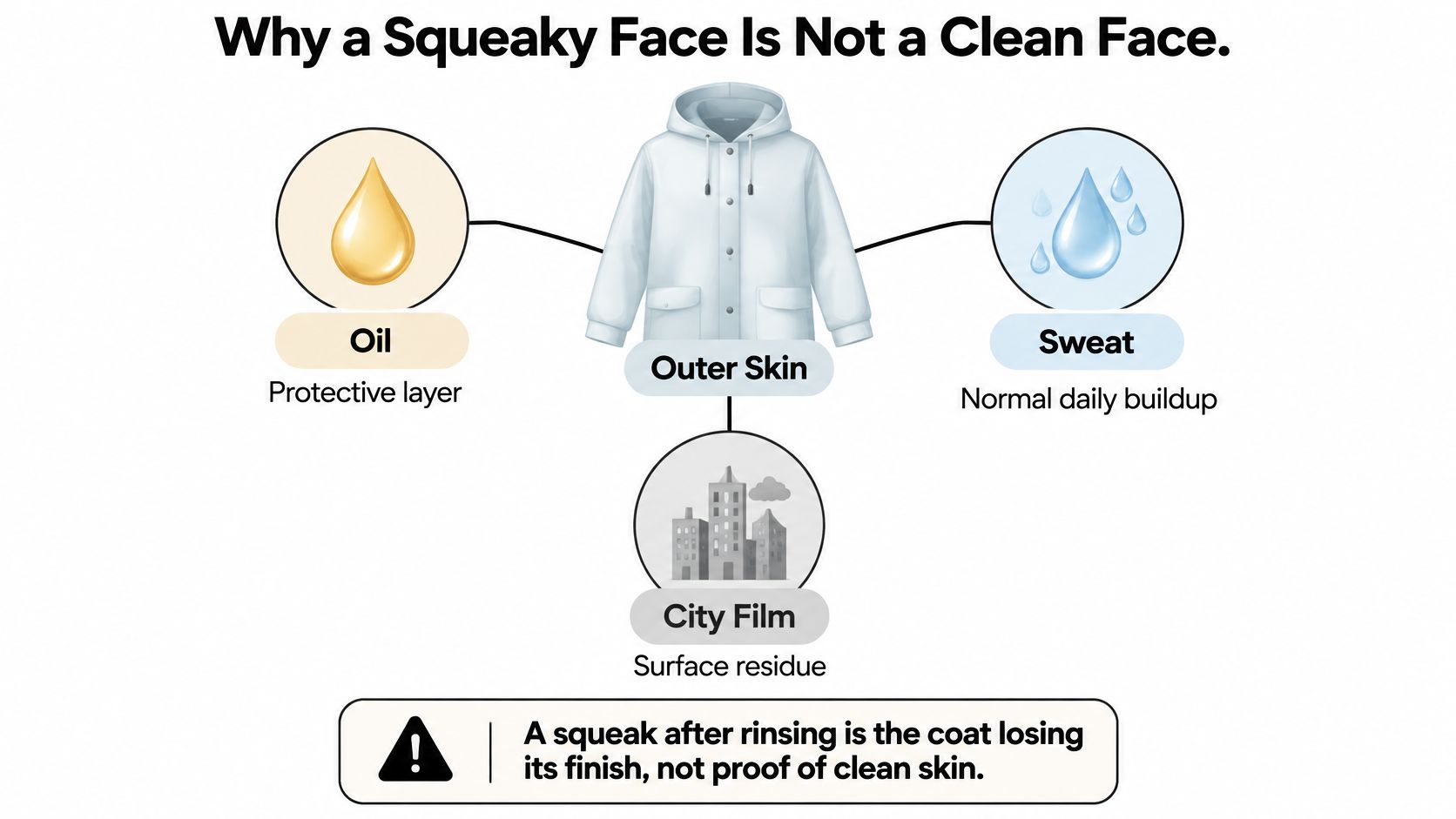
Think of your outer skin as a light raincoat. You want to remove what has collected on its surface without scrubbing away the finish that helps keep it comfortable.
That metaphor matters when you arrive home feeling greasy. Hot water, a rough washcloth, and another pump of foam may feel satisfying at the sink. Later, your cheeks can feel pinched even while your nose still looks shiny.
The illustration shows the difference between removing daily buildup and chasing a squeak.
Let your fingertips do the washing
The American Academy of Dermatology's cleansing guidance recommends gentle washing with a non-abrasive cleanser, using fingertips rather than washcloths, sponges, or scrubbing tools. It also advises choosing alcohol-free products and avoiding irritating astringents and exfoliants.
Use lukewarm water, spread the cleanser with the pads of your fingers, and move lightly over the sides of your nose, chin, and hairline. You're lifting a film, not sanding a surface. More pressure doesn't make a gentle formula work better.
Consider an evening when sunscreen has settled around your eyebrows. Give those areas careful attention rather than rubbing your entire face harder. Rinse thoroughly, then pat with a soft towel instead of dragging it across your cheeks.
Cleanliness is a face that stays comfortable after the rinse, not a drum-tight feeling at the sink.
Notice discomfort without guessing its cause
Tightness isn't a measurement of cleanliness. It can reflect the formula, water temperature, rubbing, or the combined effect of several products.
You also can't diagnose increased oil production just by seeing shine beside dry patches. Both can be present, and neither makes aggressive washing a good next step.
- Before moisturizer: Notice whether your cheeks feel pinched or sting. Don't deliberately leave them uncomfortable to complete a test.
- Later in the evening: Check whether ordinary expressions, like smiling, still feel easy.
- At the next wash: Reduce intensity if the previous rinse left discomfort.
Tonight, aim for a face that feels ordinary after washing. If you're counting the moments until you can cover the tightness with another product, the cleansing step needs adjusting.
Actives and Surfactants Worth Reading on the Label
Turn the bottle around before trusting the word natural on its front. The ingredient list tells you more about the base of a cleanser and how it removes oil.
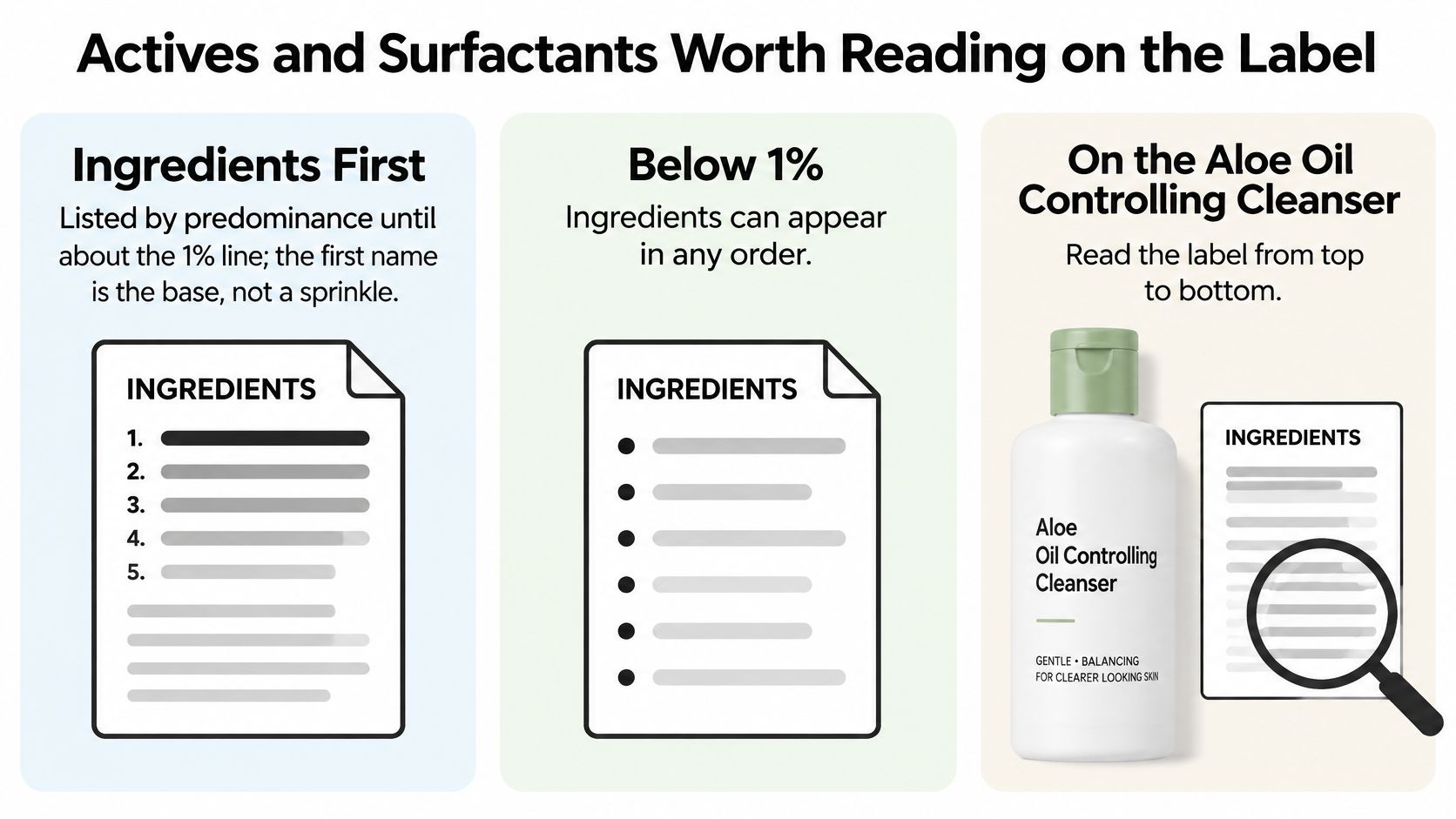
Cosmetic ingredients generally appear in descending order of predominance until the 1% threshold, below which they may appear in any order. On the Aloe Oil Controlling Cleanser ingredient listing, Organic Aloe Barbadensis Leaf Juice comes first, followed by water and the cleansing system.
The label-reading guide separates ingredient order from the smaller ingredients farther down the list.
Learn the names that do the cleansing
The formula lists potassium cocoyl glycinate, lauryl hydroxysultaine, sodium lauryl glucose carboxylate, and lauryl glucoside. These are surfactants, ingredients that help water lift oily residue so it can rinse away.
Long names aren't a warning by themselves. Nor does a plant-related name guarantee that a finished formula will suit everyone. The blend, its concentration, and your response matter more than how familiar an ingredient sounds.
The list also includes sodium chloride, glyceryl oleate, capryloyl glycine, clary oil, tocopherol, sorbic acid, and sodium benzoate. Reading that full list is especially useful if you already know that a particular ingredient bothers your skin.
Use a practical label check
- Find the base. If you're choosing an aloe-first cleanser, confirm that aloe leaf juice leads the list rather than assuming it does.
- Identify the cleansing system. Look for the surfactant names, then judge the finished wash by how it feels and rinses.
- Separate cleansing from active claims. If a bottle names a rinse-off active, find its stated percentage and directions instead of guessing from a botanical illustration.
A daily cleanser doesn't need an active to perform its basic job. Its role may be removing oil, sunscreen, and other surface residue before the rest of your routine.
Likewise, aloe-first doesn't mean fragrance-free, and soap-free doesn't mean that every sensitive face will tolerate the formula. Clary oil is worth noticing if fragrant plant oils have bothered you before.
Reading the back label gives you a better question than whether a cleanser is natural: Does this complete formula suit what I'm already putting on my face?
Fresh Aloe That Still Feels Like the Leaf
Freshness begins before a cleanser reaches your bathroom. Aloe leaves are harvested plant material, so the time between cutting and processing matters to the ingredient that eventually enters the formula.
A peer-reviewed review of aloe processing reports that leaves can begin losing biological activity about six hours after harvest at ambient temperature, with most activity potentially lost after 24 hours. That makes handling conditions more informative than a leaf picture on a label.
The finished bottle is only the last stage of that journey.
Follow the leaf to the manufacturing site
At ALODERMA, we're a fully vertically integrated aloe vera company. We grow all our own organic aloe vera, process our aloe, and manufacture onsite within 12 hours of harvest. We use that integrated approach to help ensure that the primary ingredient in every product is the most bioactive and effective aloe vera possible.
That describes our sourcing and manufacturing goal. It isn't a comparative clinical result, and it doesn't mean fresh aloe alone will produce clearer skin.
For your nightly routine, the distinction is practical: ingredient quality and skin comfort are reasonable things to consider, while a promise that freshness will change blemishes goes beyond what this processing information establishes. Our explanation of real aloe gel gives more context for understanding aloe beyond the wording on a bottle.
This video adds a visual reference to the farm-to-product story.
Compare the handling, not just the word aloe
When comparing brands, use questions with concrete answers:
- Who grows or controls the aloe supply? We grow our own organic aloe rather than leaving that part of the chain separate from our manufacturing.
- How long passes after harvest? Our harvest-to-onsite-manufacturing window is defined, not described only as fresh.
- Where does processing happen? Our processing and manufacturing happen onsite.
Freshness boundary: Better control of an ingredient's journey supports ingredient quality. It doesn't, by itself, prove what a finished cleanser will do for your skin.
You still need to read the complete formula and notice your own response. Fresh aloe is a meaningful formulation detail, not a substitute for those checks.
How Often to Wash Without Stripping
Our cleanser's directions are twice daily, morning and night. Work it into a lather, massage it onto a damp face and neck, and rinse with warm water.
For a worked example, you might spend about a minute gently distributing and rinsing a non-active cleanser when removing sunscreen or light makeup. That isn't a required contact time, and it shouldn't replace the directions on an active wash.
Adjust for the day you actually had
Wash frequency by the kind of day
| Kind of day | Washes | Cleanser to use |
|---|---|---|
| Ordinary morning and night | 2 | Gentle aloe cleanser, about one minute as a practical example, fingertips |
| After a sweaty workout | 3 if it adds a separate wash | Same gentle cleanser, warm water, no scrub |
| Heavy sunscreen or makeup | 2 | Gentle cleanser, extra attention at hairline and jaw |
| Leave-on clarifying gel already used | 2 | Non-active aloe cleanser only |
| Face feels tight or stings after rinsing | 2 or fewer | Drop the strong wash and use a tolerated gentle cleanser |
| Dry heated room | 2 | Gentle cleanser, then a light gel, not another wash |
These are example schedules, not targets you need to hit. If your workout ends just before your evening shower, that wash can serve as your evening cleanse rather than becoming an extra step.
Heavy makeup also doesn't automatically call for another complete wash. Check the hairline, jaw, and sides of the nose for residue; if the cleanser doesn't remove your makeup adequately, use an appropriate remover rather than repeatedly scrubbing.
- After indoor heat: Add a suitable moisturizer instead of washing away the dry feeling.
- After discomfort: Remove the stronger rinse-off step first. Aloe itself isn't a guarantee of tolerance.
- After ordinary midday shine: Blot gently rather than treating visible oil as a washing alarm.
Keep a simple comfort record
Try a personal check over a week: note how your face feels about an hour after your evening routine. Comfort on most nights is useful feedback, but it isn't a clinical test or proof that every product is right.
If stinging or flaking keeps returning, don't keep repeating the schedule just because a table says morning and night. Persistent discomfort deserves advice from a qualified professional.
Pairing Gentle Washes With Leave-On Actives
If you already apply a nightly active, keep the wash uncomplicated. A non-active cleanser lets you separate the cleansing step from the product you're using afterward.
For example, someone using a salicylic acid leave-on could wash gently in the morning, then cleanse again in the evening before applying the leave-on to dry skin according to its directions. There's no need to add an exfoliating wash merely to make the routine feel more complete.
Reduce overlap before adding anything
Mayo Clinic's benzoyl peroxide guidance warns about irritation from combining topical products and advises gentle washing rather than scrubs or astringents. The practical lesson is to assess the whole routine, especially when benzoyl peroxide, salicylic acid, or a retinoid is already present.
- For optional cosmetic leave-ons: If burning, stinging, or peeling starts, pause and simplify.
- For prescribed products: Ask the prescriber how to adjust use rather than changing the plan independently.
- For recurring irritation: Speak with a pharmacist or dermatologist before buying another active.
Our guide to choosing a serum for blemish-prone skin offers further context for the leave-on part of a routine.
Keep microbiome claims in perspective
A PubMed-indexed study published in 2025 reported improved microbial diversity with a specific plant-derived face wash. That finding doesn't establish the same benefit for every botanical cleanser.
Microbiome-friendly isn't a shortcut around formula evaluation. A plant ingredient, essential oil, or balancing claim still needs evidence for the finished product, along with tolerability on your face.
A Day With a Gentle Clearing Routine
Maya is a hypothetical reader who gets shiny by noon and dislikes the tightness her old foaming wash leaves on her cheeks. Her new routine is deliberately ordinary: remove residue, add comfortable hydration, and stop treating every bit of shine as a mistake.
Morning without the extra effort
She wets her face, lathers the Aloe Oil Controlling Cleanser, massages her face and neck, then rinses with warm water. She doesn't assume that its aloe-first label guarantees comfort; she pays attention to how her own skin feels.
Next, she applies Pure Aloe Vera Gel + Tea Tree Oil as an all-over moisturizing layer. Before heading out, she finishes with her usual sunscreen rather than expecting a hydrating gel to provide sun protection.
Maya's example keeps the sink routine short and easy to follow.
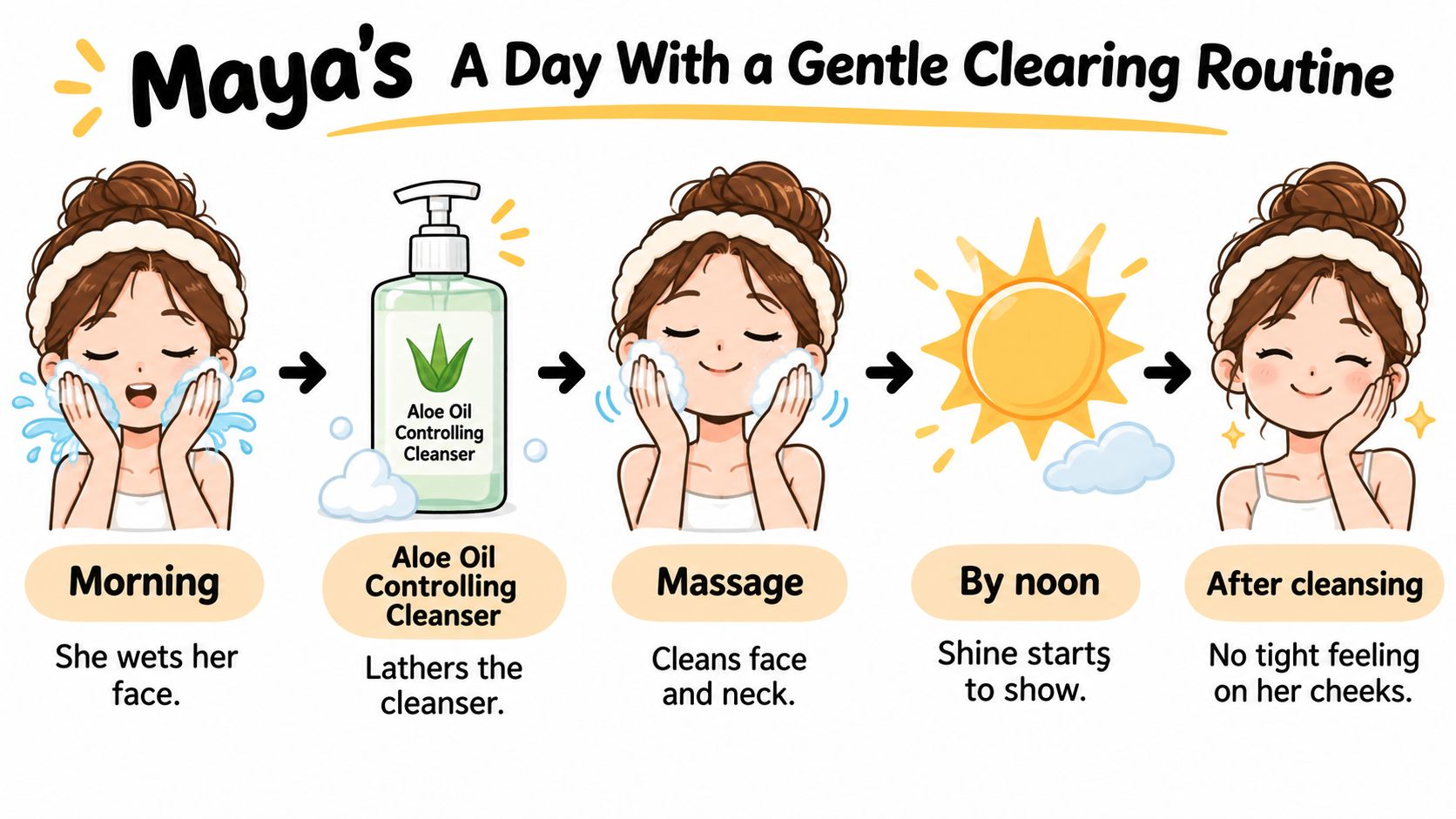
By lunchtime, Maya notices shine and blots it gently. She doesn't start the routine over unless she's been exercising and needs to wash away sweat.
If she chooses a spot product, Aloe Clearing Gel is intended for application after cleansing and intermittently during the day. She checks its ingredient information before pairing it with anything else, rather than assuming that the name identifies a particular active.
Evening with room to simplify
At night, Maya removes the day's sunscreen with her cleanser. On a more sensitive evening, she considers the Aloe Hydrating Cleanser, which contains fresh organic aloe juice, and leaves out an optional active.
An Aloe Hydrating Facial Sheet Mask can be an occasional comfort step if she tolerates it. It isn't something she has to add to make cleansing successful.
Behind the bottle, aloe requires more than squeezing a leaf: a review of aloe processing describes crushing, grinding, or pressing, followed by filtration and stabilization. Maya doesn't need to recreate that process at home, but knowing it exists helps her distinguish a manufacturing story from a vague botanical claim.
Maya's useful change isn't a promise of less shine. It's no longer treating an uncomfortable face as evidence that she washed well.
Set Out Tomorrow's Cleanser Tonight
Choose the row in the first table that best matches your current routine, then put that bottle beside the sink. Leave the other options in the cupboard so tomorrow morning doesn't become another search for something stronger.
If you're considering the packaged version of Maya's example, our Aloe Skin Clearing Set is made for sensitive and oily skin and is listed at $29.95 USD. It includes Aloe Oil Controlling Cleanser, Aloe Clearing Gel, Pure Aloe Vera Gel + Tea Tree Oil, and Aloe Hydrating Facial Sheet Masks.
Buy for the steps you'll actually use
Our Aloe Oil Controlling Cleanser contains 76% fresh organic aloe vera. That's useful formulation information, but your decision should still include the full ingredient list, the other products you use, and whether you need a complete set or only a wash.
- Check the contents: Choose the set because you want its individual steps, not because more products must mean a better routine.
- Read each formula: A sensitive face may tolerate some ingredients and not others.
- Keep the morning simple: Lather on damp skin, rinse lukewarm, and continue with suitable hydration and sunscreen.
Tomorrow's comfort check is feedback, not a verdict from a single morning. Notice whether your face feels easy to live in later, and adjust if discomfort returns.
You don't need to make your face squeak to feel that you've done enough. Set out a tolerable cleanser tonight, give it a calm rinse tomorrow, and resist turning ordinary shine into a reason to scrub again.
ALODERMA offers fresh-aloe cleansers, lightweight hydrators, and coordinated sets for building a straightforward routine. Visit ALODERMA to compare ingredient lists and choose a cleansing step that fits your skin's comfort and the products you already use.