








Your forehead is shiny by noon, but your cheeks sting when you apply moisturizer. You try another oil-control product, then wonder why your face feels even less comfortable. A useful skin routine for oily sensitive skin starts by changing the order of your decisions: establish comfort first, then add targeted oil control slowly.
The Daily Routine at a Glance
Core daily routine for oily sensitive skin
| Step | What to use | How often | Key rule |
|---|---|---|---|
| 1. Cleanse | Gentle, low-pH, fragrance-free cleanser | Morning and night, plus after heavy sweating | Lukewarm water, no scrubbing, normally no more than twice daily |
| 2. Hydrate | Lightweight oil-free moisturizer or aloe gel | Morning and night, on damp skin | Thin layer, no heavy oils |
| 3. Protect | Broad-spectrum SPF 30 or higher | Every morning | Reapply after two hours outdoors or after sweating |
The sweating exception isn't a reason to keep washing whenever you notice shine. After a workout, cleanse gently rather than adding another scrub or oil-control wash to the day.
Say you've bought a mattifying toner, a stronger cleanser, and an exfoliating serum because your nose looks oily by lunchtime. After the third new product, your cheek starts stinging. The problem isn't necessarily a missing ingredient, it may be that you've introduced more than your skin can comfortably tolerate.
Sensitivity deserves a place in the starting routine, not an emergency adjustment afterward. A 2024 global profiling study published in the Journal of Drugs in Dermatology found that 74% of surveyed participants had sensitive skin, including 40% with sensitive or very sensitive skin.
Keep the foundation predictable
Cleansing removes surface buildup. Hydration helps skin stay comfortable, and sunscreen provides protection that an oil-control serum can't supply. Treatments are optional additions, not replacements for these jobs.
Keep the same foundation while you assess it. If you change your cleanser, moisturizer, and serum together, you won't know which change helped or which caused the sting.
Run this quick check tonight:
- Tight after cleansing? Notice whether your face feels stretched within about twenty minutes. Review your cleanser and washing technique.
- Shiny again within a few hours? Check whether your skin also feels tight. Adjust hydration before reaching for a stronger treatment.
- Stinging after something new? Pause that addition and assess tolerance before adding anything else.
Comfort is the entry requirement for actives, not a reward you hope to earn by pushing through them.
How to Cleanse Without Stripping Oil
When shine keeps returning, scrubbing harder can feel logical. But a face that feels banded-tight afterward hasn't become better balanced, it has become less comfortable.
A cleanser should remove surface oil and everyday buildup without leaving a squeaky finish. Foam alone doesn't tell you whether a formula is suitable; judge the complete product and how your skin feels afterward.
Use a light touch from start to finish
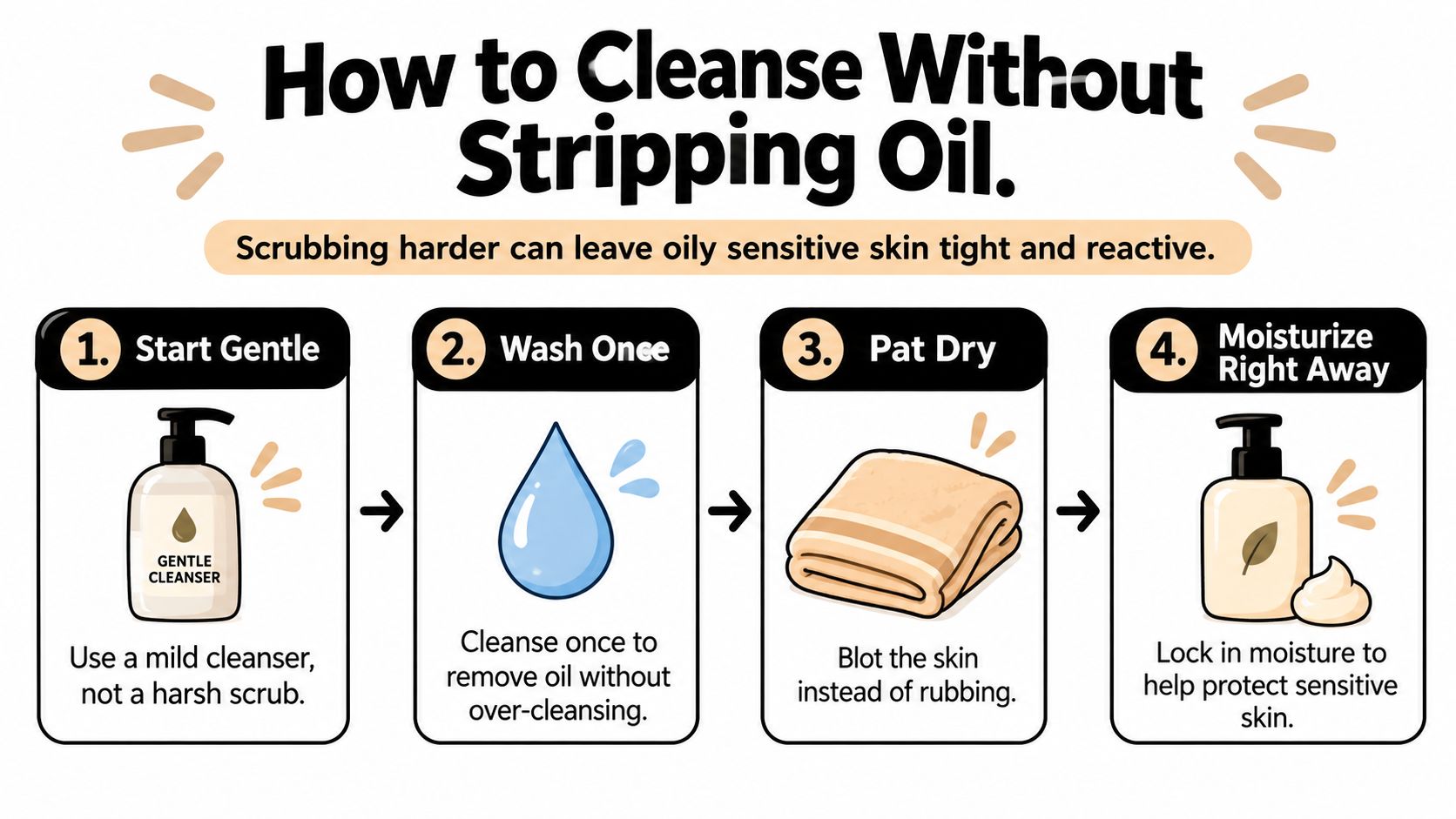
- Start with lukewarm water. Wet your face and neck without turning the tap hot. Hot water can leave reactive skin feeling drier, and extra heat doesn't make the cleanser work better.
- Spread the cleanser before applying it. Work a small amount between wet palms into a light lather, then apply it to your damp face and neck. Starting with a large dollop encourages unnecessary product use and makes thorough rinsing harder.
- Massage gently. Use your fingertips for roughly thirty to sixty seconds, paying attention to the forehead, nose, and jawline. Don't press harder over shiny areas or use a washcloth to polish the skin.
- Rinse completely with warm water. Remove cleanser from the sides of your nose, hairline, and underneath your jaw. Residue can make later products feel uncomfortable, so don't mistake a quick splash for a complete rinse.
- Pat rather than rub. Use a soft towel and leave the skin slightly damp for moisturizer. Repeated towel friction is an avoidable source of redness.
Use the cleanser morning and night, with an additional gentle wash after heavy sweating when needed. That doesn't mean washing every time you blot your forehead or catch your reflection.
This visual summarizes the technique, with “wash once” meaning one gentle cleansing pass rather than repeated washing in the same session.
Judge the finish, not the foam
Our guide to face wash for oily sensitive skin can help you assess the cleansing step without turning it into another treatment layer.
For example, if your nose feels clean but your cheeks feel stretched, don't compensate by applying more cleanser to your nose tomorrow. Try a milder formula and less friction across the whole face.
Practical rule: Your skin should feel clean and comfortable afterward, not squeaky, hot, or tight twenty minutes later.
Moisturize and Protect Without Greasy Buildup
You skip moisturizer because your forehead already looks glossy. By lunch, that same face looks shiny but feels tight when you smile. Removing hydration hasn't solved the shine, it has made the routine harder to wear.
A thin, evenly spread layer is the starting point, rather than a thick coating.
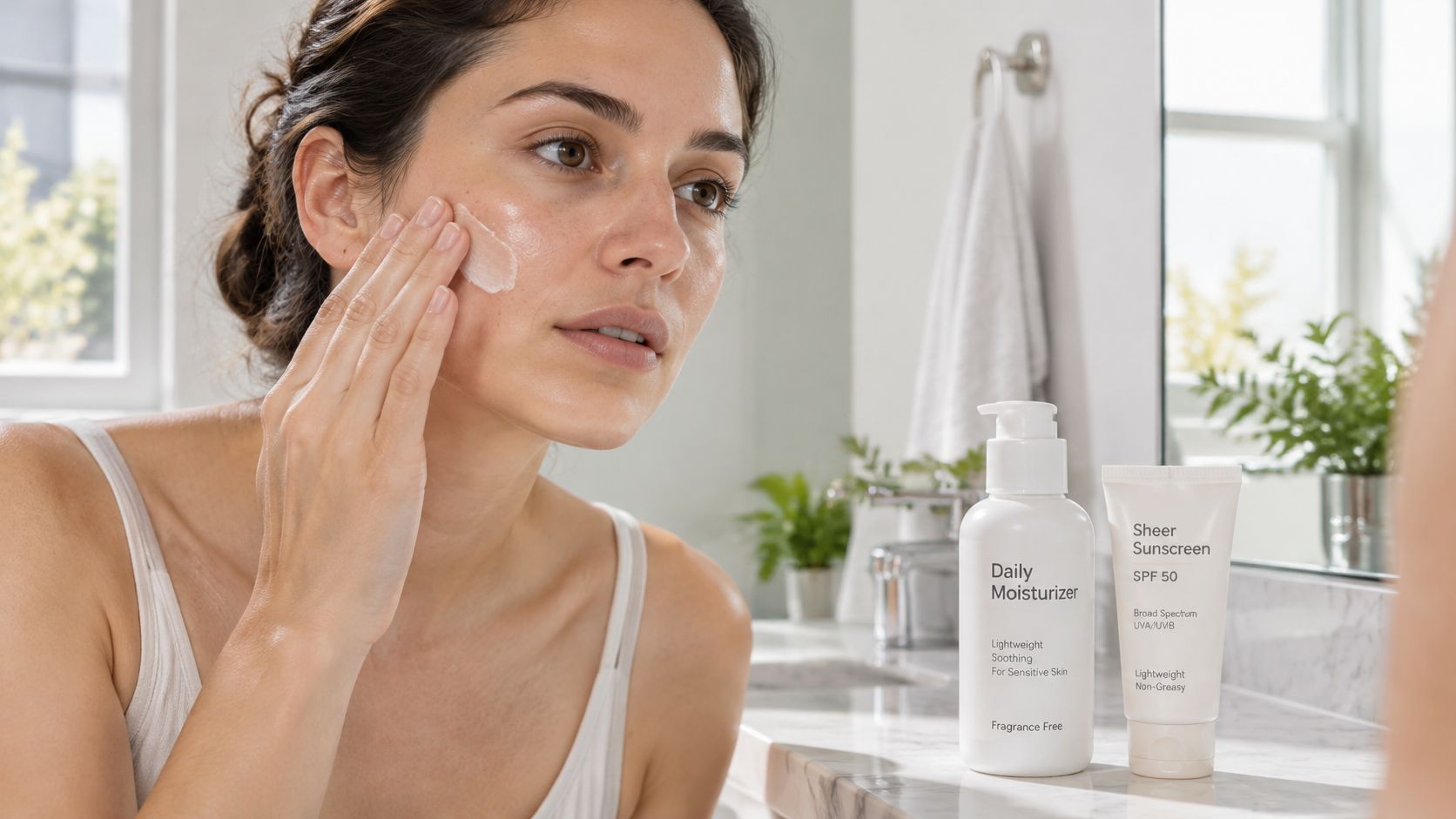
The American Academy of Dermatology's budget skincare guidance explains that moisturizer helps trap water in the skin and recommends applying it after cleansing while skin is still damp. Oiliness and a need for hydration can coexist; the practical question is which texture feels comfortable without leaving a heavy finish.
Build coverage without unnecessary layers
- Apply a thin layer to damp skin. Spread a lightweight hydrator over the face and neck. Start with enough to cover evenly, then assess whether dry areas need a little more.
- Let it settle. About a minute is a practical pause, not a performance requirement. If the surface still feels very slippery, use less moisturizer next time rather than reducing sunscreen.
- Apply broad-spectrum SPF 30 or higher. A line along two fingers is a practical starting guide for the face, with additional product for the neck and other exposed areas. Follow the sunscreen's application directions for adequate coverage.
- Maintain protection outdoors. Reapply after two hours outdoors and after sweating, following the product's water-resistance directions.
Look for water-based, oil-free, non-comedogenic, alcohol-free options. If a sunscreen stings, a formula using zinc oxide or titanium dioxide may be more comfortable, though the complete formula still matters.
Choose hydration by feel
Aloe gel suits a lighter layer, while cream can suit dry days or dry indoor air. Our sensitive oily skin moisturizer guide helps you compare textures without assuming that richer always means better.
Aloderma is a fully vertically integrated aloe vera company: we grow all our own organic aloe vera, process it, and manufacture onsite within 12 hours of harvest to ensure the primary ingredient in every product is the most bioactive and effective aloe vera possible.
The application video offers another way to follow the routine.
Check each product's ingredient list before choosing, particularly if you already know that certain ingredients bother your skin. Aloe doesn't replace sunscreen. If your face feels tight by midday, adjust the hydration texture or amount before adding a treatment.
Adding Oil-Control Actives One at a Time
You add a BHA serum, a clay mask, and a scrub in the same week. Then your face stings and flakes, and you can't tell which product caused it. Even potentially useful ingredients become difficult to assess when introduced together.
That uncomfortable result is a reason to simplify, not to exfoliate the flakes away.
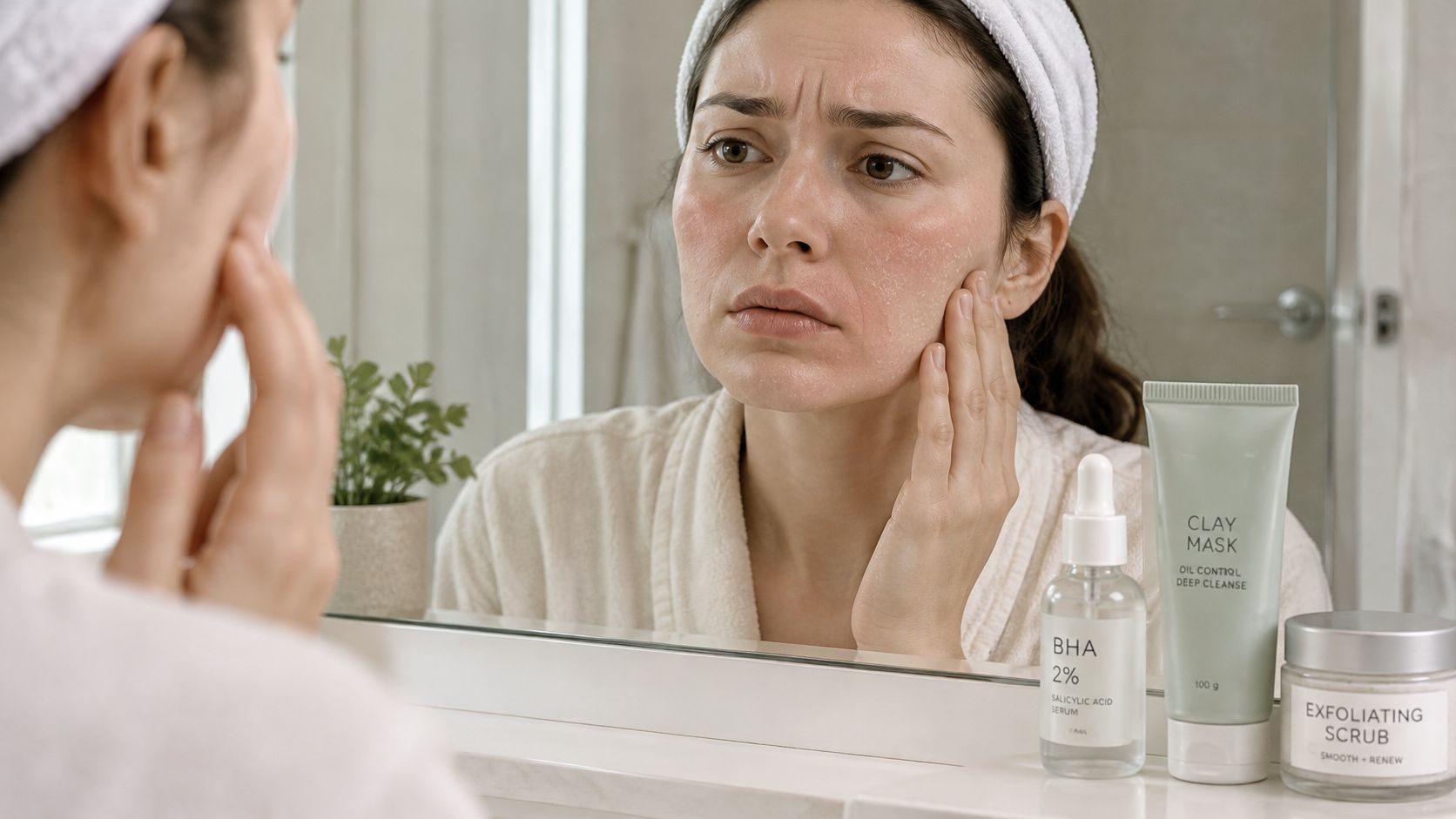
The American Academy of Dermatology's oily-skin guidance notes that salicylic, glycolic, and lactic acids can reduce oiliness but may be too harsh for some people. Sequence and frequency matter as much as ingredient choice.
Use a conservative introduction schedule
Keep the foundation steady for two weeks before introducing an active. This is a practical observation period, not a guarantee that every skin type will be ready on that date.
Patch-test a small area near the jaw for several days before wider application. Our skincare patch-testing guide explains how to make that preliminary check useful; a comfortable patch test still doesn't guarantee comfortable daily use.
If salicylic acid is your choice, start on two nonconsecutive nights each week. After two to four comfortable weeks, consider every other night, but don't increase because the calendar says you can.
Oil-control actives and starting frequency
| Active | Role for oily skin | Sensitivity note | Starting frequency |
|---|---|---|---|
| Salicylic acid (BHA) 0.5–2% | Clears oil inside pores | Can sting on reactive skin | Two nights a week |
| Niacinamide 2–5% | Supports a more balanced look of shine | Usually well tolerated | Once daily, morning or night |
| Glycolic or lactic acid 5–10% | Smooths surface texture | Higher irritation risk when stacked with BHA | One night a week, never with BHA at first |
| Kaolin or bentonite clay mask | Absorbs surface oil | Can over-dry reactive skin | Once a week, rinsed thoroughly |
These are conservative starting options, not a shopping list or a schedule for using everything. Product directions and your skin's response take priority.
Choose one route, then assess it
Niacinamide is often the easier starting choice for someone more concerned about tolerability than exfoliation. Even then, introduce it alone rather than alongside a new acid.
Keep glycolic or lactic acid off BHA nights at the start. A clay mask belongs on a separate occasion, should be rinsed thoroughly, and shouldn't leave you chasing a rigid, cracked finish.
Our Aloe Clearing Gel fits the optional treatment layer as a spot treatment after cleansing and intermittently throughout the day. Use it only on skin that already feels calm, check its ingredient list on our website before pairing it with BHA, and don't let it replace the foundation.
One change at a time makes results readable. Burning, persistent redness, or scaling means reduce frequency or stop, not add another corrective product.
Fixing Irritation Before It Spreads
Your cheeks burn shortly after a new toner, and suddenly you distrust everything on the bathroom shelf. You don't necessarily need to replace the whole routine. Start by removing the newest addition and checking whether the remaining steps still feel comfortable.
Sensitivity isn't an unusual obstacle to successful oil control. A 2020 systematic review and meta-analysis estimated that 71% of the general population reported some degree of sensitive skin, while 40% described their skin as moderately or very sensitive. These were self-reported experiences, and questionnaire methods can affect the estimates.
Symptoms, likely causes and fixes
| Symptom | Likely cause | Fix |
|---|---|---|
| Stinging within minutes of an active | New or too-strong active | Stop the active for one week and keep tolerated core steps |
| Tightness after cleansing | Foaming cleanser, hot water, or washing too often | Switch to a milder cleanser, use lukewarm water, cleanse no more than twice daily |
| Shine returns by midday but skin feels tight | Under-hydration or too heavy a moisturizer | Try a lighter aloe gel on damp skin and reassess comfort |
| Redness or itching | Fragrance or a new ingredient | Remove the newest product; patch-test only after skin settles |
| Flaking or scaling | Too many exfoliating steps | Pause exfoliation for two weeks |
| Swelling, blistering, or severe burning | Possible strong reaction | Stop all new products and get professional advice |
These are troubleshooting possibilities, not a way to identify the cause with certainty. Foaming products, for example, aren't automatically harsh, and a gel isn't automatically suitable.
Reset without testing more products
Use a two-week reset as a practical starting window: remove the most recently added product and keep only comfortable cleansing, hydration, and protection. Don't continue a core product unchanged if it also burns.
Brief tightness may mean you waited too long to moisturize or used too little. Stinging across repeated applications is a stronger reason to stop the product rather than assume your skin needs to adjust.
Redness warrants stopping the suspect addition. Persistent redness, swelling, blistering, or severe burning calls for professional advice rather than another round of home testing.
Restart rule: Wait for calm skin for two weeks, complete a patch test without a reaction, and resume at a lower frequency than before.
Choose Your Starting Routine Tonight
You don't need a long shelf of products to manage a shiny forehead and easily upset cheeks. Choose the least complicated path that matches how your skin feels today.
Pick your path by comfort
- Calm reset: Begin with only cleansing, hydration, and morning protection for two weeks. At the end of the first week, check whether washing and moisturizing feel comfortable; step back from any product that repeatedly stings.
- Shine-control path: After the reset, introduce salicylic acid on two nonconsecutive nights a week. Review tightness and flaking before adding applications; pause if comfort gets worse.
- Expanded routine: Once the first active is stable, consider niacinamide as a separate addition. Keep it only if it earns its place without adding persistent discomfort.
Don't mistake a longer routine for a more successful one. If the reset already gives you a comfortable face and manageable shine, you don't have to progress further.
Match products to the job
Our Skin Care Questionnaire gives personalized recommendations for your specific skin type. Use it to narrow your choices rather than buying several formulas and testing them together.
For readers considering a coordinated set, our Aloe Skin Clearing Set includes Aloe Oil Controlling Cleanser, Aloe Clearing Gel, Pure Aloe Vera Gel + Tea Tree Oil, and Aloe Hydrating Facial Sheet Masks. The gel is a spot treatment for blemishes after cleansing and intermittently throughout the day, not a replacement for moisturizer or sunscreen.
Check each product's ingredient list on our website before combining it with an active. A coordinated set still deserves gradual introduction, especially when your skin reacts easily.
Track comfort before chasing speed
Judge changes over weeks rather than a few mornings. The American Academy of Dermatology's moisturizer guidance describes improvement within four to eight weeks in the routines it discusses, but that isn't a promise for every cosmetic routine.
Take photographs in the same light each week and keep a short log of stinging, tightness, and shine. Less discomfort is useful progress even before your forehead looks different.
Tonight, cleanse gently, hydrate, and start the calm reset; apply protection in the morning.
ALODERMA offers fresh-aloe cleansers, lightweight hydrators, and a Skin Care Questionnaire to help you choose a manageable starting routine. Visit ALODERMA to compare ingredient lists and select your foundation before adding optional oil-control treatments.