



You're standing in a beauty aisle with two bottles in your hands. One carries a leaf symbol and says vegan. The other shows a bunny and says cruelty-free. Both look reassuring, but they answer different questions, and the packaging may not tell you which promise has been checked.
That distinction matters as vegan cruelty free beauty products move into everyday shopping rather than remaining a niche choice. The vegan cosmetics market is projected to grow from USD 5.75 billion in 2026 to USD 11.13 billion by 2031, with a 14.12% CAGR, according to Mordor Intelligence's vegan cosmetics market overview. More shoppers now need practical label literacy, not another vague list of “clean” products.
By the end, you'll know how to separate ingredient origin from animal-testing policy, screen an INCI list, interpret certification marks, and ask a brand better sourcing questions.
Why This Label Confusion Trips Up Almost Every Shopper
A bunny icon answers a different question than a leaf symbol, yet shoppers often treat them as interchangeable. The bunny usually signals a policy about animal testing. A vegan claim describes the materials in the finished formula. These promises may appear together, but one does not verify the other.
A product can contain no animal-derived materials while offering little evidence about testing by ingredient suppliers or laboratories. Another product can follow a cruelty-free testing policy while containing beeswax, lanolin, carmine, or collagen. Similar botanical artwork can make both packages feel reassuring, even though their supply-chain claims cover different checkpoints.
The first label question: Does this statement describe the ingredients, or the testing policy behind the product and its components?
Why the wording feels stronger than the proof
U.S. federal cosmetics law does not specifically define or enforce the terms vegan and cruelty-free. The FDA also does not pre-approve cosmetic safety data before products reach shelves. Shoppers therefore often rely on brand records and independent certification instead of government approval.
An unverified claim is not automatically false. It gives you less evidence to assess. Look for a registry entry, certification details, or a supply-chain policy that names ingredient suppliers, manufacturers, contractors, and laboratories. Vertically integrated, aloe-first brands can make this review easier when they document where aloe is grown, processed, and added to the formula, rather than presenting sourcing as a broad marketing line.
A quick scan you can use in the aisle
Read the front label, then turn the package over.
- “Vegan” concerns ingredient composition. Look for certification or a clear ingredient-origin policy.
- “Cruelty-free” concerns testing practices. Check whether the policy covers suppliers, ingredient manufacturers, contract laboratories, and overseas markets.
- “Vegan and cruelty-free” combines two claims. Seek separate support for each one.
- A bunny icon alone does not establish vegan composition.
- A leaf icon alone does not establish that animal testing was avoided.
The same separation helps with hair and beauty materials. Conde Professional's sourcing guide shows why origin and production practices deserve their own questions. For a focused explanation of the testing claim, read what cruelty-free means.
What Vegan and Cruelty Free Mean
A shopper can hold a vegan product and still have unanswered questions about animal testing. The two labels describe different parts of the supply chain, so they need separate checks.
Vegan describes the formula
A vegan cosmetic contains no animal-derived ingredients or by-products in its finished formula. Common examples include beeswax, lanolin, carmine, gelatin, collagen, and keratin. Less obvious materials and processing aids may also come from animals, even when their familiar ingredient names do not make the origin clear.
Glycerin, lactic acid, peptides, and stearic acid can come from plant or synthetic sources. The INCI name alone may not identify which source a manufacturer used. Supplier declarations and ingredient records fill that gap, showing whether the claim covers the materials behind the finished product, not only its front-label wording.
Cruelty-free describes testing
Cruelty-free concerns animal testing of the finished product and its ingredients. A meaningful policy should address testing by the brand, ingredient suppliers, contractors, and commissioned laboratories. Checking only a company's own facility leaves open questions about the preservative, colorant, or botanical extract supplied by another business.
The claims can therefore appear separately:
- Vegan but not cruelty-free: The formula contains no animal-derived materials, but the brand has not shown that product and ingredient testing avoided animals.
- Cruelty-free but not vegan: The company and its suppliers avoid animal testing, while the formula includes an animal-derived ingredient.
- Both: Evidence supports both ingredient origin and testing practices.
- Neither verified: Ethical wording appears without enough detail to assess either claim.
Vegan answers, “What went into the bottle?” Cruelty-free answers, “What testing happened before it reached the bottle?” A vertically integrated, aloe-first brand can make those answers easier to audit when it records where aloe is grown, processed, and added to the formula. That documentation turns sourcing into a traceable process rather than a broad marketing line.
Gift shoppers should apply the same two-part check to a vegan bath bomb gift set. Bright colors and attractive packaging may suit a thoughtful present, but the recipient may also care about ingredient sourcing and testing practices.
How Certifications and Standards Really Work
Certification marks work best as layers, not as one universal ethical score. Each program checks a different part of the product story. One may focus on animal testing, another on vegan composition, and another on farming, natural content, organic agriculture, or manufacturing controls.
Leaping Bunny is a major cruelty-free signal because its standard is built around supply-chain accountability. It requires brands to monitor suppliers, verify that ingredients and finished products weren't tested on animals since the relevant cutoff date, and maintain ongoing documentation. The mark doesn't automatically prove that a product is vegan, as Ethical Consumer's cosmetics guide explains.
The Vegan Society sunflower addresses the composition side. The Vegan Society states that a vegan product contains no animal-derived ingredients or by-products anywhere in the supply chain and that the product and its ingredients weren't tested on animals on the company's behalf. That combination makes the standard more demanding than checking only the finished INCI panel.
ECOCERT and COSMOS can add broader natural and organic criteria, including requirements around permitted materials, processing, and manufacturing documentation. USDA Organic is a separate signal focused on organic agricultural sourcing and handling. Neither mark should be read as automatically covering every cruelty-free or vegan question.
For shoppers who want to understand how ethical certification language applies beyond a bottle, this explanation of cruelty-free certification offers useful context. A brand may hold several marks because each one verifies a different piece of the chain. For example, a vertically integrated aloe producer can combine agricultural, organic, vegan, and cruelty-free documentation, but shoppers should still check what each mark specifically covers. ALODERMA's ECOCERT certification explanation provides an example of how a brand can describe one layer of verification.
Certification Standards at a Glance
| Certification | Verifies | Does Not Cover |
|---|---|---|
| Leaping Bunny | Animal-testing controls across suppliers, laboratories, ingredients, and finished products | Vegan ingredient composition |
| Vegan Society | Exclusion of animal-derived ingredients and by-products, plus relevant testing requirements | Every natural, organic, or agricultural practice |
| ECOCERT | Standards connected with natural and organic cosmetics, processing, and documentation | A universal guarantee covering every ethical concern |
| COSMOS | Broader harmonized natural and organic criteria | Automatic proof that every ingredient is vegan |
| USDA Organic | Organic agricultural sourcing and handling under its rules | A complete cruelty-free or vegan assessment |
Ingredients to Recognize, Avoid, and Welcome
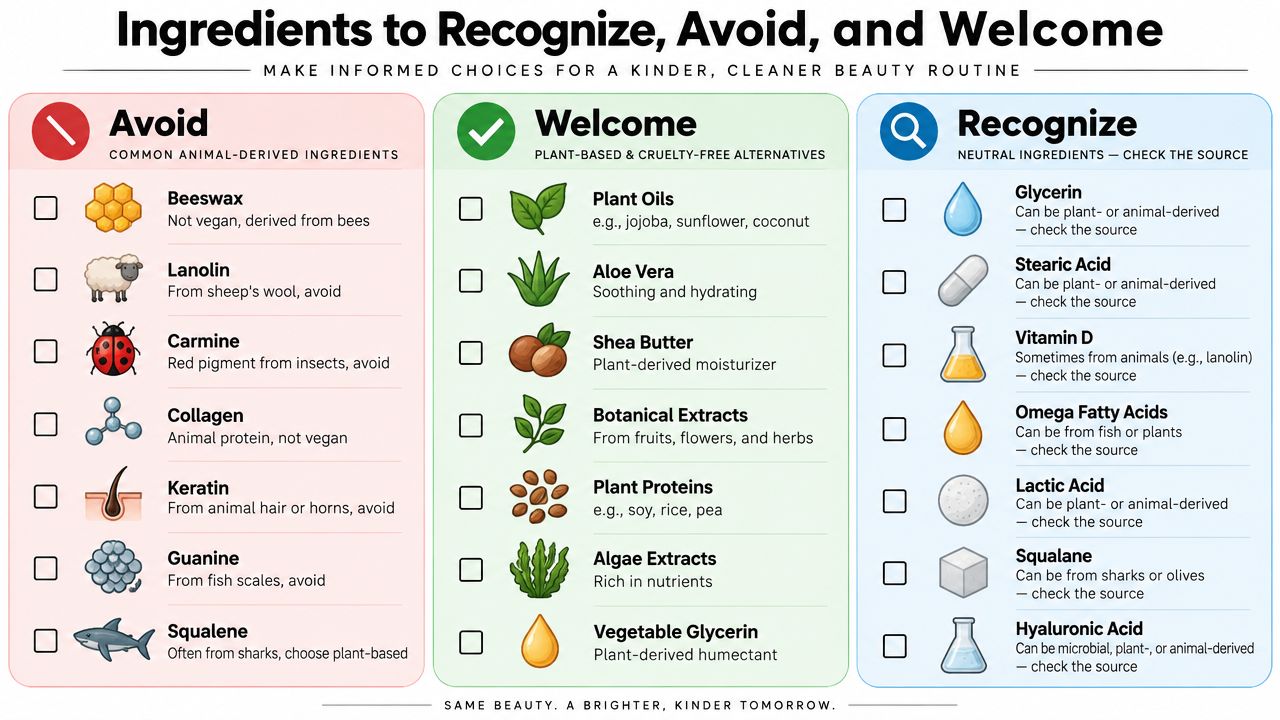
A formula can look plant-based while hiding an ingredient whose origin isn't obvious. Start with the names most likely to raise a question, then confirm the source rather than guessing.
Ingredients to question
- Beeswax, or Cera Alba: It gives balms and lip products structure. Choose plant waxes such as candelilla or carnauba when you want a vegan alternative.
- Lanolin: This wool-derived emollient helps soften dry-feeling formulas. Plant oils, butters, and hydrogenated vegetable materials can provide a similar cushioning feel.
- Carmine or cochineal: This red pigment comes from insects and can appear in blush, lipstick, and eye makeup. Mineral or synthetic colorants may replace it, depending on the formula.
- Collagen: Cosmetic collagen is generally animal-derived and is used for a film-forming, conditioned feel. Plant proteins and humectants can support a hydrated sensory experience without animal collagen.
- Keratin: This protein is associated with hair and nail products and can come from animal materials. Look for plant proteins, amino acids, or lab-made conditioning ingredients.
- Guanine: This reflective material can come from fish scales and is used for shimmer. Mineral mica or synthetic fluorphlogopite may provide sparkle, subject to the brand's sourcing policy.
- Squalene: Historically, some squalene came from sharks. Look for plant-derived squalane or an explicit plant source.
- Stearic acid: This fatty acid can be plant-derived or animal-derived. Ask the brand or check its certification rather than assuming from the INCI name.
Plant-forward choices for a simple routine
Aloe vera can provide a lightweight, water-rich base. Panthenol, beta-glucan, and plant-derived squalane can add comfort and moisture, while niacinamide can fit formulas designed for balanced-looking skin. Allantoin is another familiar soothing ingredient, although its source and certification should still be confirmed.
For readers who want a broader screening list, these skincare ingredients to avoid can help turn a long label into a manageable set of questions. Keep in mind that “natural” doesn't automatically mean vegan, and “plant-based” doesn't automatically confirm cruelty-free testing.
The INCI list has limits. It can show ingredient names and order, but it may not reveal whether glycerin, peptides, lactic acid, or stearic acid came from plants, animals, or a synthetic process. That's where supplier records, certification, and direct brand transparency complete the picture.
A short visual guide can help you remember the common flags while shopping.
Building a Gentle Aloe-Forward Daily Routine
A gentle routine doesn't need a crowded shelf. Build it around cleansing, hydration, protection, and a final moisture step, then adjust based on how your skin feels.
Morning
- Cleanse lightly. Use an aloe-based cleanser to remove overnight oil without leaving a tight finish. The Aloe Hydrating Cleanser is a practical example to investigate because its product page gives shoppers access to the ingredient information.
- Add water-based hydration. A lightweight serum can layer under moisturizer without making an oily complexion feel coated. Browse the Aloe Hydrating Serum and compare its INCI list with your own ingredient preferences.
- Use daily sun protection. Choose a broad-spectrum SPF that suits your finish and makeup habits. Mineral filters may appeal to shoppers who prefer a mineral-leaning formula, but check the complete label and application directions.
- Seal only where needed. If your skin feels dry, a thin layer of aloe gel can add a comfortable moisture seal before cream. The Aloe Vera Gel is one product category to compare.
ALODERMA is a vertically integrated aloe vera company that grows its own organic aloe vera, processes it, and manufactures onsite within 12 hours of harvest. The brand states that its products contain at least 65% fresh organic aloe vera juice, with no added water, concentration, or powder, as described in its fresh aloe skincare information. That farm-to-bottle model gives shoppers a more direct sourcing story to examine.
Evening
Repeat the cleanser, then apply serum while the skin is slightly damp. If you tolerate exfoliation, use an exfoliant on 2 to 3 nights per week, not every evening, and stop if the routine feels uncomfortable.
Follow with an aloe gel or a richer overnight layer. An Aloe Soothing Gel can suit a lightweight routine, while an Aloe Overnight Mask offers a more substantial leave-on step. Finish dry areas with a simple moisturizer, such as the Aloe Hydrating Cream, rather than applying a heavy layer everywhere.
Patch-test every new product for 48 hours before full use. Apply a small amount to a discreet area, observe how your skin responds, and introduce one new formula at a time so you'll know which product caused a reaction if your routine doesn't agree with you.
Reading Labels Like a Formulator
Two shoppers pick up the same cleanser. Maya reads “botanical blend” and “natural fragrance” and places it in her basket. Jordan turns the bottle around, checks the first ingredients, searches the certification mark, and notices that the brand hasn't explained the source of a variable ingredient. Neither shopper is being difficult. Jordan treats the label as a diagnostic rather than a promise.
Ingredients usually appear in descending order by weight, so the first five positions tell you what drives the formula's texture and identity. If aloe appears near the top, it plays a substantial formulation role. If it appears near the end after a long list of solvents, thickeners, and fragrance materials, the front-panel aloe story may be less informative than it sounds.
Freshness is part of the sourcing story
Aloe is especially interesting because the leaf changes once it has been cut and handled. “Farm-grown,” “cold-pressed,” or “fresh” describes sourcing or processing. It doesn't, by itself, prove that the finished product remains stable, safe, or effective throughout its use period. You still need the product's preservation system, packaging, storage guidance, and expiration information.
Look closely at umbrella phrases. “Natural fragrance” may contain many aromatic materials without naming them individually on the front of the package. “Botanical blend” tells you that plant extracts are present, but not which plants, in what order, or from which suppliers. A formulator asks for the INCI list, allergen disclosure, source of variable ingredients, and certification scope.
Label Decoder
| Label Claim | What It Sounds Like | What a Formulator Verifies |
|---|---|---|
| Farm-grown aloe | The ingredient came directly from a farm | Where the aloe grows, how quickly it is processed, and how the finished formula is preserved |
| Natural fragrance | The scent comes from nature | Which aromatic materials are included and how fragrance allergens are disclosed |
| Botanical blend | The formula contains several plant extracts | The complete INCI names, concentration order, and sourcing records |
| Vegan | Nothing animal-derived is in the formula | Ingredient origin, processing aids, carriers, and supplier attestations |
| Cruelty-free | No animals were harmed during development | Testing policies covering the brand, suppliers, contractors, and laboratories |
Simple Shopping Checks for Confident Choices
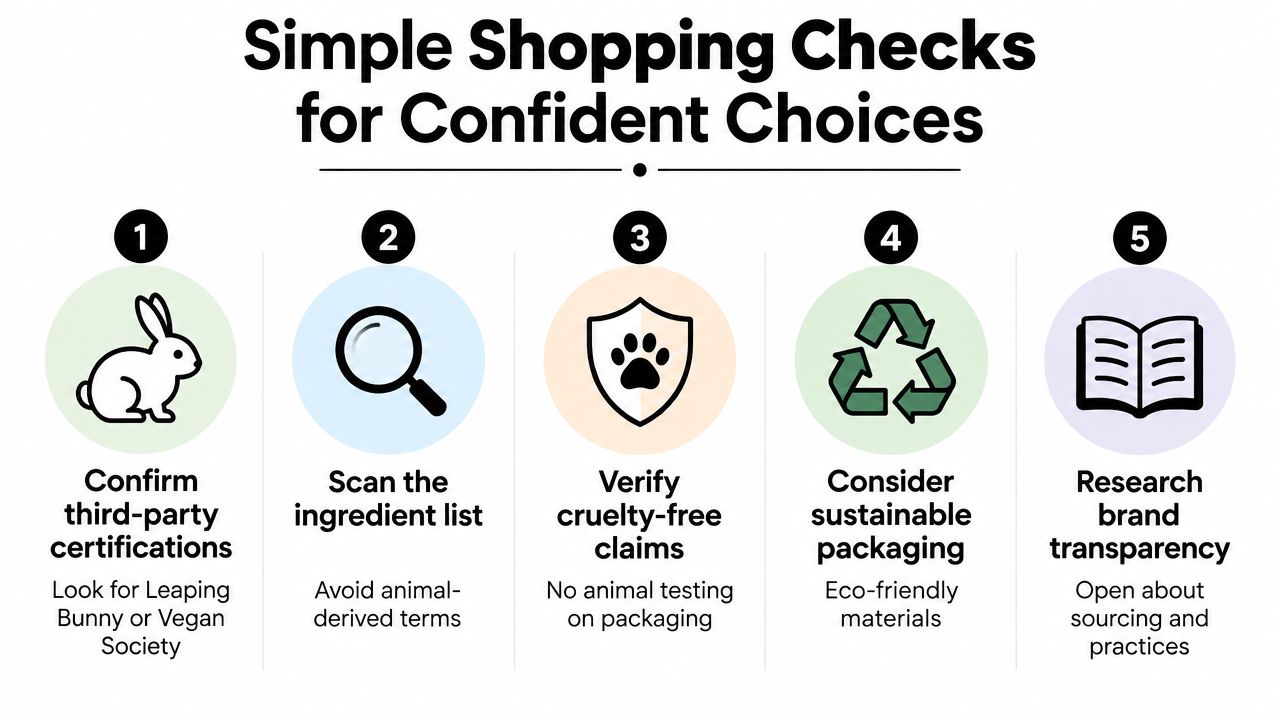
Use this checklist before you add a product to your cart. It takes less time than trying to decode a reassuring front label after you've already bought it.
- Confirm the certification. Look for an independent mark such as Leaping Bunny or Vegan Society, then visit the certifier's live registry where available. A logo without traceable details gives you less evidence than a certification record.
- Scan the INCI list. Search for beeswax, lanolin, carmine, collagen, keratin, guanine, and potentially animal-derived squalene. If an ingredient's origin can vary, ask the brand instead of making an assumption.
- Separate the claims. A vegan statement addresses composition. A cruelty-free statement addresses testing. Check that the brand supports both promises independently.
- Look for a short, named supply chain. Phrases such as “farm-to-bottle” become more meaningful when a company names its growing sites, processing location, suppliers, or manufacturing process.
- Check product age and storage guidance. Manufacture dates, expiration dates, packaging, and storage instructions help you judge a fresh aloe-forward formula responsibly. Fresh ingredient language doesn't replace finished-product stability information.
A good purchase should leave you feeling informed, not suspicious of every unfamiliar ingredient. Read the claims separately, verify the details that matter to you, and choose formulas whose sourcing story is clear enough to follow from raw material to finished bottle.
ALODERMA offers fresh organic aloe-focused cleansers, serums, gels, masks, creams, and other daily skincare options, with product pages that make ingredient and sourcing details easier to investigate. Visit ALODERMA to explore an aloe-forward routine built around vegan and cruelty-free beauty choices.