



The nose goes shiny on a video call before lunch, yet the cheeks still feel tight from the morning wash. Skipping moisturizer feels logical. By 2 p.m. the shine is worse and the skin feels papery underneath. That is the trap: an oily face still loses water, so a tight surface and a glossy one can exist at the same time.
An aloe vera moisturizer for oily face use works as a thin, water-rich layer. Aloe is the base, the water carrier, not the whole product. A humectant such as glycerin pulls water in, and a low-grease emollient keeps the surface smooth without a heavy coat. The practical pick is a lightweight aloe lotion or gel-cream built that way, rather than a bare gel or a butter-rich night cream.
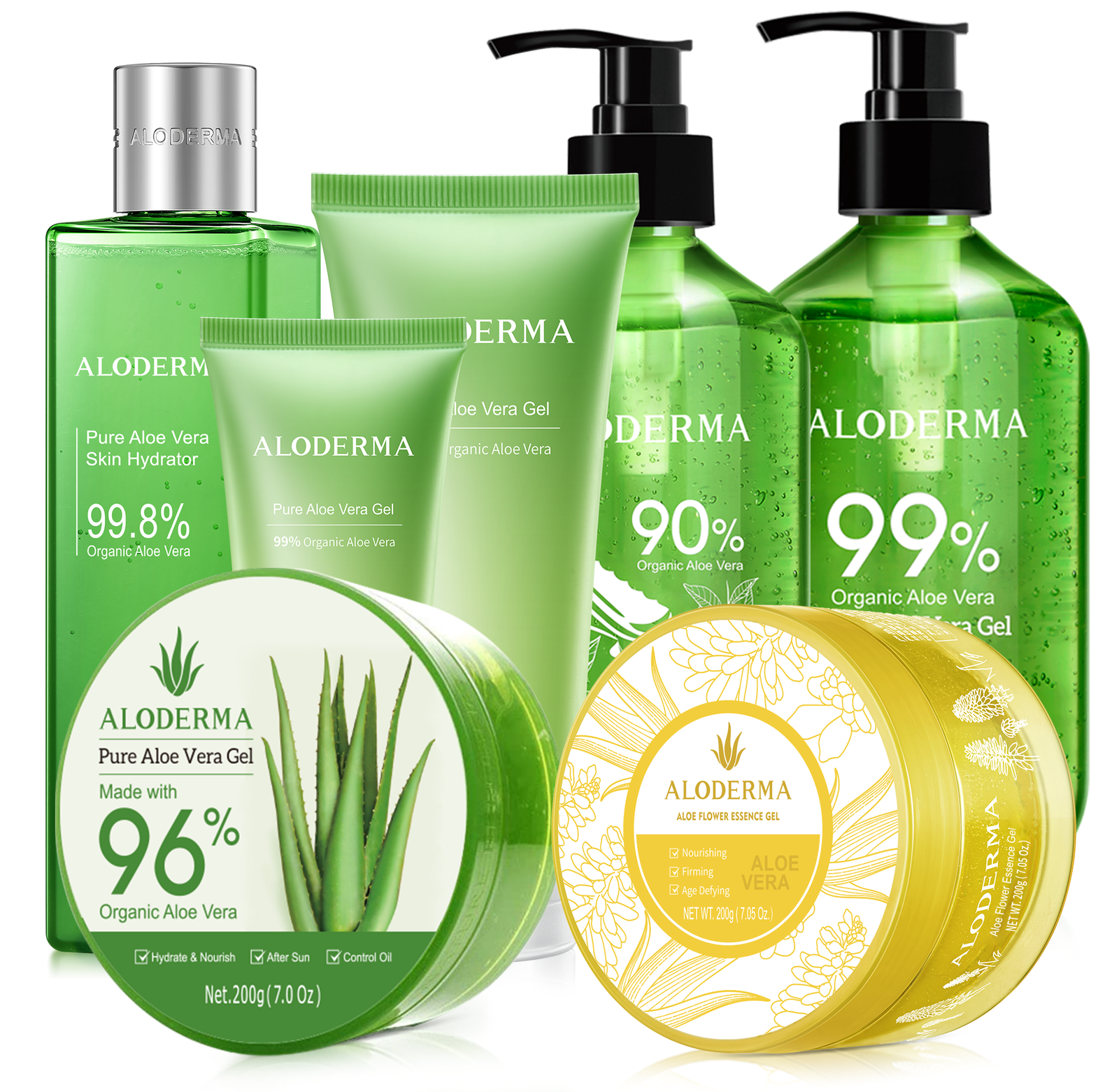
Freshness decides how much of that base is real. ALODERMA makes every product with at least 65% fresh organic aloe vera juice processed within 12 hours of harvest, and several of its creams are built mostly on that juice. Whatever the jar, check that aloe sits near the top of the ingredient list before trusting the texture claims on the front.
Which Aloe Formula Fits a Shiny Face
Maya is 28, blots at 2 p.m., and still feels tight after washing. She stopped using moisturizer because every cream felt like a coat. Her midday shine got worse, and her cheeks stayed papery underneath it. An oily face still loses water through the day. The right aloe vera moisturizer for an oily face is a thin, water-based layer she will keep on, and texture decides that.
Match the texture to how your face behaves between breakfast and lunch, before a brand story decides for you. Aloe itself is the watery base in each of these. The formula built around it decides how the finish feels.
| Formula | Feel on oily skin | Best moment | ALODERMA option | Aloe detail |
|---|---|---|---|---|
| Gel | Weightless, sinks in fast | All-over face, morning and night | Pure Aloe Vera Gel + Tea Tree Oil | Fresh organic aloe as the primary ingredient |
| Hydrator | Light, watery slip | Shiny but tight right after cleansing | Pure Aloe Vera Skin Hydrator | 99.8% organic aloe |
| Firming cream | Soft and silky | Wants cushion without a heavy coat | Aloe Firming & Rejuvenating Cream | At least 65% fresh organic aloe juice |
| Brightening cream | Light cream with a smooth slip | Dull tone sitting under the shine | Aloe Brightening Skin Cream | Juice processed within 12 hours of harvest |
| Hydrating cream | Richer, save for edges | Cooler weather or dry corners only | Aloe Hydrating Cream | Fresh organic aloe juice in a cream base |
The Pure Aloe Vera Gel + Tea Tree Oil doubles as an all-over facial moisturizer used twice a day, so it suits skin that wants almost nothing left on the surface. The Pure Aloe Vera Skin Hydrator lists at $13.99 and stays nearly all aloe, a thin first layer under sunscreen. For a face that flushes as easily as it shines, the Aloe Soothing & Moisturizing Cream pairs fresh organic aloe vera with squalane, allantoin, and vitamins C and E. At the cushioned end, the Aloe Hydrating Cream lists at $21.99, and the Aloe Firming & Rejuvenating Cream, which carries 90 reviews on the ALODERMA site, lists at $27.99.
Practical rule: If the face looks wet by lunch, stay with the gel or hydrator. If it looks oily but feels squeaky, move down a row toward the creams.
Save the hydrating cream for dry corners or cooler months. The lighter rows earn their place by disappearing fast and leaving the surface calm, with nothing heavy sitting on top.
What Aloe Can and Cannot Do for Oily Skin
Aloe has a long record of topical use, and that history is not the same as a finished moisturizer. A peer-reviewed review records medicinal use across Greece, Egypt, India, Mexico, Japan, and China for thousands of years, and that 2003 review still concluded that controlled clinical trials were needed to establish real efficacy.
What the trials actually tested
The U.S. National Center for Complementary and Integrative Health notes that only two small studies suggest topical aloe may help blemish-prone skin, and only alongside other treatments, while a 2025 review reported blemish reductions of 23.7% to 62.1% after 4 to 8 weeks for a blend of aloe, propolis, and tea tree oil. Those percentages belong to the blend, not to aloe by itself.
A separate evidence review describes a randomized, double-blind trial of 60 people who used 50% topical aloe vera gel combined with a standard leave-on active for 8 weeks. The combination was reported as well tolerated and more effective than the active with vehicle alone. Aloe worked as a sidekick. It was not the solo performer.
What that means at the sink
Treat aloe as a light, cooling base. It doesn't replace a humectant, and it doesn't replace a low-grease emollient. A watery gel can feel fresh for an hour and still leave cheeks tight by the afternoon if nothing holds water on the skin.
If a claim sounds like the plant alone will stop shine or clear every bump, the trials don't support that sentence.
Judge a new aloe vera moisturizer for oily face routines at two to four weeks, not after one comfortable morning. If you're unsure whether a shiny face should be moisturized at all, the short guide on whether oily skin needs moisturizer is the place to settle that before you buy another jar.
Ingredients to Keep and Ones to Limit
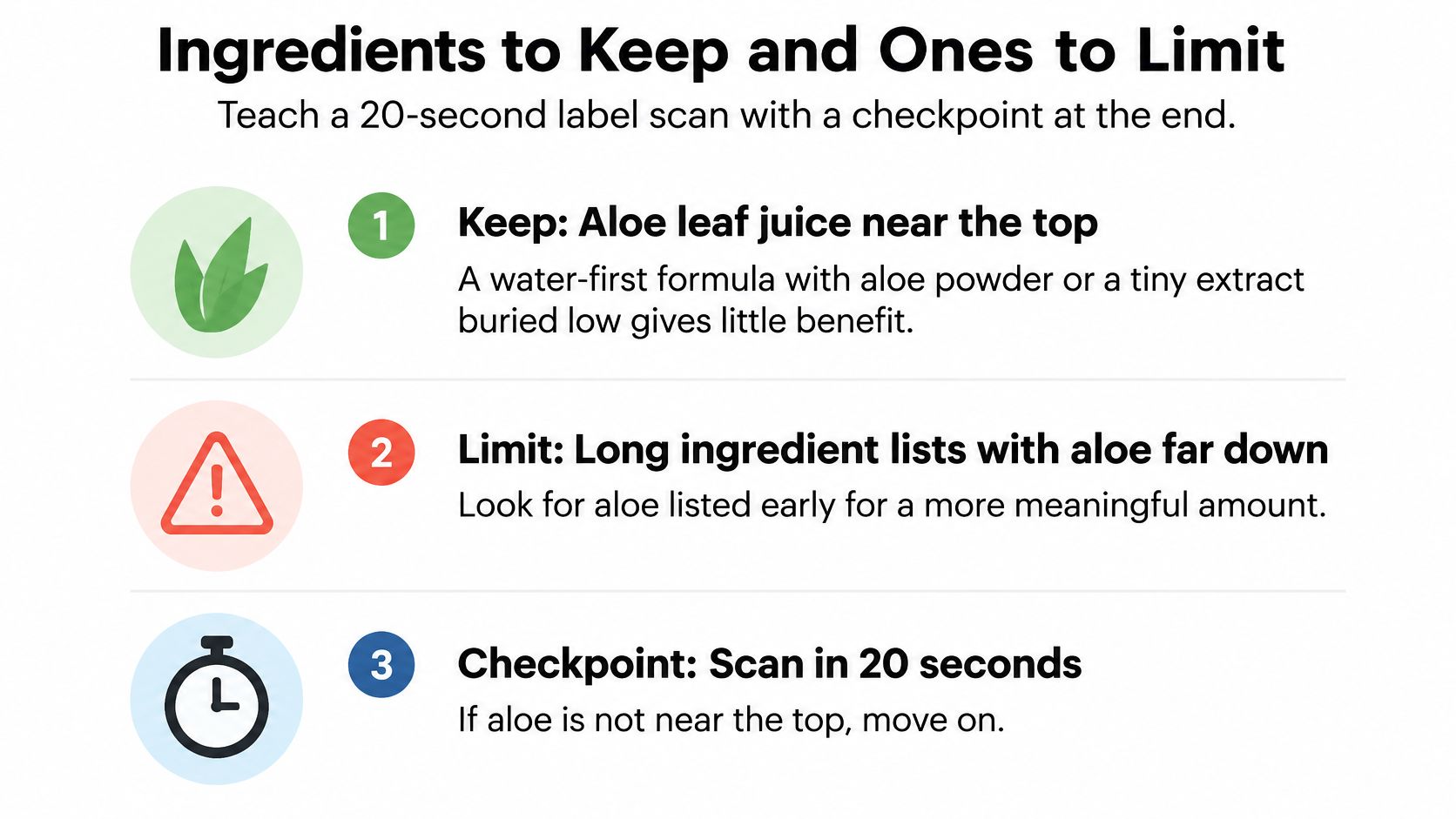
The front of the bottle is advertising. The back label is the formula, and a 20-second scan is enough because ingredients appear in order, the largest amounts first.
A controlled human study found that a single application of aqueous polysaccharide fractions from aloe vera raised skin hydration, while repeated application over four weeks produced a predominantly dehydrating effect. Aloe works like a drink of water for skin: refreshing on contact, gone by afternoon unless something else holds it there. That is why one comfortable morning says little about week three, and why oily skin still needs a humectant such as glycerin alongside a low-grease emollient or occlusive such as dimethicone.
The keep-or-limit scan
| Look for | Why it helps | Limit | Why it backfires |
|---|---|---|---|
| Aloe leaf juice in the first position | The real base of the formula | Water first and aloe powder far down | Little fresh aloe in the jar |
| Glycerin, butylene glycol, or propanediol | Holds water on the skin | Aloe as the only moisturizing ingredient | Fresh feel that fades with daily use |
| Coco-caprylate, isoamyl laurate, squalane, or dimethicone | Slip without a grease film | Shea or heavy oils high on a day formula | Midday shine and pilling |
| Short botanical-oil list you already tolerate | Scent without surprise | Long essential-oil blends if you sting easily | Comfort problems on a reactive face |
Aloe near the top means the juice carries the formula. A humectant next is glycerin, butylene glycol, or propanediol. One light slip agent is enough: coco-caprylate/caprate, isoamyl laurate, a C15-19 alkane, squalane, or dimethicone. Sodium hyaluronate, niacinamide, and Zinc PCA are useful companions on a complete cream, and none of them excuse a missing moisture system.
Oils and marketing words
Shea butter or another heavy butter sitting high on a daytime lotion is the usual reason a "light" cream looks shiny by noon. Botanical and essential oils deserve the same scrutiny. They vary from one product to the next, and a scented blend that one face finds pleasant can sting another. Before you commit, read the full ingredient list on the product page and flag any botanical oil you already know your skin does not tolerate.
Non-comedogenic and oil-free are marketing terms. Judge them against the actual list, because the words on the front answer to nobody.
Checkpoint: aloe first, a humectant next, one light slip agent, and no heavy butter in the first five ingredients for daytime.
If aloe isn't near the top, put the bottle back.
Why Freshness Changes the Aloe You Feel
All clear gels are not the same liquid. ALODERMA is a fully vertically integrated aloe vera company. We grow all of our own organic aloe vera, then we process that aloe and manufacture onsite within 12 hours of harvest so the primary ingredient stays as bioactive as possible.
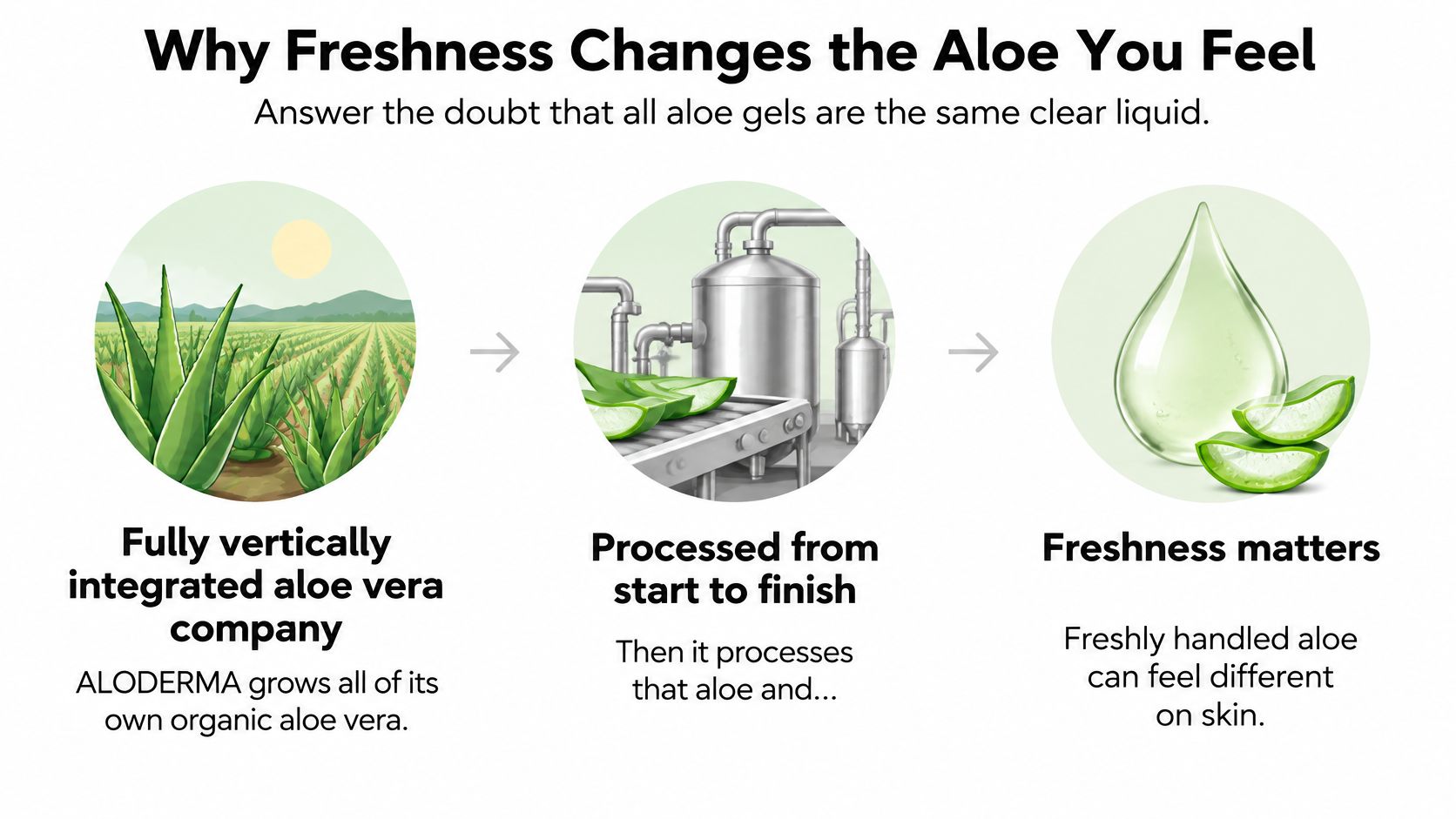
That window is the opposite of a generic water base built on reconstituted powder. Our aloe vera juice is processed within 12 hours, is never from concentrate or powder, and has no water added. For a shiny face, the point is a light gel or lotion that can be mostly real aloe and still include glycerin and a light emollient so it can live on a bathroom shelf.
The fridge test you already know
A true single-ingredient gel doesn't sit unrefrigerated for months and stay pleasant. A finished moisturizer can, because the formula is built to be used morning and night. Fresh handling supports a comfortable, non-greasy feel. It doesn't promise that every face will love every oil in the bottle.
Our farms are ECOCERT-certified, alongside USDA and EU Organic standards. The line uses at least 95 percent naturally derived ingredients and is cruelty-free. Organic status doesn't erase a scent you dislike. Read the full lists for the Aloe Hydrating Lotion, Aloe Firming Moisturizer, and Aloe Brightening Moisturizer before you decide. The oily-skin guidance describes the hydrating lotion as moisturizing without a greasy finish, and the farm-to-face story is the sourcing detail behind that feel.
How to Apply It Morning and Night
One routine is enough. Amount and wait time matter more than a long shelf of extras.
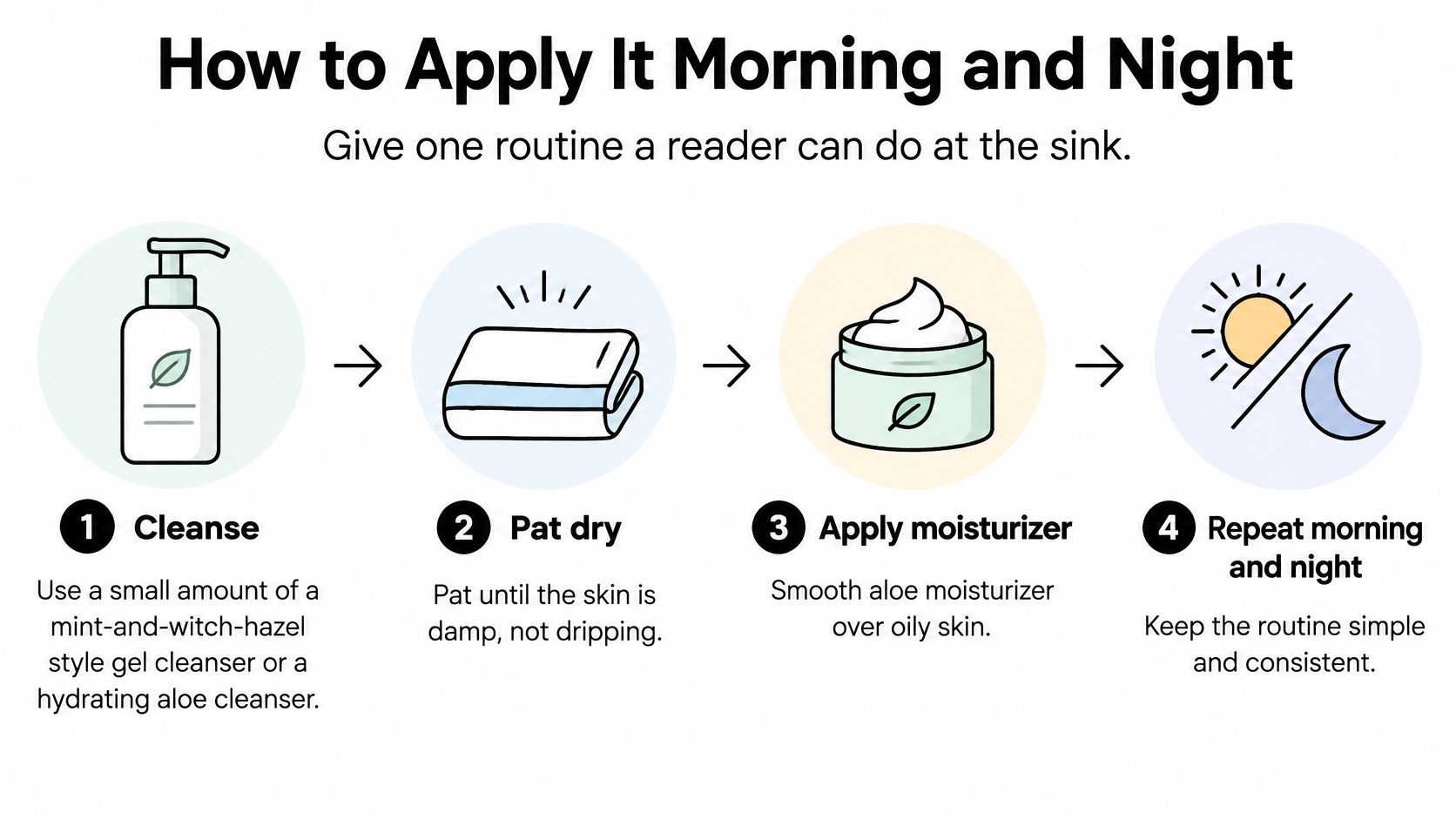
- Cleanse, then leave the skin damp. Use a small amount of a mint-and-witch-hazel style gel cleanser or a hydrating aloe cleanser. Pat until the skin is damp, not dripping. Damp skin gives the next layer water to sit on.
- Press a hydrator only if you already use one. Two or three drops over the face, then about a minute. Skip this if your lotion already feels like enough. Extra watery layers are how a T-zone gets glossy.
- Measure a small amount. A pea-sized amount of lotion, or a blueberry-sized amount of gel, covers the whole face. More product is what leaves the nose shining.
- Dot, then sweep thin. Forehead, cheeks, nose, and chin. Sweep outward so the nose and chin get the thinnest coat. Those are the zones that look wet first.
- Wait before sunscreen. In the morning, let the layer feel set, about one to two minutes, then apply sunscreen. Rushing is what makes mineral filters pill.
- Keep night the same size. After cleansing, use the same amount. Add a second thin pass only on cheeks that still feel tight. Don't "make up for oil" with a thick cream.
- Start once a day for a week. If the skin still feels comfortable, move to morning and night. A practical consumer method is once daily for one week before twice daily, so you don't confuse a fresh film with a formula you can live with.
What day three should feel like
Makeup or sunscreen sits without pilling. The noon blot is lighter. Cheeks don't feel papery when you smile. If you rubbed a thick cream into a just-washed oily face and then blamed aloe for the shine, the amount was the problem, not the plant.
Pairing Cleansers Serums and Masks
Most oily faces do well with one cleanser, one optional serum, and one light moisturizer. Three sink scenes cover a normal week.
A shiny office morning. Wash with the Aloe Oil Controlling Cleanser, which pairs fresh organic aloe with mint and witch hazel and contains 76% fresh organic aloe vera. If the cheeks feel tight, press on a hydrating or soothing serum. We make the Aloe Hydrating Serum for that step. Then the light lotion, then sunscreen. That's the whole lineup before you leave.
Night after a long day outside. Use the same cleanser, or switch to the Aloe Hydrating Cleanser, which contains fresh organic aloe juice, when the face feels stripped. Serum if you want it, then gel or lotion. Stop there. A strong exfoliating serum, a second gel, and a rich cream in one night is how a lightweight routine starts to pill and sting.
Once or twice a week, not nightly. Lay on an Aloe Hydrating Facial Sheet Mask, enriched with hyaluronic acid, for 10 to 15 minutes. Follow with a thinner moisturizer than usual, because the mask already left water on the skin. If a single spot shows up, dab Aloe Clearing Gel on that spot after cleansing. It contains 91% aloe vera, plus witch hazel, sugar kelp, and purslane, and it's meant for the spot after cleansing and now and then through the day. Keep the regular moisturizer on the rest of the face.
The order question comes up every time a serum enters the picture. A clear walk-through of which order to apply skin care keeps the mask, the serum, and the lotion from fighting each other.
A First-Week Comfort Check
Natural is a starting point, not a guarantee. A fresh formula can still be wrong for one person, and that is useful information.
Before the whole face, place a pea along the jaw or behind the ear once a day for three days. Go ahead only if there's no sting, itch, or new redness. If warmth or itching shows up, rinse and stop. Don't push through because the bottle says organic.
Readers who already react to garlic, onions, or tulips should keep that first test tiny. A clinical reference notes that people allergic to plants in that same family may need to avoid aloe preparations, and topical studies have generally reported no serious adverse effects while some users had reversible burning, itching, and contact dermatitis, including reactions tied to contaminants such as anthraquinones, according to a systematic clinical review.
Use the fragrance check from the label. If scent bothers you, choose the shortest botanical-oil list. During the first week on the face, change only the moisturizer so any reaction is easy to trace.
Judge comfort at four weeks, not four hours. Immediate slip isn't the same as skin that still feels comfortable after a month.
If tightness, sting, or persistent redness continues, stop the product. Ask a pharmacist or us, rather than stacking more layers on top.
Start Tonight with One Light Layer
If the face is shiny all day, start with Pure Aloe Vera Gel + Tea Tree Oil as the all-over moisturizer morning and night. If the face is shiny and tight, keep that same gel as the base, then add a thin layer of Aloe Hydrating Cream on the cheeks that still feel tight by midday. The gel carries the water; the cream is the small patch that holds it where skin dries out.
Read the full ingredient list on the product pages at aloderma.com, including the botanical oils, before checkout. Amazon works too if that is where you already shop. Tonight's action is small. Cleanse, apply a pea of the chosen layer, and note how the face feels at noon tomorrow. Compare that note with the label checkpoint: aloe first, a humectant next, one light slip agent after that.
ALODERMA grows our own organic aloe and turns it into gels, creams, and hydrators within 12 hours of harvest, so an oily face can get moisture without a heavy coat. If you're choosing an aloe vera moisturizer for an oily face, start with one light layer and the ingredient list in front of you. Visit ALODERMA to compare the gel, the hydrating cream, and the clearing set before your next wash.