







You look in the mirror at lunchtime and see a glossy forehead and nose, yet your cheeks feel tight from the morning cleanse. By evening, the T-zone seems ready for another wash while the jawline feels dry and uncomfortable. That combination can make every product decision feel like a compromise.
Learning how to treat combination skin starts with abandoning the idea that your whole face needs one strength, one texture, or one treatment schedule. Your forehead, nose, chin, cheeks, and jawline can have different needs on the same day. The practical answer is a zone-based routine that keeps the cleanser mild, hydration light where oil collects, and richer support where the skin feels dry.
Why Combination Skin Is Really a Zone Problem
Combination skin is a zone problem, not a permanent label that should dictate one routine. The T-zone may produce more sebum and become shiny quickly, while the cheeks and jawline lose comfort after cleansing or exposure to dry air. Hormonal and seasonal changes can shift these patterns, so your face needs observation rather than a fixed prescription. A consumer-facing dermatology source cited by cosmetic specialists estimates that around 60% of people experience combination-skin characteristics at some level (PR Newswire survey document).
The common mistake is treating oil as a problem across the entire face. A strong foaming cleanser, drying toner, and rich repair cream can create a predictable cycle. The forehead may look cleaner for a short time, while the cheeks become uncomfortable. Product switching then starts before the skin has had time to settle.
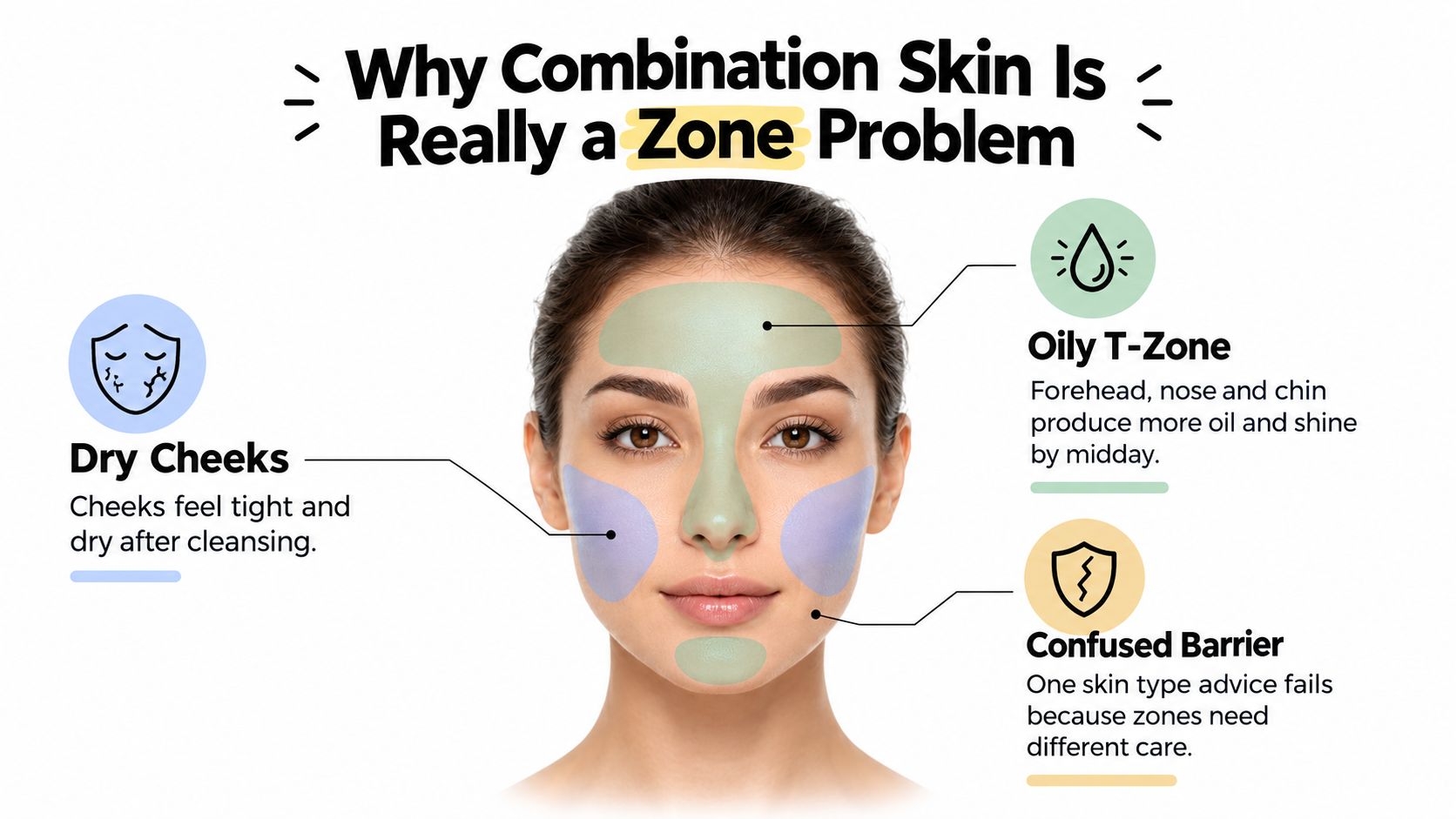
Treat the face as a map
Apply the lightest effective texture broadly, then change the amount and finish by zone:
- T-zone: Keep cleansing brief, use thinner hydrator layers, and direct oil-controlling treatments here when needed.
- Cheeks and jawline: Start with water-based hydration, then add a more protective moisturizer if tightness remains.
- Eye area: Avoid dragging cleanser or strong actives across delicate skin. A small amount of comfortable moisturizer is usually more useful than additional treatment.
Fresh aloe-forward care supports this method. A lightweight gel can add hydration without leaving oily areas feeling coated. Fresh aloe's same-day-harvest story also fits a routine built around simple, gentle support, though aloe alone will not address every concern or replace careful product selection. Use it as a flexible base, not as a promise of a permanently matte face.
Practical rule: If your cheeks feel tight while your nose remains shiny, adding more product usually misses the problem. Adjust the placement and amount instead.
A 2014 clinical study of a specified acne skin-care regimen shows why consistency matters for combination-type skin. Total lesion counts fell by 30.6% at week 2, 35.9% at week 4, and 44.0% by week 8, from baseline counts averaging 76.7 total lesions, including 27.3 inflammatory and 49.4 non-inflammatory lesions (Dermatology Times reference). Those results are a practical benchmark for patience, not a promise that every routine will produce the same outcome. Gentle, consistent care gives each zone more opportunity to adapt than aggressive spot-only treatment.
Mapping Your Own Skin Zones at Home
Before buying another serum, map your face. A simple paper-towel or blotting-sheet test can show whether your routine is responding to actual zone differences or to assumptions.
Run the test tonight
- Cleanse gently. Wash with a mild, non-stripping aloe-based cleanser, using less rubbing on the cheeks. Pat dry rather than polishing the skin with a towel.
- Leave the face bare. Don't apply moisturizer, serum, oil, or sunscreen for the test.
- Check after one hour. Press separate pieces of plain paper towel or blotting paper against the forehead, nose, chin, both cheeks, and jawline. Mark each piece according to the amount of oil it picks up.
- Record comfort. Note tightness, roughness, tingling, itch, or a dry pulling sensation. A zone can show oil and still feel uncomfortable, so the paper alone doesn't tell the whole story.
Use a simple three-part score:
- Oily: Visible shine or clear oil transfer, with little tightness.
- Balanced: Minimal oil transfer and no meaningful discomfort.
- Dry: Little oil transfer combined with tightness, roughness, or visible flaking.
Sketch a basic face outline and label each area. You might find that only the nose and center forehead are oily, while the chin is balanced and the outer cheeks are dry. That map is more useful than choosing a product because the label says “combination.”
Repeat before you redesign everything
Repeat the check across two or three days in different conditions, such as after a warm day, a cool day, or a night when you've slept in dry indoor air. A single snapshot can reflect recent cleansing, weather, exercise, or product residue rather than your usual pattern.
Don't press hard or keep rubbing the same area. The test is meant to observe your skin, not provoke it. Once you have a repeatable map, use it to decide where to apply a lighter gel, where to add cream, and where an active treatment belongs.
Your Morning Routine for Combination Skin
Morning care should prepare the surface for the day without making the T-zone feel slick or the cheeks feel stripped. Keep the sequence simple: cleanse, hydrate, protect. The order matters because each layer needs a clean, comfortable surface and enough time to settle before the next one.
Cleanse with restraint
Choose a low-foam, sulfate-free cleanser that doesn't leave a squeaky finish. Work it over the forehead, nose, and chin for less than a minute, then let the rinse water do most of the work on the cheeks. If your cheeks feel comfortable in the morning, you may need only a brief rinse there rather than a full cleansing massage.
A gentle cleanser should remove overnight oil and residue without creating a tight feeling. If you're comparing formulas, this face wash guide for combination skin can help you think through texture, cleansing strength, and application by zone.
Pat dry and move to hydration while the skin still feels comfortable. Don't wait until the cheeks feel parched before applying the next layer.
Let aloe provide the first hydration layer
Apply a thin layer of fresh aloe vera gel across the face, then add a second, smaller pass to the cheeks and around the eyes if those areas tend to look creased or feel dry. Aloe gel offers water-binding polysaccharides in a light texture, so it can support dehydrated areas without automatically adding the heaviness of an oil-rich cream.
The technique matters more than the amount. Smooth a small quantity over the T-zone, press rather than rub over the cheeks, and allow it to settle before sunscreen. If the gel pills, you're probably applying too much, layering too quickly, or combining incompatible textures.
Finish with sun protection
Use a broad-spectrum sunscreen rated SPF 30 or higher. A fluid or gel-cream texture often sits more comfortably over aloe than a thick formula, but the best choice is the one you can apply evenly without skipping the cheeks or hairline.
Wait briefly between hydration and sunscreen, then apply sunscreen as the final morning skincare step. If your forehead becomes shiny, adjust the amount of moisturizer underneath rather than reducing sunscreen. Your morning routine should feel almost boring. That usually means you've removed the friction that causes people to skip it.
Your Evening Routine That Rebuilds the Barrier
Night care has a different job from morning care. The morning routine prepares and protects, while the evening routine removes sunscreen and daily residue, replenishes water, and supports the skin's overnight barrier function.
Start with an oil or balm cleanser when you've worn sunscreen, makeup, or a water-resistant product. Massage it over the face without scrubbing, emulsify thoroughly, and rinse. If the skin still feels coated, follow with a mild water-based cleanser. If it feels clean and comfortable, a second cleanse may add unnecessary dryness.
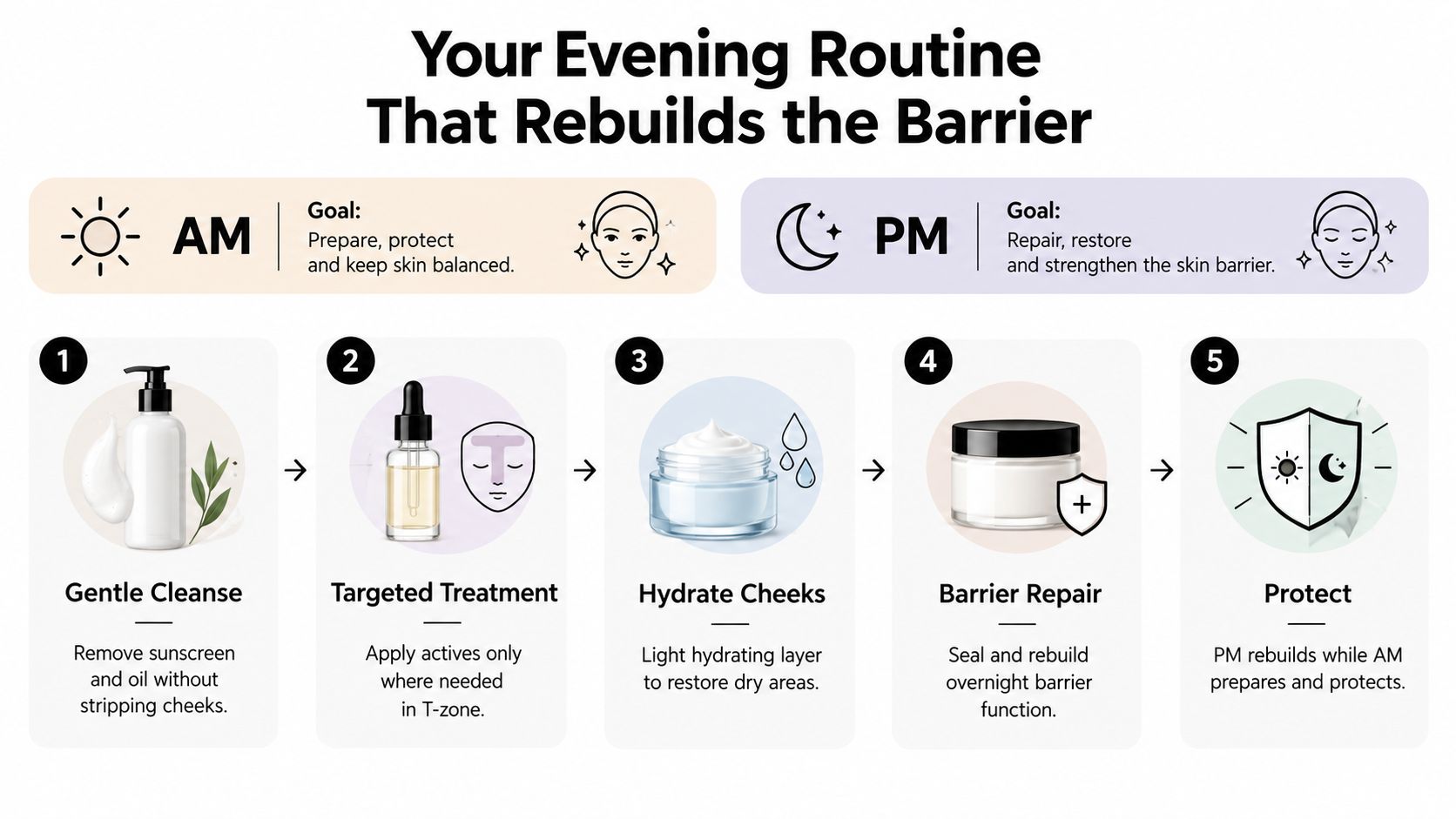
Build the night in zones
Skip toner unless it improves comfort. A pH-balanced mist can be pleasant, but it isn't mandatory, and adding another watery step won't compensate for an overly harsh cleanser.
Apply fresh aloe gel across the face after cleansing. Follow with a barrier-supporting moisturizer, using a thinner layer over the T-zone and a fuller layer over the cheeks, jawline, and the area around the eyes. A serum-plus-cream approach can be useful when one moisturizer isn't enough. A clinical study of that combination found more sustained hydration, lower transepidermal water loss over time, and better preservation of baseline sebum levels than either product alone (International Journal of Cosmetic Science study).
Retinal or a low-strength BHA can fit into the evening routine, but don't apply everything at once. Use an active on two to four nights per week, apply it mainly where it is needed, and buffer it with hydration if your cheeks are easily stripped. Keep exfoliation and retinal on separate nights. If you experience persistent discomfort, stop the active rather than trying to overpower the reaction with more products.
For a broader explanation of rebuilding an impaired barrier, this damaged skin barrier repair guide offers useful context. A fresh aloe compress on the cheeks after cleansing can also make the evening routine more comfortable. Soak clean cotton rounds or a soft reusable pad with aloe gel diluted only if the product instructions allow it, place them briefly on the cheeks, then moisturize.
The embedded routine below is useful as a visual reminder of the sequence:
Keep the bedroom air from becoming excessively dry if possible, change pillowcases regularly, and avoid turning bedtime into an experiment with multiple new actives. The most effective night routine is the one your skin can tolerate repeatedly.
Ingredients That Help and Ones to Avoid
Combination skin benefits from ingredients that add water and support comfort without forcing every zone into the same finish. Aloe is a gentle backbone, not a miracle ingredient. It can hydrate and soothe, but it still needs to be paired with a cleanser, moisturizer, and sunscreen suited to your actual skin map.
Combination Skin Ingredient Scorecard
| Ingredient | Verdict for Combination Skin | Why |
|---|---|---|
| Fresh aloe vera gel | Helpful foundation | Provides lightweight hydration and can be layered by zone without a greasy finish. |
| Hyaluronic acid and glycerin | Helpful | Bind water and work well under a moisturizer, especially on dry cheeks. |
| Niacinamide | Useful when tolerated | Can support a more balanced-looking T-zone and fit into a simple serum step. |
| Panthenol and ceramides | Helpful for dry zones | Support comfortable, barrier-focused moisturization without requiring a heavy texture. |
| Beta-glucan and allantoin | Gentle support | Useful additions when the skin feels easily unsettled or dry. |
| High-strength salicylic acid | Use selectively | Helpful for oilier areas, but excessive whole-face use can leave cheeks uncomfortable. |
| Denatured alcohol high in the formula | Approach carefully | May feel immediately light while making dry zones feel less comfortable. |
| Heavy occlusive textures | Zone dependent | Can be useful on cheeks but may feel excessive over the T-zone. |
| Fragrance and essential oils | Approach carefully | Dry or reactive cheeks may not appreciate additional scent components. |
| Jagged physical scrubs | Usually skip | Abrasive particles can make dry zones feel rougher and more sensitive. |
Retinoids and exfoliating acids aren't automatically off-limits. The useful distinction is dose, location, and recovery time. Apply a treatment to the T-zone if that is where the concern appears, keep it away from dry patches, and leave enough non-treatment nights for the rest of the routine to support comfort.
High-strength salicylic acid across the whole face often fails because the user is trying to solve shine by removing too much surface comfort. A low-strength, targeted application is more practical. For cleanser selection and texture comparisons, this face wash buyer's guide provides additional product-selection context.
ALODERMA's guide to ingredients to avoid in skincare is also useful when you're simplifying a crowded routine. Read ingredient lists from the top down, but judge the finished formula by how your zones feel over several uses. A fast, polished glow can be misleading if it arrives with tight cheeks and an unusually shiny forehead later in the day.
Weekly Masks and Exfoliation Without Overdoing It
Weekly care should correct a specific pattern, not give every part of the face the strongest treatment available. If the T-zone feels congested while the cheeks feel dry, use different products on different areas instead of applying a single mask everywhere.
Start with a low-strength BHA or PHA on the oily zones one or two times per week. Apply it to the forehead, nose, and chin, avoiding the cheeks unless your skin map shows that they tolerate it. Physical scrubs are a poor shortcut for dry zones because friction can leave those areas rougher.
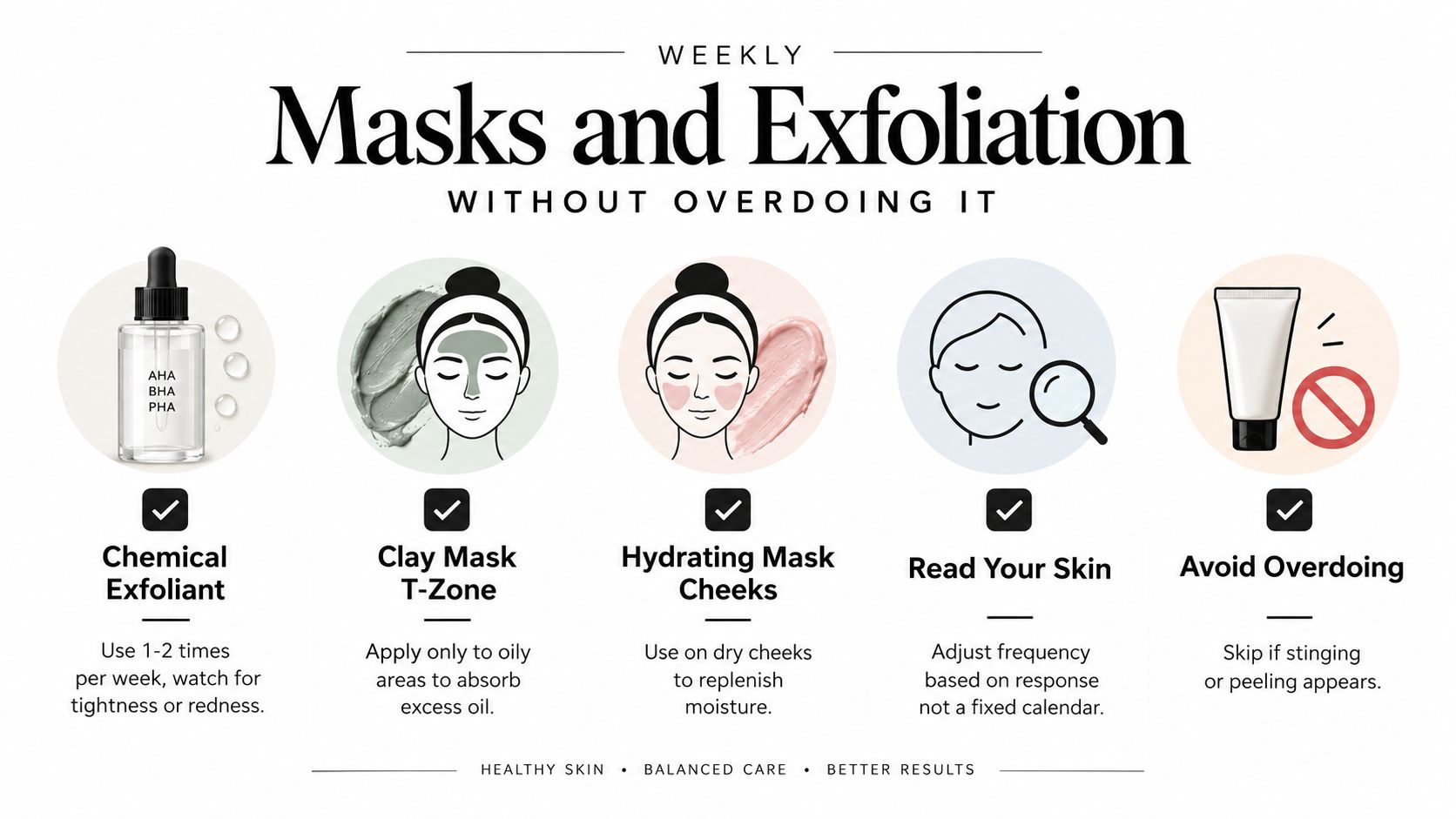
Read the response, not the calendar
After exfoliation, watch what happens through the next day. Tightness, unusual afternoon shine, flaking, or new sensitivity on the cheeks means the schedule is too aggressive, even if the T-zone looks smoother.
Use a clay or charcoal mask on the T-zone once weekly when oil absorption is needed. Keep it away from the cheeks, and don't wait for the mask to become fully rigid and uncomfortable. Apply a hydrating or aloe-rich mask to the cheeks and jawline on the same evening or the following night.
A simple rhythm might look like this:
- Exfoliation night: Target the T-zone, then hydrate the entire face.
- Hydration night: Use aloe and a comfortable moisturizer, with no active.
- Barrier-rest night: Cleanse gently and apply only the layers that prevent tightness.
Don't stack exfoliation, clay, and a retinoid in the same evening. Don't mask daily just because a mask feels soothing for a few minutes. If you want to understand how professional hydration-focused treatments differ from home masking, review this Beverly Wilshire Aesthetics Hydrafacial resource.
Seasonal adjustments matter. Use lighter textures in humid weather, add richer cheek coverage in dry weather, and pause exfoliation entirely if your cheeks remain tight for two consecutive days. A practical guide to choosing a hydrating mask is available in ALODERMA's best hydrating face masks article.
Adjustments, Troubleshooting, and Your FAQ
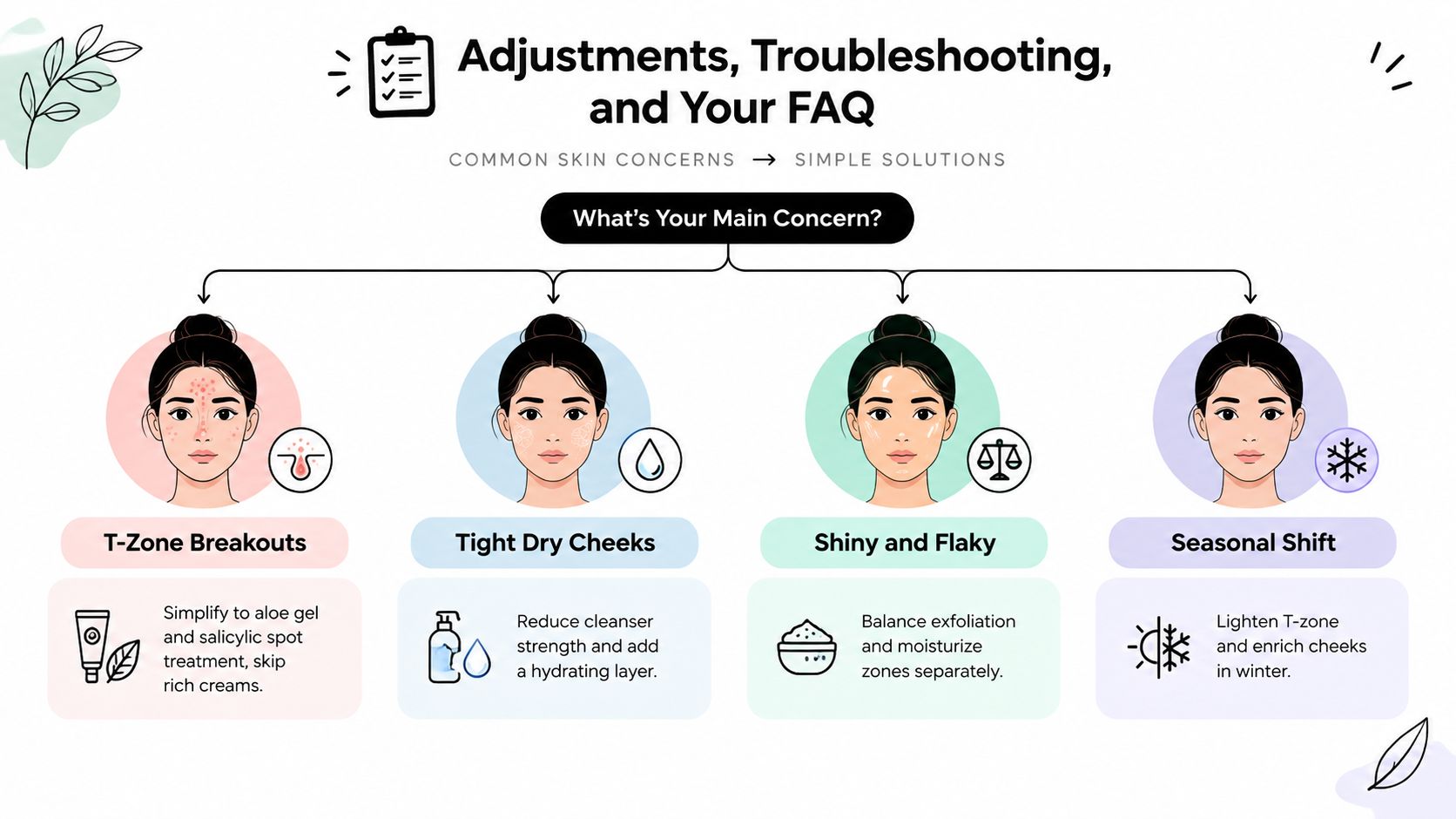
Combination skin changes by zone and by day. Start with the area causing trouble, change one variable, and give your skin enough time to show whether the adjustment works.
Use the smallest useful adjustment
For blemishes concentrated in the T-zone, keep that area simple with aloe gel and a targeted salicylic treatment. Skip richer cream on the forehead, nose, and chin, while continuing to hydrate the cheeks.
If the cheeks sting or flake, stop all actives for a week. Use a fragrance-free aloe moisturizer, cleanse briefly, and avoid introducing another serum until the skin feels consistently comfortable.
Shine and flaking together usually call for less cleansing, not more. Reduce exfoliation, keep the T-zone layer thin, and add hydration followed by a more protective cream on dry zones.
Texture should follow the weather. In humid summer conditions, a fluid or gel moisturizer may suit the whole face. During dry winter weather, use a richer aloe-cream hybrid on the cheeks and keep the T-zone lighter. Hormonal shifts can also move oil and blemishes between zones, so keep the core routine steady and change targeted treatment only after the pattern repeats.
Common questions
Is combination skin permanent?
Not necessarily. Hormones, seasons, climate, cleansing habits, and product use can alter skin behavior. Treat your zone map as a current observation, not a lifelong identity.
How long does a new routine take to balance out?
Track comfort, shine, and dryness rather than changing products every few days. Gentle improvements often build progressively over several weeks, so judge the routine by its overall direction instead of expecting an immediate reset.
Can aloe replace moisturizer?
Aloe gel may be enough for a humid morning or an oily zone. Dry cheeks may still need cream to slow water loss and leave a more protective finish. Fresh aloe care is most useful when it supports the zone that needs it, rather than forcing the same texture everywhere. ALODERMA states that it processes aloe and manufactures onsite within 12 hours of harvest, and that its products contain at least 65% fresh organic aloe vera juice, not concentrate or powder and without added water, according to ALODERMA.
How should I handle post-acne marks?
Keep the routine gentle, apply sunscreen daily, and avoid picking or repeatedly exfoliating the area. If a mark persists or worries you, professional advice is more useful than adding several strong products.
When should I see a dermatologist?
Seek guidance for discomfort, persistent peeling, recurring blemishes, or sensitivity that does not improve after simplifying your routine. A dermatologist can help distinguish a product reaction from a condition that should not be managed by trial and error.
Treat combination skin as a daily zone assessment. Keep the foundation gentle, make one controlled adjustment at a time, and let fresh aloe-forward care provide hydration without pretending to replace every barrier-supporting layer.