







Your forehead looks shiny again, but your cheeks feel tight when you smile. You're standing at the sink wondering whether to wash again, switch cleansers, or add another hydrating layer. That combination can feel frustrating because the obvious response to oil, more cleansing, isn't always the response your skin finds comfortable.
Choosing a sensitive oily skin cleanser means balancing residue removal with how your face feels afterward. Instead of judging only the lather or immediate freshness, pay attention 30 minutes after washing, two hours later, and the next morning. Those are practical observation checkpoints, not a clinical test, but they can help you make a calmer, more useful decision.
Cleanser Types at a Glance for Oily, Sensitive Skin
A gentle gel or mild foaming wash is the default choice; a cream or milk cleanser is the fallback when washing leaves your skin stinging or tight. Other formats suit particular jobs, such as removing heavy makeup or simplifying your travel bag.
Treat texture as a starting point, not proof of mildness. A foaming formula can be comfortable, while a creamy one can contain ingredients your skin doesn't enjoy.
Cleanser types and when each fits oily, sensitive skin
| Cleanser type | Texture and lather | Good fit when | Watch for |
|---|---|---|---|
| Gel cleanser | Clear, light, moderate foam | Oil builds up by midday but skin doesn't sting after washing | Can feel tight with morning-and-night use in dry weather |
| Mild foaming wash | Airy, dense lather | Skin is oily but comfortable with brief contact | Harsh surfactants leave a squeaky, tight finish |
| Cream or milk cleanser | Soft, low foam | Skin feels tight, stings, or reacts to strong foam | May leave residue on very oily skin; rinse thoroughly |
| Aloe-based gel or lotion cleanser | Cool, watery, sometimes lightly lathering | Oily-looking skin also needs hydration | Check the full label for essential oils or fragrance |
| Syndet bar, or synthetic detergent bar | Dense, creamy lather | You want a solid, low-waste option with mild cleansing agents | Some bars have a higher pH; assess comfort before daily use |
| Micellar water | Watery, often marketed as no-rinse | You're removing light makeup or sunscreen on busy days | May need rinsing or a follow-up wash; assess whether residue remains |
| Oil-based cleanser | Rich, emollient | Heavy sunscreen or makeup needs removing at night | Often paired with a water-based wash, but don't add another step automatically |
Choose by the job, then check the finish
A good cleanser should work like a soft sponge rather than a scrubbing brush, lifting residue without grinding against the surface. You shouldn't need force, a cleansing brush, or repeated passes to feel finished.
Aloe-based gels and lotions can sit between a conventional gel and a cream, combining a lightweight feel with hydrating ingredients. However, aloe content alone doesn't tell you whether the finished cleanser will foam lightly, rinse easily, or suit your skin.
For a simple home comparison, use one candidate consistently for a week and write down how your face feels at the first checkpoint. Keep your other products unchanged so you're assessing the cleanser rather than an entirely new routine.
Why Oily and Sensitive Skin Need a Gentler Clean
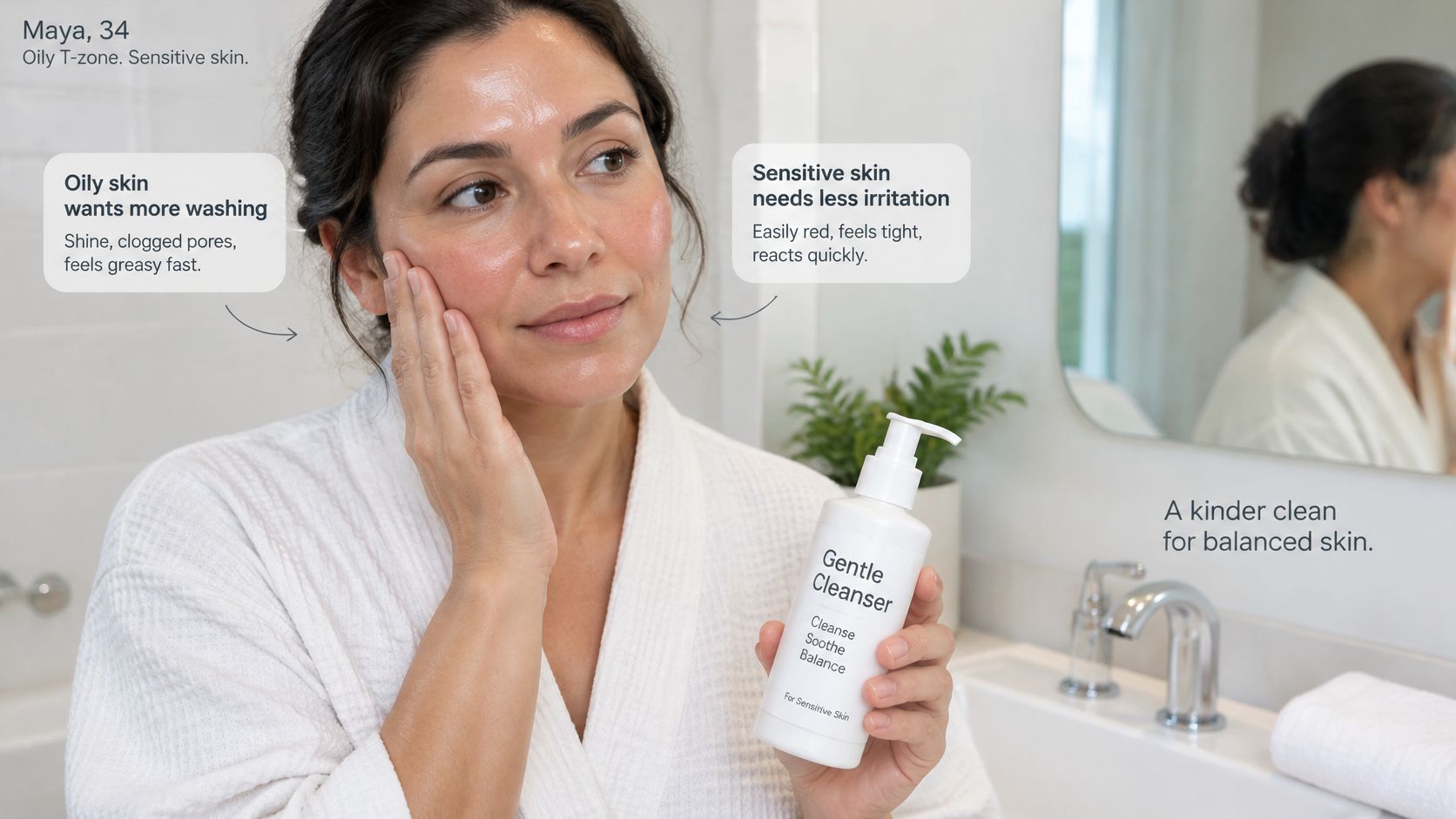
By two o'clock, Maya's face looks shiny again. She has already washed it three times, and now her toner stings. More washing may remove surface oil for a while, but it can also leave easily irritated skin less comfortable.
Oily skin can seem to call for frequent cleansing, while sensitive skin may react to repeated washing. Surface oil and comfortable hydration are different things. A shiny forehead does not mean your cheeks need another wash.
Why the squeaky finish matters
Cleansing agents loosen oil and residue, but an overly aggressive formula can also remove protective lipids and disturb surface proteins. A dermatology review of cleanser formulation explains why surfactant type, concentration, combinations, rinsability, and pH matter more than foam volume alone.
Sensitivity is widely self-reported, and questionnaire-based research on sensitive skin suggests many people describe their skin as sensitive. Such reports reflect personal assessments, not a universal test for choosing a cleanser.
At the sink: Treat shine as a signal to reassess your routine, not an automatic reason to wash again.
Aim to remove sebum, sunscreen, sweat, and daily residue without leaving your face uncomfortable once it dries. For more on the difference between effective cleansing and a stripped feeling, read this guide to what makes a cleanser gentle. Judge the result over time: notice how your skin feels about 30 minutes after washing, two hours later, and the next morning.
Gentle Ingredients Worth Looking For in a Cleanser
Use the ingredient panel as a checklist, not a vocabulary test. You're looking for a sensible combination of cleansing agents and comfort-supporting ingredients, rather than a single ingredient that promises to do everything.
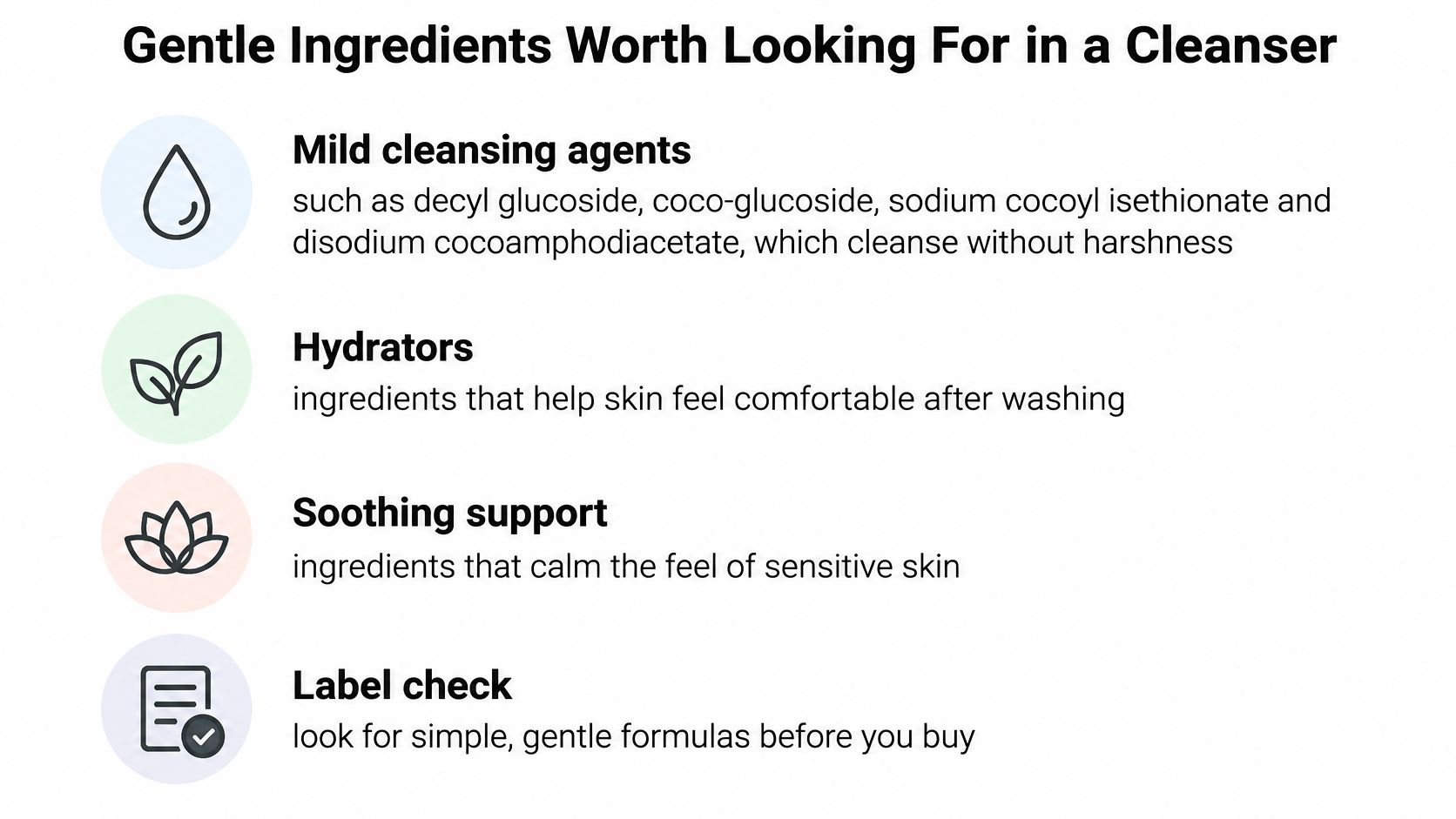
- Mild cleansing agents: Decyl glucoside, coco-glucoside, sodium cocoyl isethionate, and disodium cocoamphodiacetate are useful names to recognize. Their presence is a starting point, not a guarantee that the complete formula will suit you.
- Hydrators: Glycerin, sodium hyaluronate, and fresh aloe leaf juice are ingredients to look for when you want a comfortable finish.
- Barrier-supporting lipids: Ceramides, cholesterol, and fatty acids may be helpful components of a more cushioning formula.
- Soothing support: Panthenol and allantoin are reasonable checklist ingredients when comfort is your priority.
- Light oil-control support: Niacinamide is an optional consideration, not a requirement. Don't reject an otherwise comfortable cleanser because it lacks another active ingredient.
Read pH as context, not a promise
A review in the International Journal of Cosmetic Science supports approximately pH 5–6 as a reasonable formulation starting point, while explaining that pH 10 solutions can swell the outer skin layer and alter lipid properties. It also cautions that low-pH systems dominated by anionic surfactants can still be drying or irritating.
That means skin-like pH doesn't automatically equal gentle. The complete formula and your experience using it matter more than a number printed on the bottle.
If the first five ingredients appear to be only water and cleansing agents, keep reading before buying. That isn't an automatic rejection, but it's a reason to examine the rest of the formula rather than trusting the front label.
Our guide to ingredients for oily skin offers additional label-reading context. For botanical ingredients, sourcing transparency is another useful consideration, provided it isn't mistaken for proof of personal tolerance.
Ingredients to Avoid and Why Natural Labels Mislead
A cleanser can smell like a garden and still bother sensitive skin. Plant extracts and essential oils are active parts of a formula, not decorations, and a naturally derived scent may not suit every face.
A Practical Dermatology discussion of clean beauty points to a gap between reassuring marketing and the ingredient panel, including botanical fragrance ingredients in some products labeled fragrance-free. Read the full list, but don't assume every botanical is unsuitable.
Ingredients and claims to check in a sensitive oily-skin cleanser
| Ingredient or claim | Why it can be a problem | Who should be careful | What to check instead |
|---|---|---|---|
| Sodium lauryl sulfate, or SLS | A strong surfactant may leave skin feeling stripped or tight | Anyone who feels squeaky after washing | The complete surfactant system |
| Fragrance or parfum | Fragrance ingredients may provoke unwanted reactions | Readers who notice stinging with scented products | The fragrance-free claim and full ingredient panel |
| Essential oils such as lavender, citrus, or peppermint | Concentrated botanicals may irritate | Readers who react to naturally scented formulas | Whether essential oils are listed and how the product feels on skin |
| Denatured alcohol, including SD alcohol | It may contribute to dryness when prominent in the formula | Skin that already feels tight | Its position in the ingredient order |
| Ground nut shell or apricot kernel scrubs | Abrasive particles add friction | Easily unsettled skin | A smooth cleanser without grit |
| High-pH bar soap | Alkaline cleansing may stress the outer layer | Dry-feeling or reactive skin | Mild surfactants and available pH information |
| Deep-clean or squeaky-clean claims | They can make a stripped sensation sound like a goal | Anyone already washing frequently | A cleanser that rinses easily and leaves skin comfortable |
Separate a screening list from a guarantee
Choosing a cleanser involves more than checking for one ingredient category. Mesoderm RX's resource on gentle cleansing beyond the sulfate-free label offers a companion perspective on reading the full formula.
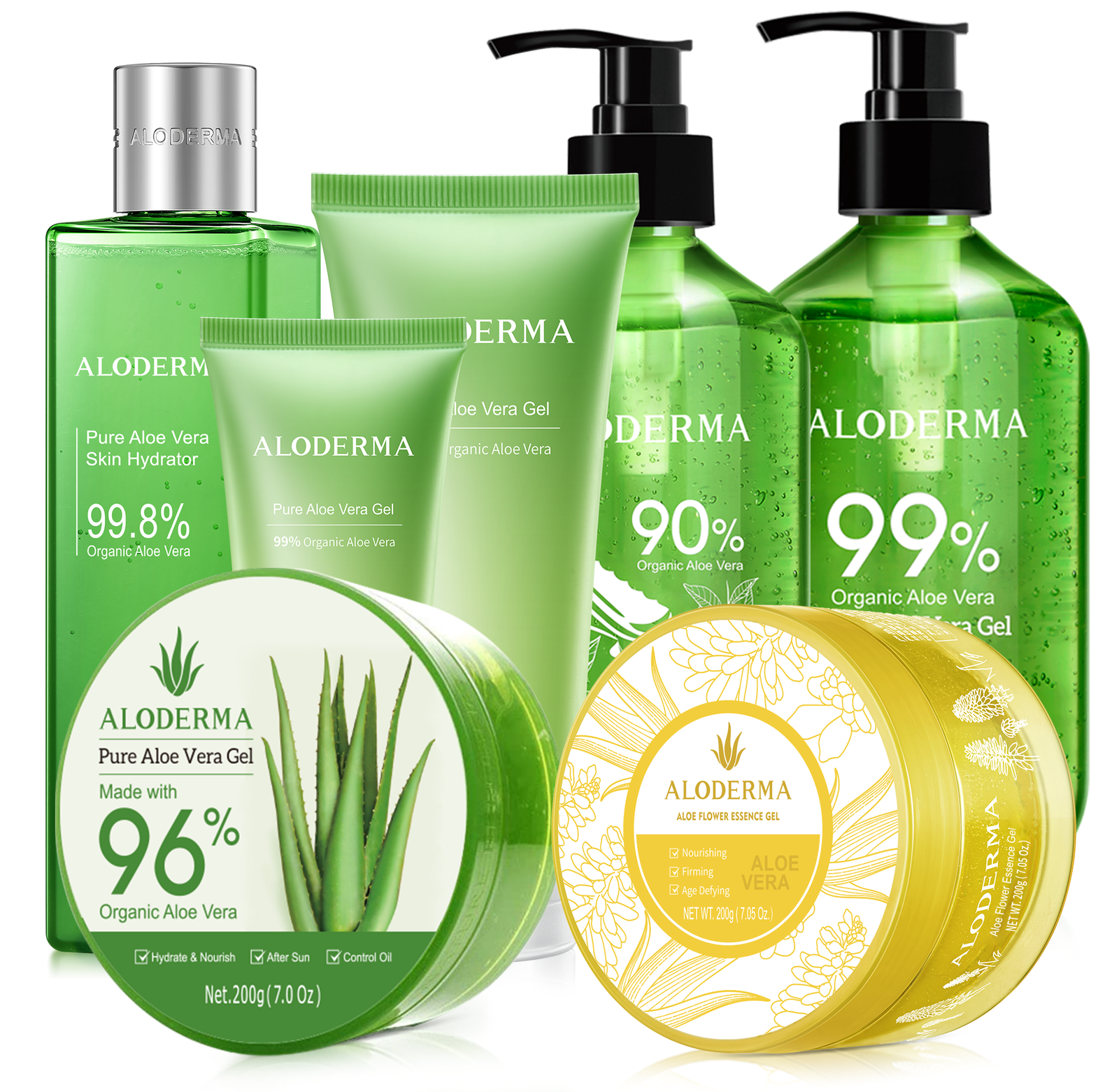
ALODERMA describes its line as cruelty-free and formulated without harsh additives. Compare each product's full ingredient panel with your own preferences, especially if you are cautious about fragrance or essential oils. A brand claim can help you screen, but it cannot establish that every remaining ingredient will suit your skin.
A brief sting isn't something to push through, and a cleanser label isn't a tool for self-diagnosis.
If discomfort fades quickly after rinsing, note what happened and pause the suspected product. Persistent redness, swelling, continued burning, or a reaction that worries you calls for professional advice rather than another round of experimentation.
A readable ingredient list is more useful than a long list of reassuring front-label claims.
Daily Cleansing Routine for Morning and Night
Gentle technique matters even when you've chosen a mild formula. You don't need to polish your face until it feels frictionless, and you shouldn't keep massaging just because bubbles remain.
Our cleanser directions use a morning-and-night rhythm: work the cleanser into a lather, massage onto damp face and neck, then rinse with warm water. Personal comfort still matters when deciding whether your morning routine needs cleanser or just a water rinse.
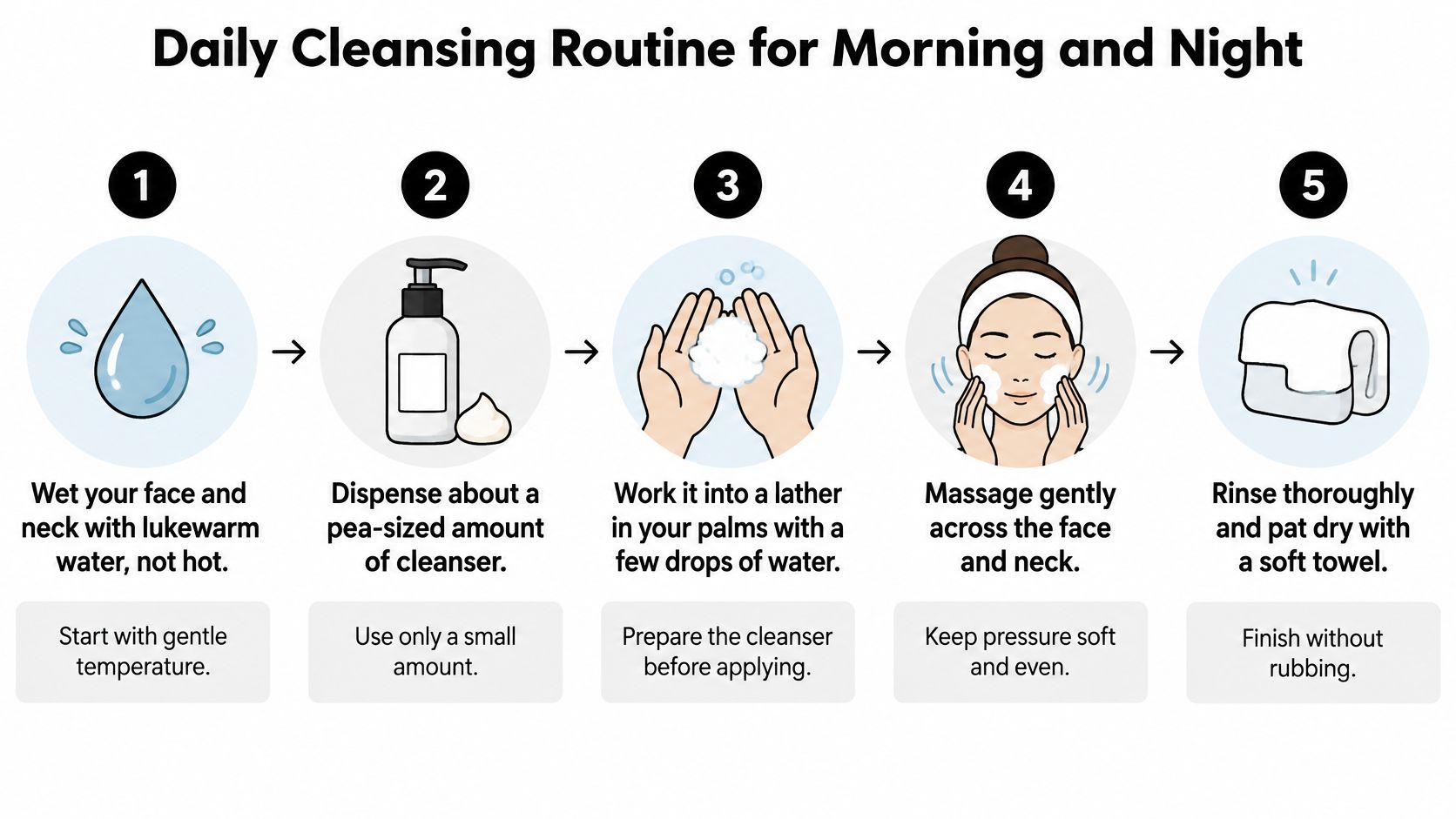
- Wet your face and neck with lukewarm water, not hot. Choose a temperature that feels comfortably warm rather than steamy.
- Dispense about a pea-sized amount as a starting point, adjusting for the product's directions and how readily it spreads. More cleanser isn't automatically more effective.
- Work it between your palms with a few drops of water. This helps distribute a lathering formula evenly before it reaches your face; don't force a non-foaming cleanser to produce bubbles.
- Massage softly across damp skin. Give the nose and forehead deliberate attention, but keep your fingertips moving without scrubbing or repeatedly working tender areas.
- Rinse thoroughly with comfortably warm water. Check the hairline, sides of the nose, and jaw for remaining cleanser rather than using heat to chase a squeaky finish.
- Pat dry with a clean, soft towel. Press and lift instead of rubbing back and forth.
- Apply your next hydrating product while your skin still feels slightly damp, when its directions allow. You don't need to wait until your face feels tight.
Match the rhythm to what needs removing
A morning wash can clear overnight oil and sweat. An evening wash has a different job: removing the day's sunscreen, makeup, and environmental residue.
Consider Daniel, a hypothetical reader aged 41, who rinses with water after his morning run and uses cleanser at night. He chooses that rhythm because adding another cleanser wash leaves his cheeks uncomfortable by lunchtime, not because morning cleansing is universally wrong.
If you wear substantial makeup or a tenacious sunscreen, an evening removal step may be useful. Don't automatically add a second cleanser when the first has already removed the residue comfortably.
Extra cleansing should answer a removal problem, not shine alone. If your forehead looks glossy while the rest of your face feels clean, blotting is a more restrained first response than starting the washing routine again.
Pairing Your Cleanser With Toner, Moisturizer and Sunscreen
After cleansing, add only the layers your skin needs. Toner is optional, and a hydrating gel may not provide enough moisture when your cheeks feel dry.
Products that pair with a sensitive oily-skin cleanser
| Product step | Role after cleansing | Good match | Avoid when |
|---|---|---|---|
| Toner or essence | Adds hydration and evens out the feel of the skin | Alcohol-free, fragrance-free toner | Skin stings after cleansing; pause it |
| Pure aloe vera gel | Light hydration on damp skin | Aloe-based gel designed for oily and sensitive skin; check its ingredient panel for aloe content and added ingredients | Skin needs a richer barrier layer in dry weather |
| Water-based gel moisturizer | Light moisture without a heavy finish | Oily skin that feels dry soon after washing | Heavy sweating makes the combined layers uncomfortable |
| Richer cream | Adds cushioning in dry conditions | Winter weather or air-conditioned offices | Humid conditions make it feel excessively heavy |
| Sunscreen | Completes the morning routine | A formula you can apply comfortably and consistently | Don't omit it just to reduce shine; reassess the layers underneath |
| Oil-based cleanser | Removes sunscreen and makeup before a water-based wash | Evening removal of substantial coverage | A light morning routine doesn't need a removal step |
Keep hydration light without making it inadequate
A pure aloe vera gel can offer a lightweight layer of hydration. Check the ingredient panel before buying to see how much aloe it contains and whether other ingredients suit your skin. A gel may not be enough on its own if your face feels dry.
A simple sequence is to cleanse, pat dry, then apply a thin layer of gel while your face is slightly damp. In the morning, let it settle before applying sunscreen, and follow the sunscreen's directions.
If your face feels greasy by midday, try simplifying an optional layer before replacing your whole routine. Keep the remaining combination unchanged for a week, as long as it stays comfortable. Leave sunscreen in place and adjust the toner, serum, gel, or cream beneath it. Change one product at a time so you can tell what affects the feel of your skin.
Troubleshooting Tightness, Shine and Stinging
Use your three observation points: 30 minutes after washing, two hours later, and the next morning. Notice comfort, visible redness, residue, and where shine appears, rather than giving the cleanser a single pass-or-fail score.
A glossy nose with comfortable cheeks is different from a glossy nose with burning cheeks. The first may just reflect your normal surface oil; the second calls for reducing irritation, not stronger oil removal.
Cleanser symptoms, likely causes and fixes
| Symptom | Likely cause | First fix to try |
|---|---|---|
| Tight, squeaky finish after washing | Cleansing system is too strong, water is too hot, or washing is too frequent | Try a milder gel or cream cleanser and lukewarm water |
| Stinging when toner or serum is applied | A fragranced or active leave-on product is poorly tolerated after washing | Pause optional actives and simplify to comfortable essentials |
| Shine returns within two hours | Normal sebum return; frequent washing may coexist with discomfort | Blot rather than adding another wash |
| Dry patches persist during your trial | Repeated lipid removal or insufficient moisturizing | Reduce cleansing stress and add a suitable moisturizer |
| Clogged feeling along the jaw | Residue or an overly heavy layer | Rinse carefully and simplify heavy leave-on products |
| Oil returns quickly despite a gentle cleanser | Normal oil return or uneven cleansing across the face | Distribute cleanser evenly over the T-zone without extending the wash indefinitely |
Fix discomfort before chasing a matte finish
These are working possibilities, not diagnoses. Oil returning quickly doesn't prove that you washed incorrectly, and it doesn't establish that your skin has increased oil production in response to cleansing.
If you want more context about protecting comfort, ProMD Health Bethesda offers a clinical guide to skin resilience. Use that background to simplify your routine, not to assign yourself a condition.
Priority check: Address stinging or tightness before trying to extend the time your forehead stays matte.
Gentle doesn't mean ineffective. A cleanser that removes the residue you need removed and leaves your face soft can be doing its job without dramatic foam or a cooling sensation.
There's no reliable universal timetable for discomfort to disappear. Don't assume that stinging must settle overnight or that dry patches should resolve by a particular day; pause the suspected cause and watch whether you're improving.
Persistent redness, burning that continues after stopping a product, swelling, or a reaction that concerns you needs qualified professional advice. A planned trial is never a reason to continue using something that hurts.
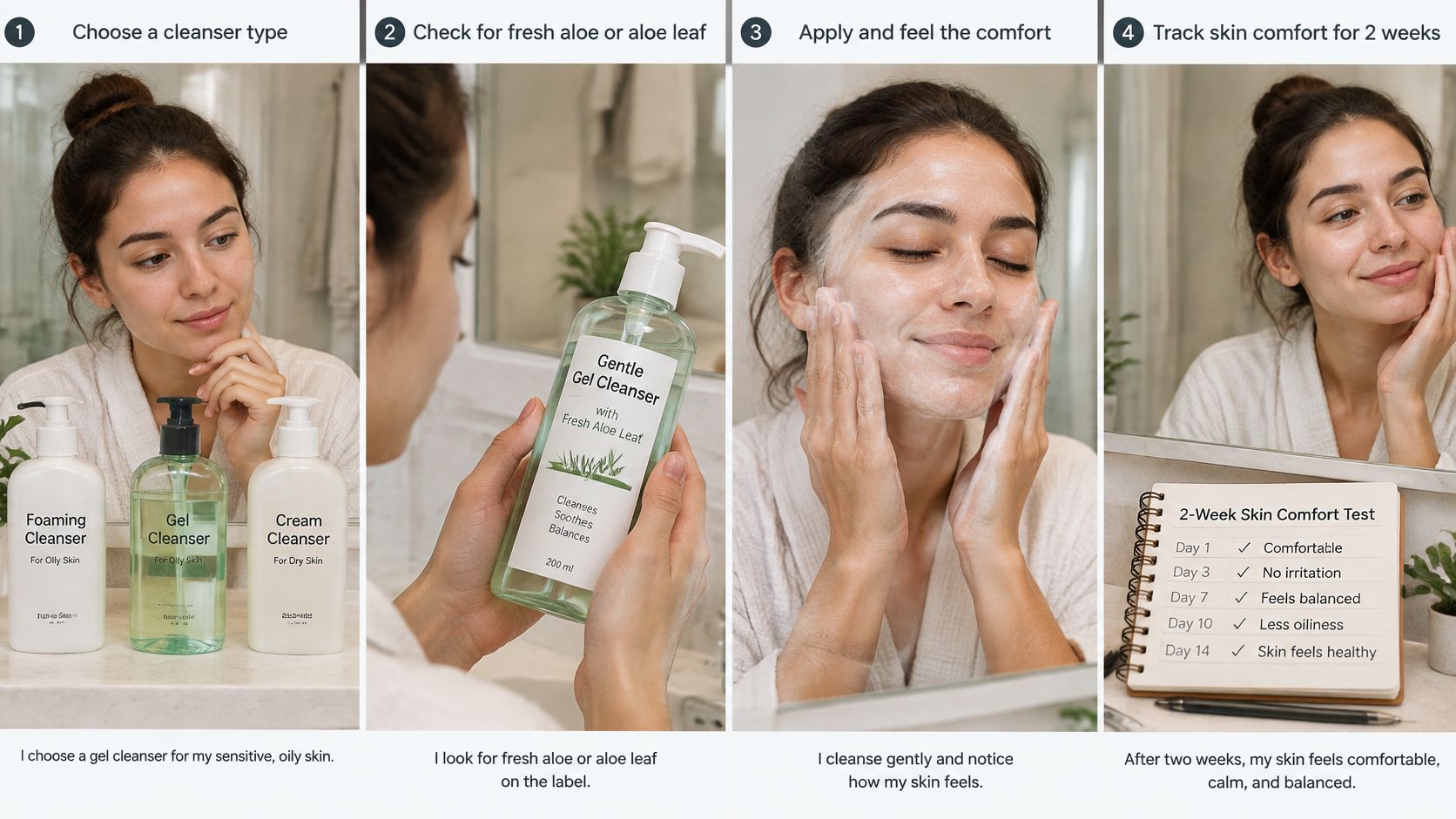
Choose Your Cleanser and Run a Two-Week Comfort Test
A cleanser may feel fine at the sink but leave your skin tight later. Judge your choice at three points: about 30 minutes after washing, two hours later, and the next morning. Note comfort and shine, and don't wash again just because oil returns.
Start by choosing a formula that suits both oiliness and comfort. A light gel or mild foam may suit an oily feel, while a creamier cleanser may feel more comfortable if washing leaves your skin tight. Check the full ingredient list rather than relying on a product name or a “natural” label.
Introduce the cleanser to a small area first. A cautious guide to patch testing skincare can help you make that first trial; it cannot guarantee you won't react later. During the first week, use the cleanser as directed only if it remains comfortable, and avoid adding other new products so you can make sense of changes.
In the second week, look for steady comfort, not a longer-lasting matte finish. Pause if stinging returns. A trial is never a reason to keep using a product that hurts.
What our sourcing standard tells you
ALODERMA grows its own organic aloe and processes it on-site within 12 hours of harvest. The brand describes its approach as farm-to-skin, with fresh organic aloe as a primary ingredient in its formulas. Freshness and organic sourcing can inform your choice, but your skin's comfort with the finished formula matters too.
Compare the cleanser details with your priorities
ALODERMA offers an Aloe Hydrating Cleanser containing fresh organic aloe juice, alongside the Aloe Oil Controlling Cleanser. The Oil Controlling Cleanser contains 76% fresh organic aloe vera and combines aloe with mint and witch hazel. It is used twice daily, morning and night.
ALODERMA's Skin Care Questionnaire offers personalized recommendations for your skin type. Use those recommendations alongside the ingredient panel and your comfort notes. If the cleanser feels comfortable at the sink, 30 minutes later, two hours later, and the next morning, that is more useful than a squeaky-clean sensation.
Visit ALODERMA to compare product ingredient panels and use the Skin Care Questionnaire. Choose gradually, track comfort, and treat returning shine as a signal to rebalance your routine rather than wash again.