





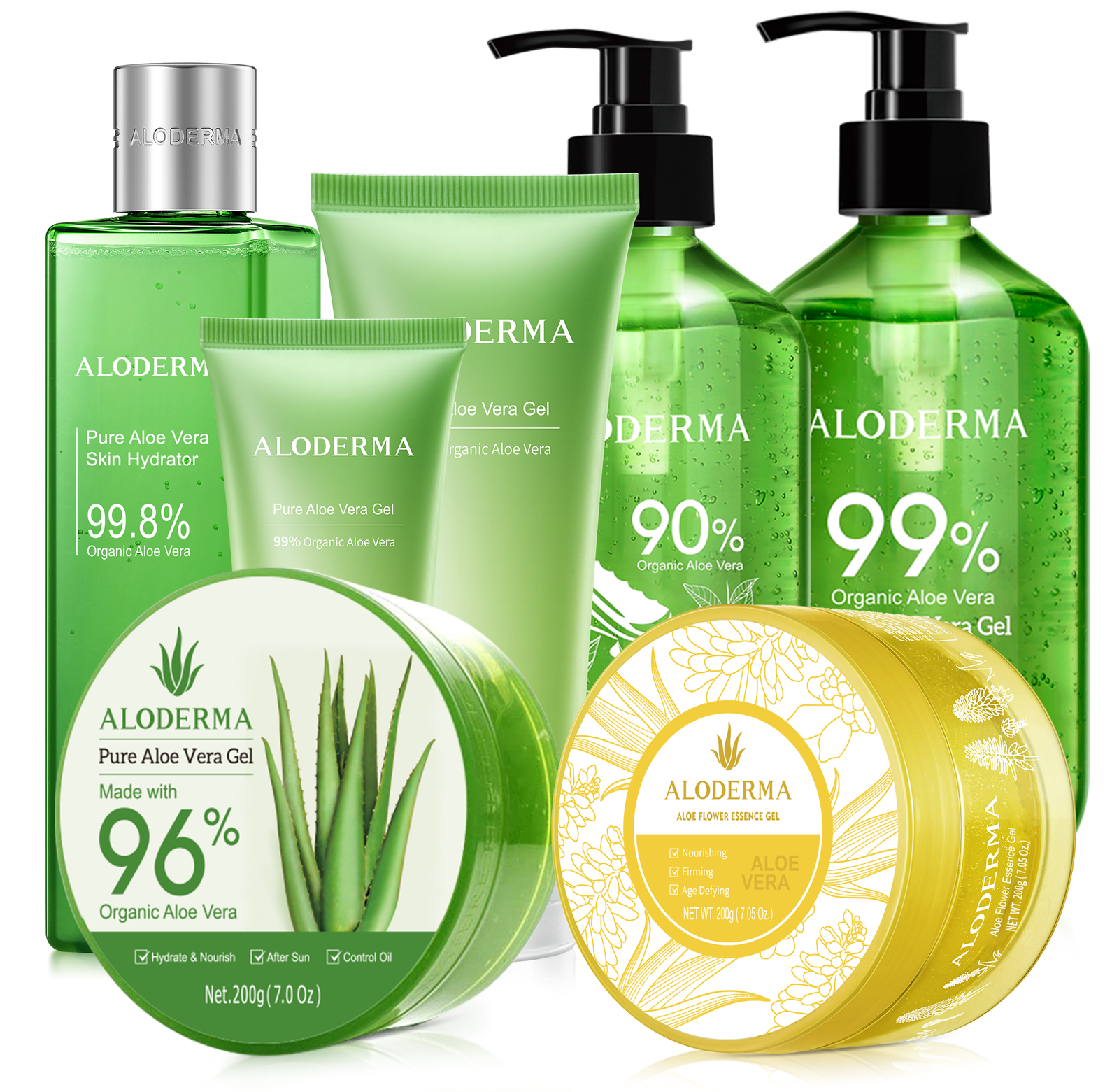


You're standing in a skincare aisle with a bottle turned toward the light, trying to decide whether “gentle,” “calming,” or “soothing” means anything beyond attractive packaging. The ingredient list looks long, your skin has reacted to products before, and you don't want another purchase that leaves your face tight, hot, or uncomfortable.
A simple sensitive skin toner should make that decision easier, not more confusing. The useful questions are straightforward: what does “simple” signal on a label, which ingredients support reactive skin, and how can you read past marketing language? There's also a fourth question worth asking before you buy anything: do you need a toner at all?
This guide approaches the choice like a formulator reading a recipe. You'll learn how to evaluate the bottle in your hand, compare it with products already on your bathroom shelf, and decide whether a fresh aloe-based formula or no toner fits your routine better.
Finding Your Way Through the Toner Aisle
Maya has already chosen a fragrance-free cleanser and a plain moisturizer. She reaches for a toner because her skin feels dry after washing, but every bottle makes a different promise. One says “balancing,” another says “clarifying,” and a third highlights botanical extracts without making the actual formula easy to understand.
The safest response isn't to choose the bottle with the softest wording. It's to ask what the product is built to do. A gentle toner should add water and comfort after cleansing, not create a new test of your skin's tolerance.
Start with the label, not the front panel
A useful formula usually has a clear job for each ingredient. Glycerin and hyaluronic acid help attract and hold water. Panthenol supports a softer, more comfortable feel. Aloe vera can provide a lightweight, cooling base when it's processed and preserved carefully.
Sensitive skin is a large audience, not a tiny niche. A 2020 meta-analysis summarized by dermatology sources found that self-reported sensitive skin reached 71% of adults overall, compared with 46% about two decades earlier, while another review also reported 71% of the general population experienced sensitivity to some degree. These estimates come from DermNet's sensitive skin overview, and they help explain why simple, low-irritant toners appeal to so many shoppers.
A toner shouldn't make you wonder whether your skin is “strong enough.” The formula should make its purpose easy to see.
That purpose may be hydration, a more comfortable post-cleanse feel, or a light layer before moisturizer. It doesn't have to exfoliate, tingle, smell strongly, or leave a squeaky finish to be useful.
Look beyond familiar branding
Brand recognition can help you find a product, but it can't replace ingredient literacy. A toner from an unfamiliar company may suit you better than a famous one if its formula is short, fragrance-free, and focused on humectants.
The facial cleansers and toners category is projected to grow from USD 34.29 billion in 2026 to USD 48.09 billion by 2031, with a projected 7.01% CAGR, according to Mordor Intelligence's facial cleansers and toners market forecast. The same forecast projects faster growth for sensitive-skin products, at 9.12% CAGR through 2031. More choices can be helpful, but they also make the back label more important than the promise on the front.
What Makes a Toner Simple and Sensitive-Skin Friendly
“Simple” doesn't mean that a toner contains only a handful of ingredients. It means the formula has a short, purposeful structure, and each component has a sensible role. Think of it as a recipe card. Water provides the base, humectants add hydration, soothing agents improve comfort, and the preservation system keeps the product safe during normal use.
If you can't explain why most of the main ingredients are there, the formula may be too busy for a reactive routine. You don't need a chemistry degree. You only need to recognize whether the bottle is built around hydration and barrier support or around strong sensory effects.
Read the first part of the ingredient list
Water-based toners often begin with water, aloe juice, or another aqueous base. Humectants such as glycerin and hyaluronic acid then help the skin hold onto water. Panthenol, beta-glucan, allantoin, or a modest amount of niacinamide may add a more comfortable finish.
A sensitive-skin-friendly formula generally avoids common triggers such as fragrance, dyes, drying alcohols, sulfates, and unnecessary exfoliating acids. A gentle balancing toner can be a useful comparison point when you want to see how another product presents a balancing role without assuming that every toner needs strong actives.
“Gentle” also doesn't mean inactive. A mild toner can still reduce the dry, tight feeling that follows cleansing and prepare slightly damp skin for moisturizer. The key difference is that it supports the routine instead of asking the skin to tolerate resurfacing, intense fragrance, or a deliberately sharp finish.
Use the ingredient self-test
Before buying, try this quick exercise:
- Name the base. Is it primarily water, aloe juice, or another lightweight liquid?
- Identify the hydrators. Look for glycerin, hyaluronic acid, panthenol, or similar humectants.
- Check the sensory extras. Ask whether fragrance, essential oils, alcohol, or strong acids are necessary for your goal.
- Find the preservation system. A water-based product needs protection against contamination, so “preservative-free” isn't automatically better.
- Decide what you expect. If you want comfort and hydration, don't choose a formula designed mainly for exfoliation.
For more label-reading context, see this guide to alcohol-free toners. The useful question isn't whether a product sounds clean. It's whether the complete formula matches what your skin can comfortably use.
Gentle Ingredients That Earn Their Place on the Label
Aloe vera deserves attention in a gentle toner because it can act as more than a decorative botanical. Aloe gel contains polysaccharides and has a naturally cooling feel, while a well-designed formula can use aloe as part of a light, water-rich base. That makes it a practical starting point for someone who wants comfort without a heavy cream texture.
The rest of the formula should support that role rather than compete with it.
What each useful ingredient contributes
Glycerin is a dependable humectant. It attracts water and helps the skin feel less dry after cleansing. It's not flashy, but it earns its place because a simple toner needs reliable hydration more than a long list of novelty extracts.
Hyaluronic acid is another humectant. It can help create a cushioned, hydrated feel, especially when you apply the toner to slightly damp skin and follow with moisturizer. If a hyaluronic formula feels tight, the issue may be the whole product or the lack of a moisturizing layer afterward, not the ingredient in isolation.
Panthenol, also known as provitamin B5, helps support a soft, comfortable skin feel. It fits well in a toner because it adds a barrier-supportive function without requiring an oily or dense texture.
Niacinamide can suit oily-but-sensitive users when the formula keeps the level modest. Dermatology coverage describes niacinamide as helping preserve barrier function and regulate oil production, making it a useful pairing with humectants when you want hydration without a heavy finish. A low-irritancy formula still matters, because even a familiar ingredient may not suit every person.
Build a short supporting cast
Allantoin and beta-glucan can contribute soothing, cushion, and comfort. Ceramides are skin-identical lipids that can support a barrier-focused routine, although they're more commonly associated with creams and emulsions than very watery toners.
Texture doesn't need to come from heavy oils or a thick silicone layer. A toner can feel smooth through humectants and lightweight conditioning ingredients, which may be preferable if your skin becomes shiny or congested easily.
Formulator's check: After application, your skin should feel hydrated and flexible. Tightness is feedback that the formula, amount, frequency, or follow-up moisturizer needs reconsideration.
The broader formulation principle is “less is more.” NBC News' sensitive-skin product coverage highlights fragrance, dyes, alcohol, and other potential irritants as ingredients shoppers may want to avoid, while also emphasizing gentle, supportive choices such as glycerin, aloe, hyaluronic acid, and panthenol. A well-chosen toner is still doing something. It's doing less to provoke the skin.
Triggers to Avoid and Why Freshness Matters
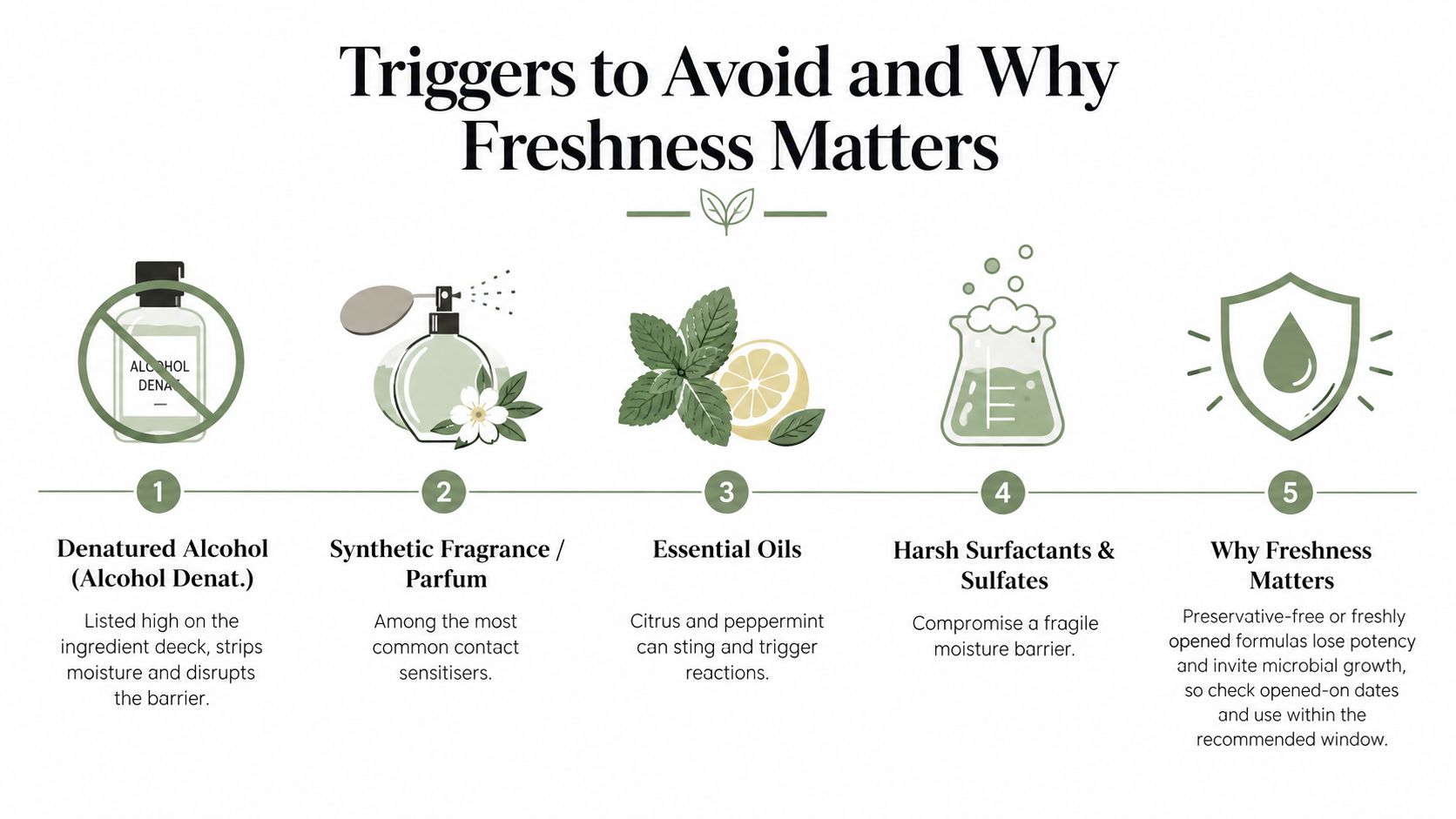
A bottle can look minimal and still contain ingredients that don't suit reactive skin. Start with the position of the ingredient, not only its name. Alcohol Denat. high on the list may create a fast-drying, weightless feel, but it can also strip moisture and make a fragile barrier feel tighter.
Fragrance and parfum deserve similar caution. Fragrance compounds are common contributors to contact hypersensitivity, and essential oils aren't automatically gentler because they come from plants. Citrus and peppermint oils may sting, while oxidized fragrance components such as linalool can become stronger sensitizers over time.
Apply the avoid list logically
Strong exfoliating acids can be useful for some routines, but a toner designed for daily comfort doesn't need to rely on a low-pH resurfacing effect. Alcohols, acids, and preservatives can contribute to irritant reactions, while preservatives such as methylisothiazolinone and fragrance components are more often associated with true allergic contact reactions. Curex's toner reaction guidance discusses this distinction and explains why “natural” essential-oil products aren't automatically safer.
Harsh surfactants and sulfates can compromise a delicate moisture barrier, particularly when a person is already cleansing too often. Preservatives, however, shouldn't be rejected as a category. Water-based skincare needs a preservation system, and a poorly protected product can become unsafe.
Fresh aloe changes the evaluation
The freshness question adds another layer that an avoid list can't answer. Aloe vera begins losing polysaccharide activity soon after harvest, so the time between harvest, processing, stabilization, and bottling can affect the character of the finished ingredient. A product may be fragrance-free and still feel underwhelming if its hero ingredient has been handled without attention to time and stability.
ALODERMA says it grows its own organic aloe vera, processes it, and manufactures products onsite within 12 hours of harvest, with the stated aim of preserving the aloe's naturally occurring active compounds. That farm-to-bottle control gives shoppers a concrete question to ask: how quickly did the primary ingredient move from leaf to finished formula?
Use the ALODERMA guide to how long aloe vera lasts to understand why storage, preservation, and opening dates matter. “Simple” should describe both the ingredient list and the handling process.
How to Use a Sensitive Skin Toner the Right Way
A gentle formula can still feel unpleasant if you apply it to dry, freshly scrubbed skin or layer it with too many new products. Start slowly and make the first use easy to interpret.
Follow a quiet introduction
- Patch test first. Apply a small amount behind the ear or along the jaw, then wait 48 hours before using it across the face.
- Cleanse gently. Use a mild, fragrance-free cleanser and rinse without hot water or vigorous rubbing.
- Pat skin damp. Leave the surface slightly moist, not dripping. This gives humectants water to work with.
- Dispense carefully. Pour toner into clean palms or onto a reusable cotton pad.
- Press, don't wipe. Press the product into the skin rather than sweeping back and forth. Finish with moisturizer.
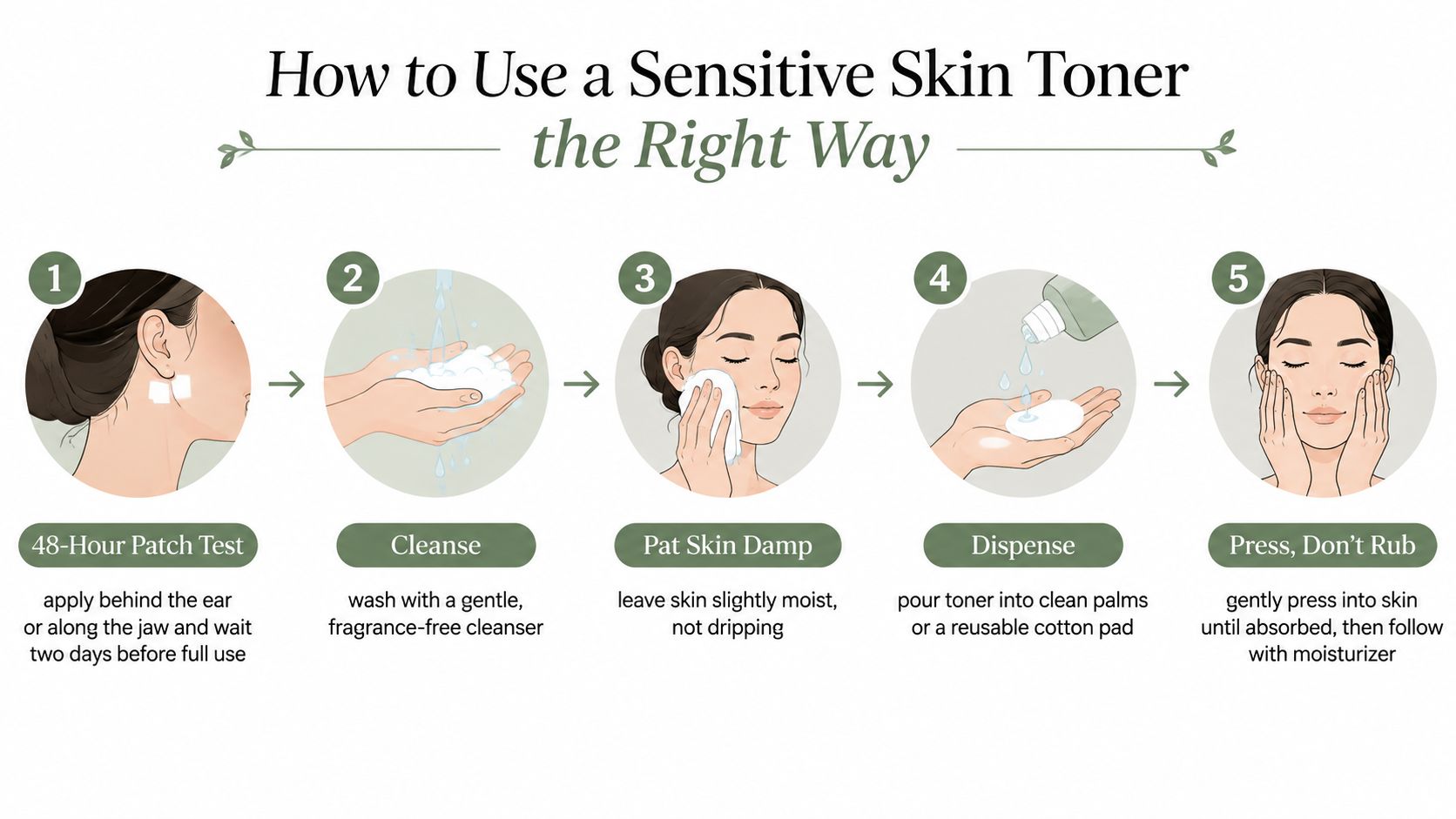
Toner belongs after cleansing and before serums or moisturizer. In the morning, complete the routine with sunscreen. The order is simple: cleanse, toner if you're using one, serum, moisturizer, then SPF.
Adjust for oily, reactive skin
Oily skin can still feel stripped. If you shine by midday but sting after washing, avoid responding with harsher acids or repeated cleansing. Choose a light humectant layer, use a modest amount, and avoid following immediately with several rich, occlusive steps if they make you uncomfortable.
A mild tingle can happen with a new product, but persistent burning, increasing redness, or swelling means you should stop. Don't try to “push through” a reaction in the hope that your skin will adapt.
Here's a short demonstration of gentle application:
Use the toner once daily or less often at first, preferably when you can observe your skin afterward. If the bottle tingles more each time, pause it and return to the cleanser-and-moisturizer basics. You can find additional application guidance in this aloe vera toner routine.
Do You Really Need a Toner
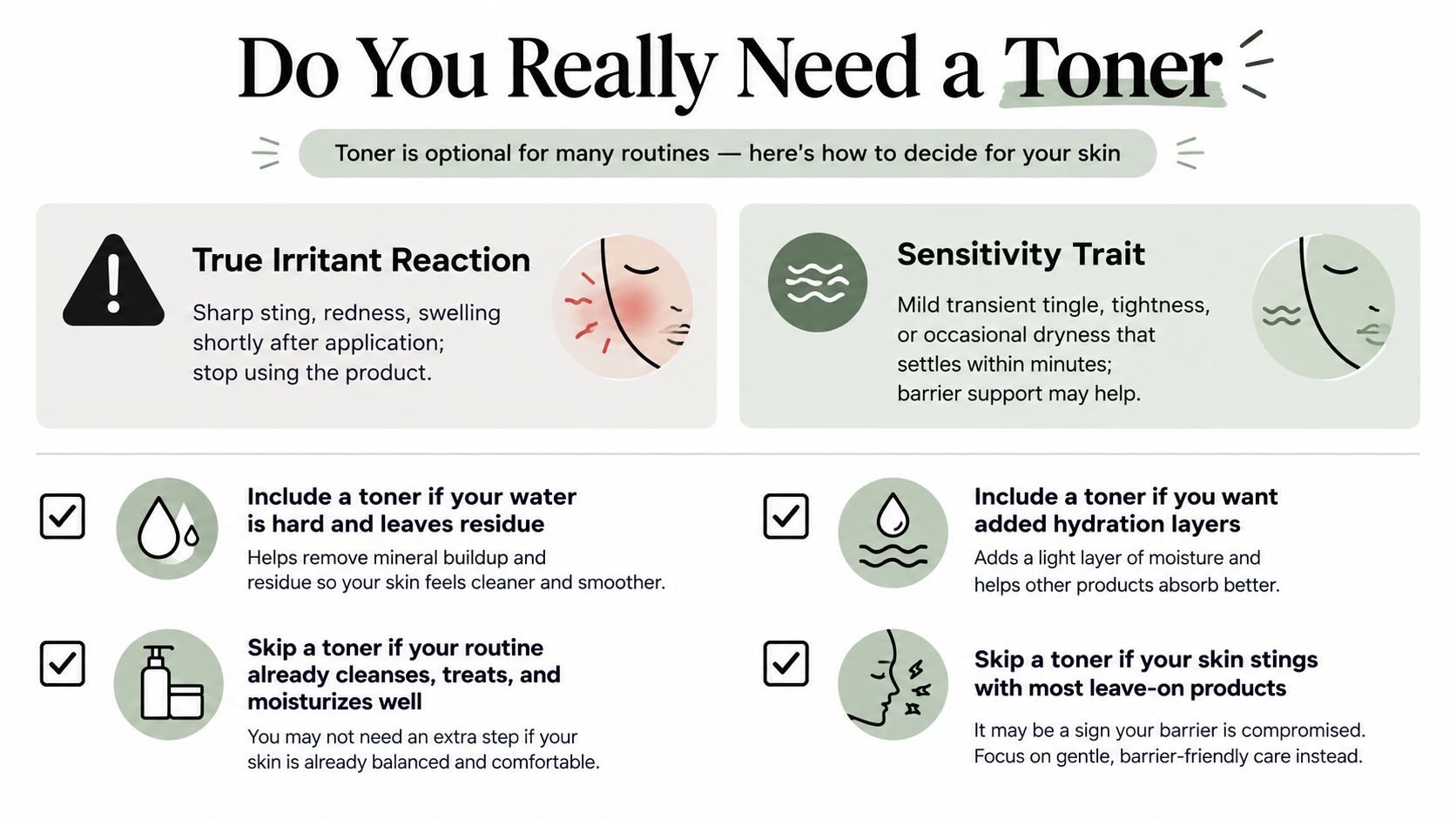
Toner is optional for many routines. If your cleanser leaves your skin comfortable and your moisturizer keeps it hydrated, adding another watery step may not improve anything. Skipping it isn't neglect. It's a valid way to keep a reactive routine small.
The useful distinction is between a product reaction and a general sign that your routine needs more support.
Separate discomfort types
A sharp sting, visible redness, or swelling shortly after application is a reason to stop the product. That pattern suggests the formula isn't suitable for you, whether the cause is irritation or an allergic response.
Tightness, dullness, or a dry feeling after cleansing may point to a routine that removes too much or doesn't replace enough water and moisture. A toner may help fill that gap, but changing the cleanser or moisturizer may be the more direct solution.
Use a practical decision rule
Keep a toner in your routine if you want an extra hydration layer, your water leaves a residue after cleansing, or your skin feels comfortable with a lightweight watery product. Leave it out if your routine already cleanses, treats, and moisturizes well, or if most leave-on products make your skin sting.
A mildly acidic toner is often positioned as barrier-friendly because it aligns more closely with the skin's naturally acidic surface. Derm-led toner coverage identifies pH 5.5 formulas as suitable for sensitive skin and connects low pH with better protection against future irritation in Allure's Korean toner guide. That doesn't make pH balancing a mandatory step after every cleanse.
If your current routine feels good, you don't need to create a problem for toner to solve. Revisit the option when weather, cleansing habits, or product changes leave your skin less comfortable.
Choosing a Toner You Can Trust
Ingredient quality starts before the ingredient list. With aloe-based products, sourcing and processing influence what reaches the bottle. An aloe leaf processed near harvest may retain a different character from an ingredient transported through several stages before formulation, although the final product still depends on stabilization, preservation, packaging, and testing.
Look for aloe near the beginning of the ingredient list if you want it to play a meaningful role. “Cold-pressed” or low-heat processing can be useful label information, but it shouldn't replace the complete formula review. Ask whether the company explains its processing method, verifies pH, and supports shelf-life claims with stability testing.
Use certification as one checkpoint
Natural and organic certification can clarify sourcing and processing standards, but it doesn't guarantee that a toner will suit every reactive person. Ecocert says COSMOS-certified natural and organic cosmetics average 99% ingredients of natural origin, as described in its COSMOS certification guidance. A published COSMOS standard also sets a minimum of 95% ingredients of natural origin for the total formula in certain certified products, according to Ecocert's standard information.
Those figures describe natural-origin content, not personal tolerability. You still need to check fragrance, essential oils, alcohol, acids, preservatives, packaging, and the patch-test plan.
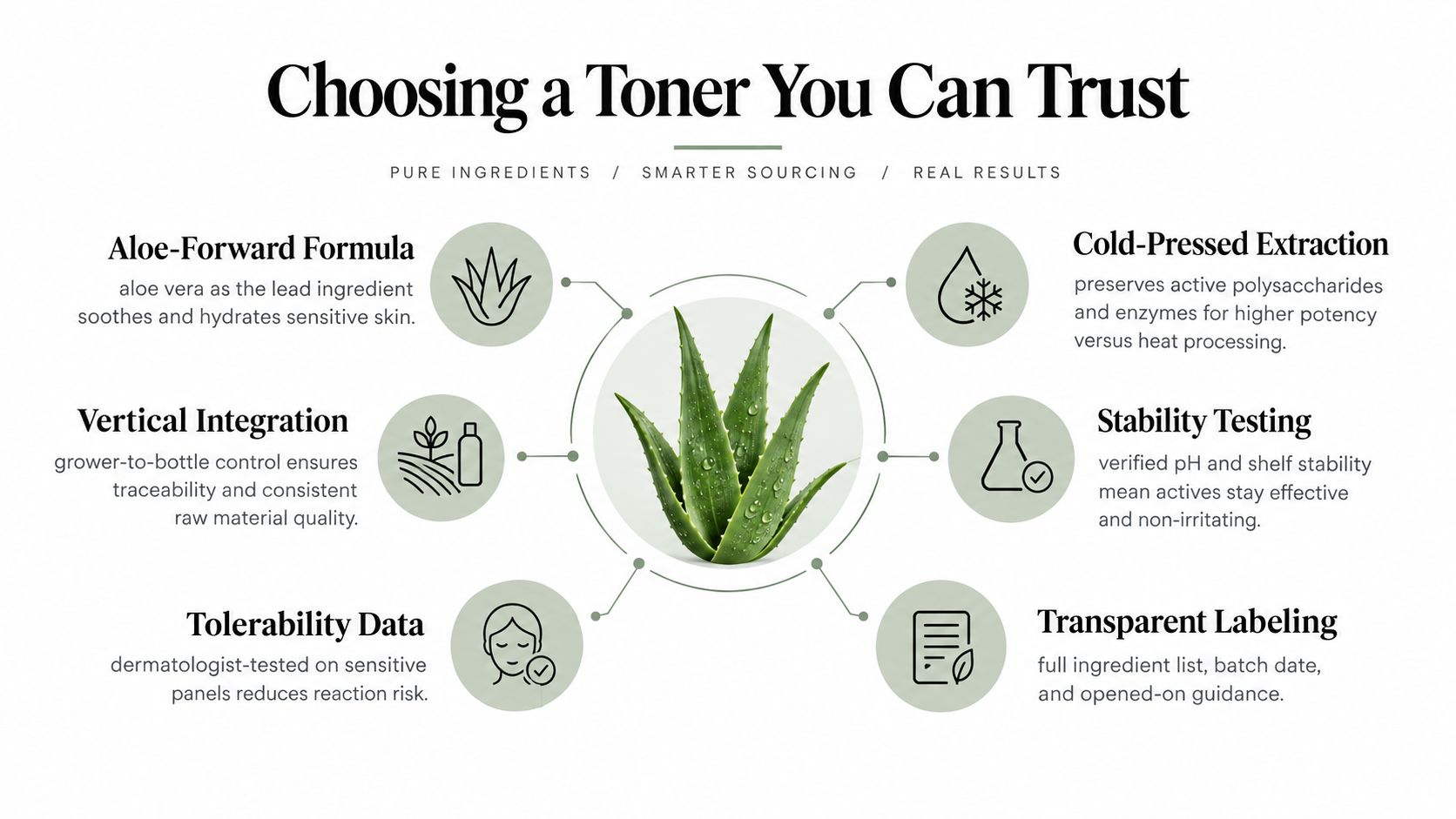
Keep a purchase checklist
- Aloe position: Check whether aloe appears early enough in the list to support the product's aloe-forward description.
- Processing story: Look for clear information about harvest, processing, stabilization, and manufacturing.
- Formula purpose: Favor humectants and soothing agents when your goal is hydration, not resurfacing.
- Trigger review: Scan for alcohol, parfum, essential oils, dyes, and strong acids.
- Packaging: Choose a container that limits unnecessary exposure to air, light, and repeated contact.
- Freshness guidance: Check batch information, opening guidance, storage instructions, and the recommended use window.
- Personal test: Patch test before full-face use, even when the label sounds reassuring.
ALODERMA offers aloe-based toners and other lightweight skincare products built around fresh organic aloe, including options positioned for sensitive skin. The company states that it controls cultivation, processing, and onsite manufacturing, which gives shoppers a specific sourcing detail to evaluate alongside the full ingredient list and their own skin response.
ALODERMA's fresh organic aloe approach gives you a practical starting point for a simple sensitive-skin routine, with toners and lightweight hydrators designed for comfortable daily use. Visit ALODERMA to review the Aloe Hydrating Toner and compare its ingredients, processing story, and routine fit before choosing your next step.