







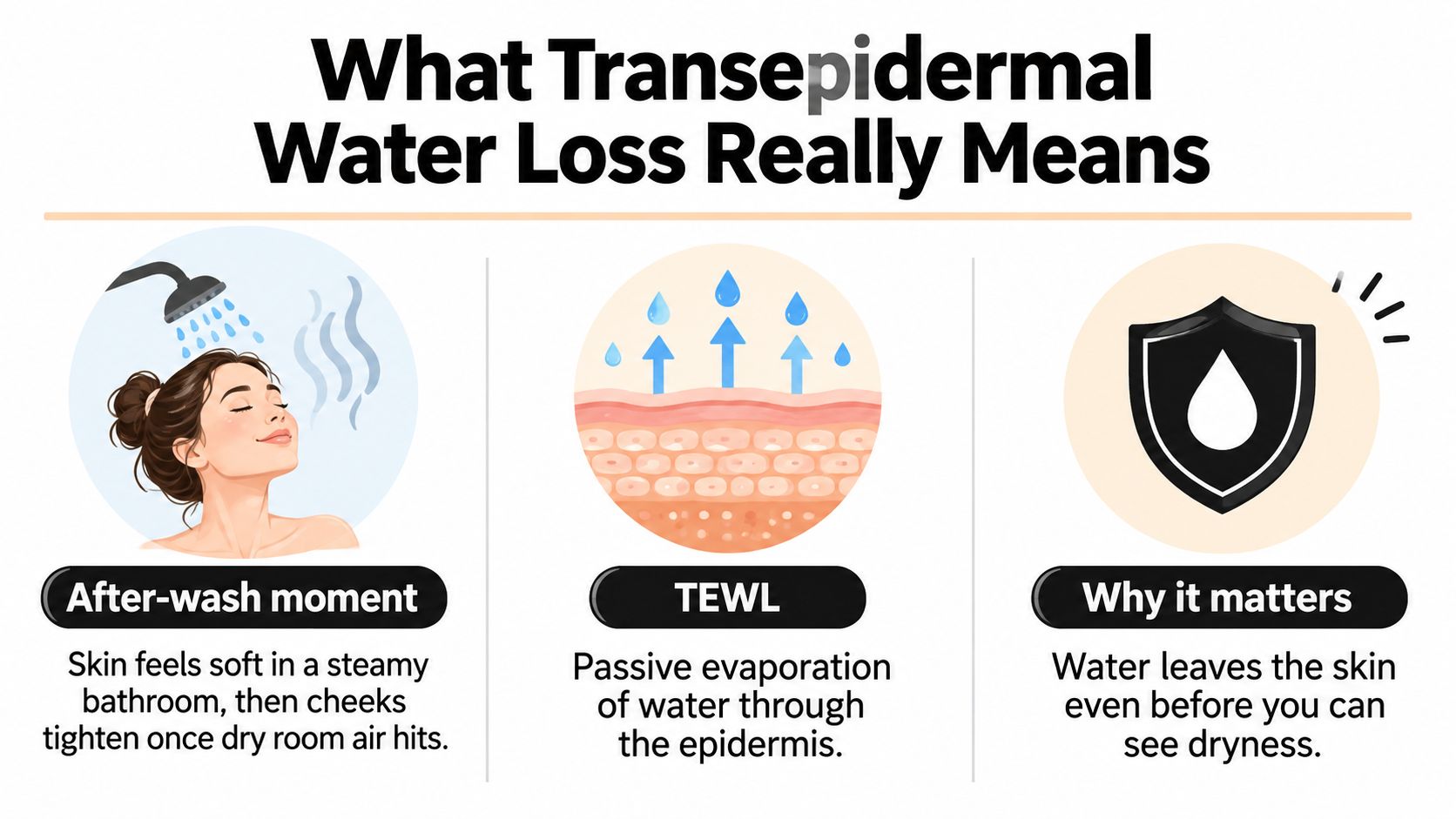
Transepidermal water loss is the passive drift of water vapor out through your epidermis into the air around you, and on healthy skin in ordinary indoor conditions it usually runs at about 4 to 10 g/m²/h. That water is leaving your body right now, through skin you can see, without a single visible bead of sweat.
You know the scene that follows. The shower is hot, the bathroom is foggy, and your skin feels soft and roomy. Then you step into a bedroom with the window cracked, or into an air-conditioned office at nine in the morning, and within twenty minutes your cheeks pull tight. Nothing looks different yet. Nothing is flaking. The mirror shows the same face. What changed is how fast water left your skin surface, and how freely your outer layer let it go.
Asked plainly, what is transepidermal water loss? It's the leak rate of your skin's own waterproofing, and it's the most useful number we have for talking about how well that waterproofing is holding.
What Transepidermal Water Loss Really Means
A tight-cheek moment after stepping into a dry room can start with a process you cannot see. Transepidermal water loss (TEWL) is water evaporating through the epidermis into the surrounding air. Devices measure it in grams of water lost per square meter of skin per hour (g/m²/h) by reading the water-vapor gradient above the skin. On healthy skin under ordinary ambient conditions, the typical range is about 4 to 10 g/m²/h, according to this review of TEWL as a barrier measure.
Across the whole body, passive water loss adds up over the day, even when no sweat is visible. That quiet, ongoing loss helps explain why a dry room can leave skin feeling less comfortable. A hydrating layer applied to slightly damp skin can help ease that feeling.
TEWL numbers worth remembering
| Situation | Typical value | What it suggests |
|---|---|---|
| Healthy skin, ordinary indoor conditions | About 4–10 g/m²/h | A working barrier with stable water loss |
| Whole body across a day, no visible sweat | Adds up over the day | Passive loss continues even when skin looks calm |
| Injured epidermis | Up to about 30 times the usual level | A sharp rise in permeability, not a new normal |
A lower, stable reading generally suggests the outer barrier is holding water well. A higher one suggests the surface has become more permeable. When the epidermis is injured, TEWL may reach as much as 30 times the usual level, the review reports.
Still, a reading is not a fixed personal score. TEWL varies by body area, and reported values in healthy adults range from very low on some skin sites to very high in the underarm. Compare readings from the same area under similar conditions and look at the trend, rather than judging the skin by one number.
How the Skin Barrier Holds Water In
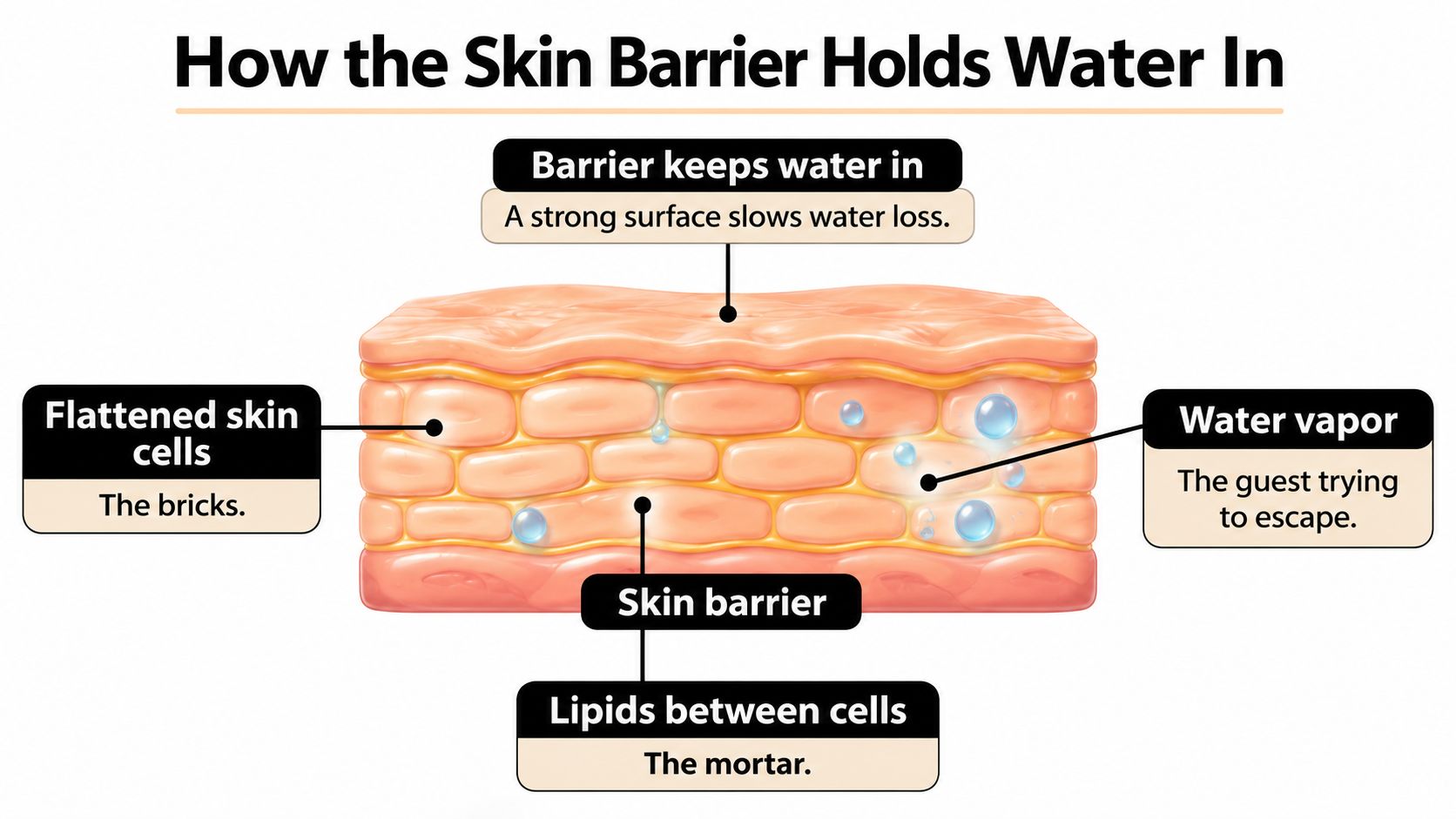
Picture the surface of your cheek as a brick wall. The bricks are flattened skin cells, packed and layered. Between them sits a mortar made of fats. Water vapor is the guest trying to slip out through the tiniest gaps in that wall, and the wall's job is to make those gaps as uninviting as possible.
When the mortar is even, loss stays quiet. You don't think about your skin at all. When hot water, towel friction, or a long day in dry air disturbs that arrangement, more vapor escapes and tightness arrives before the mirror shows anything. That lag is the part people miss. The feeling changes first, the appearance later.
Three kinds of water, one word for all of them
Most confusion about transepidermal water loss starts here. People use "moisture" for three different things happening at three different depths.
- Water deep in living tissue keeps cells working. You get it from drinking and eating, and no cream changes it.
- Water held in the outer layer is what you feel as plumpness. It's the water a moisturizer can influence in the short term.
- Vapor that has already left is the loss itself. Once it's in the air, no product brings it back.
Natural moisturizing factors act like tiny sponges inside the bricks themselves, which is why skin can feel beautifully cushioned after a watery aloe gel and still lose water quickly if nothing softens and supports the mortar afterward.
The practical rule: hydration is water currently in the outer layer. TEWL is the rate at which it's leaving. A comfortable face isn't proof of a sealed one.
Why a lab number isn't a beauty verdict
Devices read the vapor gradient immediately above the skin using open or closed chambers, so the figures describe the air next to your surface rather than your opinion of a cream's finish. If you want a real barrier check, it's whether water loss stays lower when the same spot is rechecked later, not how dewy you look thirty seconds after applying something.
For a fuller picture of how the surface renews itself and what supports it day to day, these tips from Bonna Beauty therapists on caring for reactive skin pair well with the barrier basics here. If your skin has been feeling fragile for weeks rather than hours, this guide to improving the skin barrier walks through the habits in order.
Why the Same Number Changes by Body Area
Healthy-adult TEWL by body site
| Body area | Reported TEWL | 95% confidence interval | How to read it |
|---|---|---|---|
| Breast skin, lowest reported site | 2.3 g/m²/h | 1.9–2.7 | A low site is not a target for the face |
| Axilla, highest reported site | 44.0 g/m²/h | 39.8–48.2 | A high reading can be normal for that site |
| Forehead, cheek, forearm, or underarm compared with each other | No shared normal | Site-specific | Use the same site and its own baseline |
Those extremes come from a systematic review of healthy adults that identified TEWL estimates for 86 anatomical areas across 212 studies, reporting its lowest value at 2.3 g/m²/h on breast skin and its highest at 44.0 g/m²/h in the axilla (British Journal of Dermatology). Two healthy sites, one body, a nineteen-fold difference.
Now take a Tuesday commute. Your cheeks feel tight the moment the train doors close, while your underarm doesn't feel dry at all. If you had a device in your bag and read both spots, the underarm would very likely out-score the cheek, and the cheek is the one bothering you. Numbers and feelings are answering different questions.
That's why an underarm figure is normal for that site, and pasting it onto your face as a target would invent a problem you don't have. Repeat the same spot instead, ideally the mid-cheek, once the room and your skin have settled, and compare it with its own earlier reading.
When a spot feels different from the day before, treat that as information about that spot. Not about the other eight areas of your body.
For sensitive, oily, or blemish-prone skin, that habit beats chasing the lowest figure anywhere on your body. Recent washing, the device type, air movement across the room and the exact square centimeter all shift the result, which is why a single home figure is a clue rather than a verdict.
One clarification worth saying out loud: these values come from clinical open-chamber or closed-chamber instruments reading the vapor gradient at the skin surface. Without one, you can't produce a comparable TEWL score at home, and any phone app or handheld gadget claiming to do so is giving you something softer than the published numbers. What you can do is observe the same cheek over time, in the same conditions, and track whether it's improving.
Water Loss Is Not the Same as Dry Skin
The most common shortcut in skincare writing goes like this: water is escaping, therefore your skin is dry. It sounds logical and it leads people to buy the wrong things. Water escaping is a rate. Dryness is a sensation, and sometimes a texture, and neither one is a diagnosis of a leaky barrier.
You can mist on a hydrating gel, feel a lovely cushion of water, and still be losing water quickly through an outer layer that hasn't been supported. Someone else can feel rough and tight in February with a barrier number that isn't unusual for their age and that site. The feeling and the number are related, but they're not the same instrument.
TEWL, hydration, and sweat
| Idea | What it actually tracks | Excluded or easy to confuse | Can feel and number disagree? |
|---|---|---|---|
| Transepidermal water loss | Passive water vapor through the stratum corneum | Sweat | Yes, skin can feel hydrated while TEWL stays high |
| Skin hydration | Water held in the stratum corneum | Vapor already lost to the air | Yes, a dewy feel is not a barrier score |
| Sweat | Active perspiration from heat, stress, or exercise | Passive TEWL | Yes, damp skin after a workout is not a TEWL result |
Run a Saturday morning for combination skin and you'll see the problem. Your nose looks shiny by eleven, your cheeks feel tight by noon, and neither clue on its own tells you what the barrier is doing. A review of TEWL as a barrier-function indicator makes the same point: transepidermal water loss is passive diffusion through the outer layer and excludes perspiration, while skin hydration measures water contained in that same layer (systematic review of TEWL methodology).
Then add measurement reality. Temperature, humidity, air movement, body site, recent washing, whatever cosmetics are still on the skin, and the instrument itself all move the reading. The same review reports in-vivo coefficients of variation ranging from 4.7% to 76.9%, a spread wide enough that one home reading should never be treated as a diagnosis or a universal cutoff.
Judge trends, not single readings. Same cheek, similar room, similar time of day, two weeks apart. That's the comparison that tells you something true.
This is also why I'd never tell you one ingredient will "stop" water loss. Nothing stops it, and a barrier that lost nothing at all couldn't renew itself properly. What you're aiming for is a gentler rate, held steady, on skin that stays comfortable. If the outer layer is doing most of the leaking, the products that help are the ones that rebuild what's missing rather than the ones that feel wettest on contact. This overview of products for dehydrated skin helps sort watery hydration from sealing support, which are two different jobs.
How Weather and Daily Habits Shift Readings
Follow one reader through a winter morning. She showers warm, steps out into a steamy bathroom, pats her face dry, and spends four minutes choosing a sweater. Then she walks into a cold bedroom, then a heated train, then an office with the air conditioning running in February. By the time she sits down, her cheeks feel papery. Nothing visible has changed.
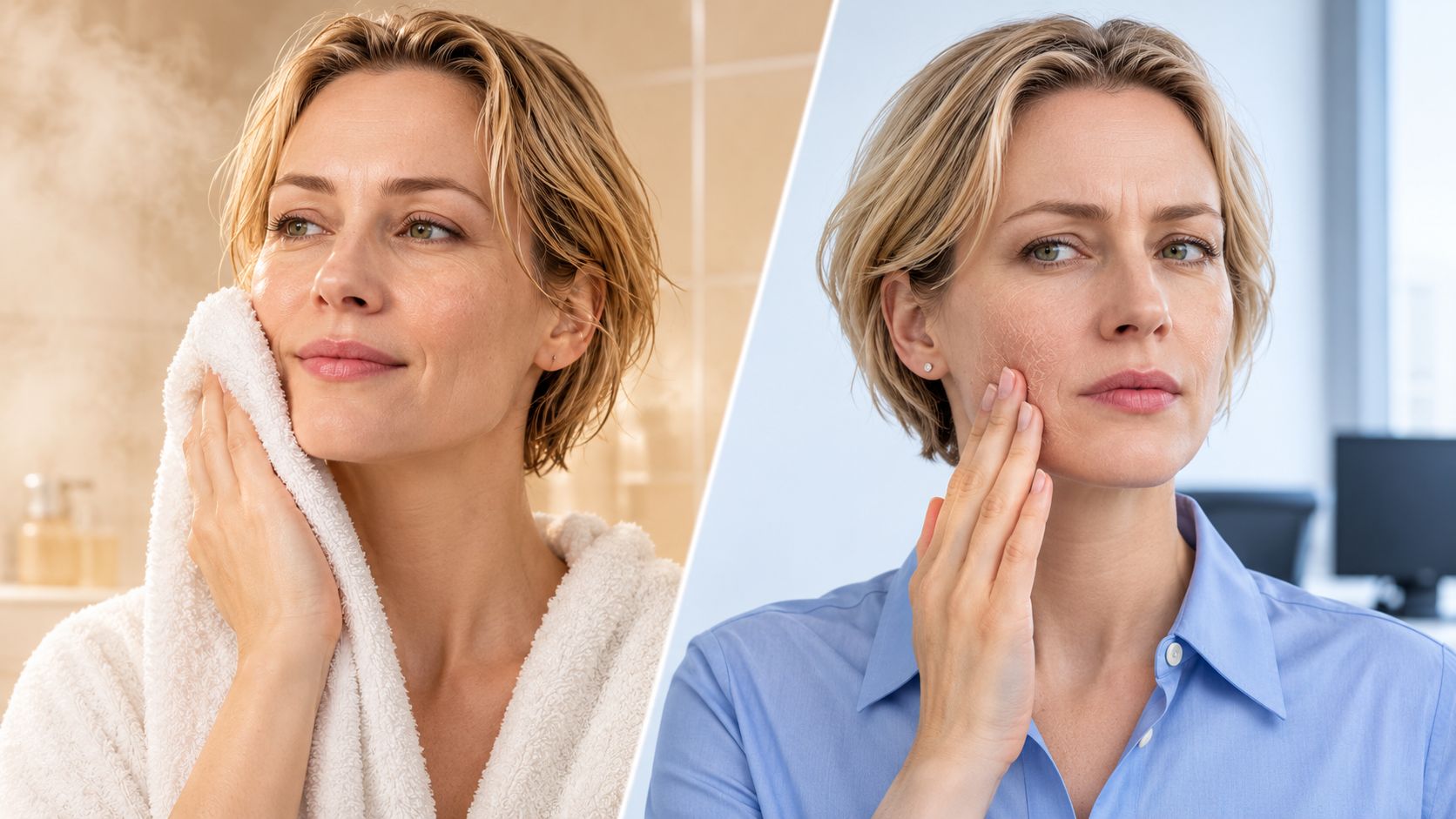
Temperature and humidity change how much water the outer layer holds, which is the mechanism behind that whole sequence. Experimental work reported that stratum-corneum water content increased by 50% when temperature rose from 20°C to 35°C at relative humidity below 60%, and that as humidity approached 90%, the temperature effect became nearly absent (British Journal of Dermatology experimental work). The same body of work reports that low humidity and low temperature reduce the water held in the outer layer, while TEWL tends to correlate positively with skin temperature.
Translated into your week: heated flats, long flights, and air-conditioned offices all increase the driving force for evaporation, so the same routine that felt fine in June feels thin in January.
Air quality adds another layer. A review of environmental influences reports increased TEWL in people exposed to particulate matter or nitrogen dioxide, plausibly through oxidative effects on the barrier's lipids and proteins, while finding inconsistent results for season and climate (review of environmental effects on TEWL). That inconsistency is worth sitting with: there is no single worldwide normal, and any advice claiming one is overselling. If your home sits on a busy road, improving home air quality is a barrier measure as much as a comfort measure.
Timing matters just as much as weather. A reading taken immediately after cleansing, exercise, or a hot shower will look worse because of the moment rather than because anything permanent has changed. Sweat sitting under a sensor confuses the measurement too. So let your skin and the room settle before you judge anything, record the exact site, and compare like with like. When the seasons turn and your cheeks start complaining early, this guidance on sensitive skin winter care covers the adjustments worth making first.
One last thing, said gently. Discomfort that persists for weeks, or that comes with cracking or stinging that doesn't settle, is a reason to speak to a qualified professional. It isn't a reason to diagnose yourself from a single bad afternoon.
A Gentle Routine That Slows Water Loss
Barrier stress shows up as discomfort before it shows up in the mirror. A clinical review describes TEWL as a measure of functional barrier status and explains that it rises in proportion to the level of barrier damage, with increases appearing after chemical exposure or physical disruption, sometimes before changes are visible (clinical review of TEWL in cosmetic testing). Repeated cleansing, towel friction and dry air all nudge that number upward.
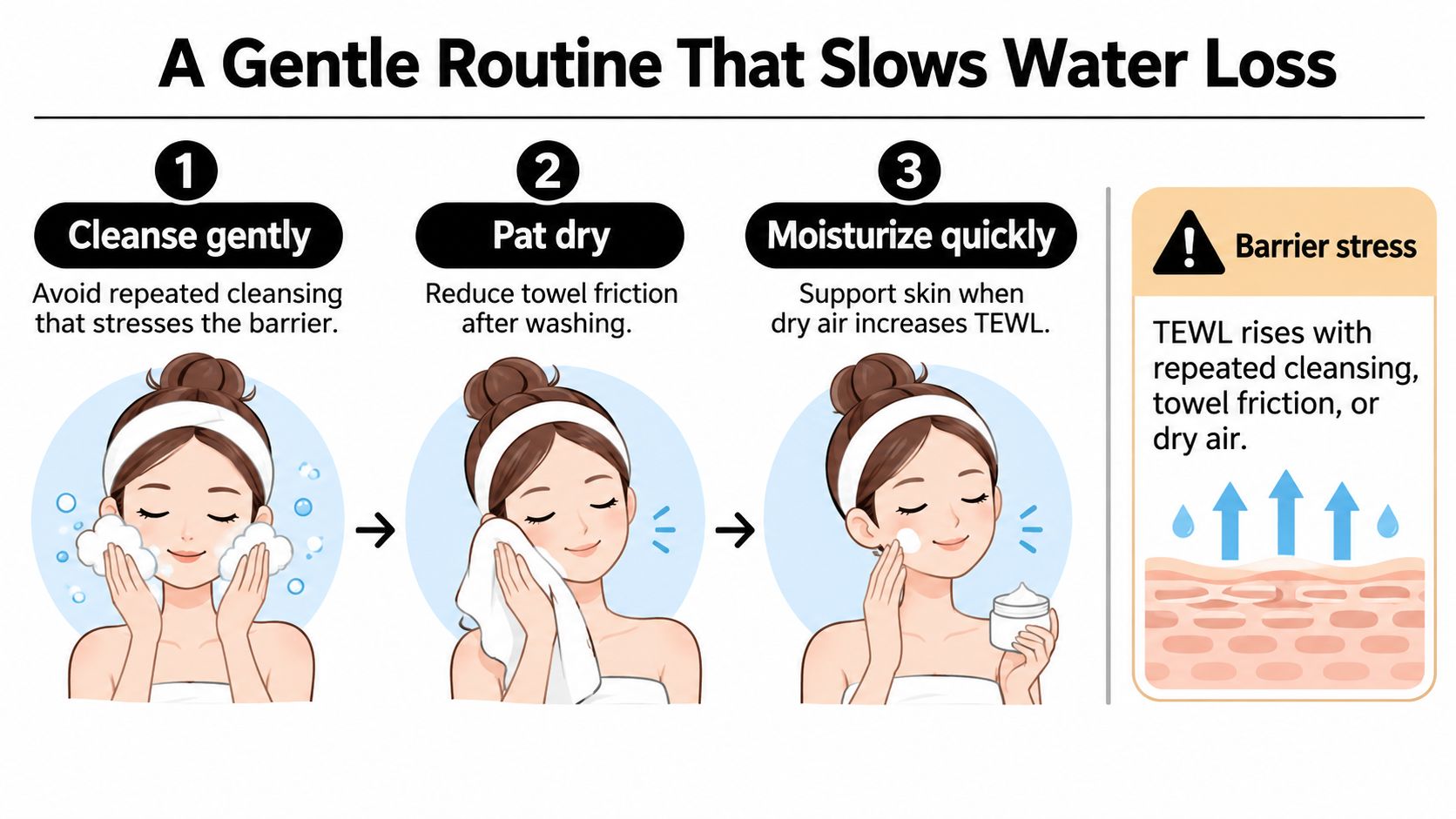
So build the routine around comfort that lasts, in this order.
- Cleanse with lukewarm water and keep it short. Long, hot showers strip the surface feel that makes skin comfortable, and the tightness arrives minutes later. Warm is enough.
- Pat dry instead of rubbing. A towel dragged across damp cheeks adds friction to a surface that's already vulnerable. Press and lift.
- Apply a watery hydrator within a few minutes, while skin is still damp. You're layering water under something rather than leaving a bare surface open to dry air.
- Seal with a lightweight moisturizer. On oily or blemish-prone skin, keep the layer thin across the T-zone and use a touch more only where cheeks feel tight. Skin that feels smothered gets washed more, which undoes the work.
- Add a cream over face and neck in very dry indoor air or at night. This is the step people skip in winter and then blame their cleanser for.
- Stop stacking strong leave-on products and stop scrubbing the same spot daily. Two exfoliating steps in one week on one cheek is the fastest way to keep a patch irritated.
- Recheck the same cheek at the same time of day for two weeks. Judge the trend, not the first cool sensation. A product that feels amazing for ten minutes tells you very little.
Why the last step matters most. Laboratories compare readings before and after a defined stress or product application precisely because softness is not a measurement. A worthwhile hydrator shows a sustained or repeated drop in water loss, and stays easy to tolerate the whole time.
If you want a second opinion on which textures suit thirsty, reactive skin, these skincare picks for dehydrated skin are a sensible cross-check against your own two-week notes. Keep the sequence, change one product at a time, and give each change long enough to show a pattern.
Choose Fresh Aloe Care for Your Barrier
A tight cheek after washing can make the next step feel like a small but important choice. ALODERMA makes skin care with fresh organic aloe vera, which is its formulas' primary ingredient. The brand sources aloe from its own plantations and processes it on-site within 12 hours of harvest.
For sensitive or easily reactive skin, a simple routine can include a pure aloe gel, a hydrating facial sheet mask, and a cream. Apply the gel to damp skin. The sheet mask is designed to restore the skin's protective barrier and reduce transepidermal water loss (TEWL). Use the cream over the face and neck twice daily, morning and night, when extra hydration or dry environmental conditions call for it.
Oily or blemish-prone skin may need a lighter touch: use a thin layer of gel across the T-zone and reserve cream for cheeks that feel tight. ALODERMA's Our Ingredients section explains what each component does. The Skin Care Questionnaire gives personalized recommendations for your skin type, and the website's Skin Care Quiz offers another way to explore options.
A single product cannot promise a measured change in TEWL. Readings shift with body site, weather, and timing, so compare trends under similar conditions rather than relying on one number or one product. A routine that feels comfortable enough to repeat may be easier to maintain.
For a simple starting point, try gel on damp skin, use the sheet mask when your skin needs extra care, and apply cream where it feels tight. Visit ALODERMA to take the Skin Care Questionnaire and explore products suited to your skin type.