







You're at the sink at 10:40 p.m., and your face still has the whole day on it: a water-resistant sunscreen you were told to wear daily, a tinted moisturizer, maybe a second layer of both. Somewhere in your saved posts is a routine promising that oil first and foam second will solve everything. Meanwhile your skin stung this morning when you applied moisturizer, which makes a two-step plan feel less like self-care and more like a gamble.
Here's the reframe that makes the decision simpler. Double cleansing isn't a membership you join or a habit you owe your skin. It's a tool you pick up on the nights it's needed, for residue a single mild cleanser can't shift. Once you can read what's sitting on your face, the routine stops being a rule and becomes a choice, and a quick one at that.
This guide treats double cleansing for sensitive skin as a decision with three parts. What's on your face tonight. Which texture removes it. And a stop rule that overrides both, no matter what the rest of your routine says. Start with the table, not the shopping cart.
When Double Cleansing Makes Sense for Sensitive Skin
Habit has outrun need. In a 2024 YouGov survey of U.S. adults, 19% of women said they used facial cleanser multiple times per day and 24% used it once per day, while 23% of women named skin sensitivity as a concern. Washing twice, twice a day, has become the default script, even for the readers whose skin is most likely to object to it.
For sensitive skin, that default makes no sense. Double cleansing earns its place as a conditional, evening-only move for heavy residue. A second pass adds value only when the first one left something behind; on a bare or lightly covered face, it spends barrier lipids your skin will want back tomorrow morning. Read the residue first, then decide how many steps it deserves.
Decide tonight's cleansing steps by residue
| Tonight's residue | What it means | First cleanse | Second cleanse |
|---|---|---|---|
| Water-resistant sunscreen or long-wear makeup | Needs oil-soluble lifting | Cleansing balm or oil, 20–30 seconds | Gentle water-based cleanser, 15–20 seconds |
| Light tinted moisturizer or powder | Moderate residue | Micellar water or cleansing milk | Mild gel cleanser only if skin still feels filmy |
| Only moisturizer or nothing | Minimal residue | None | One gentle cleanser |
| Skin stings, feels tight, or looks flushed before washing | Barrier feels stressed | Skip the first step | Short single cleanse with lukewarm water |
| Heavy workout or humid day with sweat and grime | Water-soluble residue | None | One gentle cleanser; repeat only if residue remains |
| Makeup removed earlier with wipes | Leftover film possible | Cleansing milk or micellar water | Mild cleanser only if no tight feeling |
The stop rule that overrides the routine
Stop rule: if your skin already stings, feels tight, or looks flushed before you touch a cleanser, the first step is off the table tonight. Shorten the single cleanse, use lukewarm water, and moisturize while your skin is still slightly damp.
That rule outranks the table, and it outranks any product you have already paid for. A double cleanse should finish with skin that feels soft and pliable, with a little slip left under your fingers, the way hair feels after conditioner has been rinsed well. If your face squeaks, you have removed more than the day's residue; the squeak is a sensation, not a standard of cleanliness.
Two cleanses belong to the evenings that earn them. On the nights they don't, one gentle pass is the whole routine.
Choosing Textures That Respect Sensitive Skin
Texture decides more than technique does. A rich balm on a moisturizer-only night adds friction and rinse time for little benefit. A gel aimed at water-resistant sunscreen makes you scrub at a film that will not shift. The logic fits in one sentence: first-step textures lift oil-soluble sunscreen and makeup, while second-step textures remove sweat and water-soluble film. That division of labor lets two gentle steps replace one aggressive wash. Keep the massage brief, use a small amount of the second cleanser, and stop before skin feels tight. Texture is a decision you make from tonight's residue, not a two-step ritual you perform by default.
Cleanser textures compared for sensitive skin
| Texture | Best for | How to use | Skip if |
|---|---|---|---|
| Cleansing balm | Dry, thickened textures and full-coverage makeup | Massage onto dry skin for 20–30 seconds, emulsify with lukewarm water, rinse | Skin feels tight after the first step |
| Cleansing oil | Water-resistant sunscreen and long-wear makeup | Apply to dry skin, keep fingers gliding, add water to emulsify, rinse thoroughly | The slip feels uncomfortable or you need a one-minute routine |
| Micellar water | Low-friction makeup removal on reactive days | Saturate a soft pad, hold for 5–10 seconds, wipe once, then rinse | You leave it on without rinsing and feel a film |
| Cleasing milk or lotion | Dry, easily irritated skin and light makeup | Massage onto damp or dry skin, tissue off or rinse, then use a water-based second step | You need to dissolve water-resistant formulas |
| Gel or foaming cleanser | Second step for most sensitive skin | Lather a pea-size amount in damp hands for 15–20 seconds, then rinse | The foam feels stripping or the formula is strongly fragranced |
| Cream cleanser | Morning single cleanse or dry winter skin | Massage onto damp skin, rinse or tissue off | You need to remove heavy sunscreen or long-wear makeup |
How each texture feels on reactive skin
Balms cushion dry, thickened textures and full-coverage makeup, but they feel heavy on a humid night. They work like a soft cloth for products that cling, provided you emulsify and rinse well. Cleansing oil has more slip for water-resistant sunscreen and long-wear makeup, yet that same slip can feel uncomfortable if your skin dislikes an oily film. Micellar water is the lowest-friction option for a face that is already unhappy, and it still needs a rinse if you can feel a film afterward. Cleansing milk suits dry, easily irritated skin, though it will not dissolve a water-resistant formula. Gel and foam earn their place in step two, once step one has done the heavy lifting. If your skin leans red, inflamed, or easily irritated, the best gentle cleanser for sensitive skin can help narrow the second-step choice.
What to leave on the shelf
Fragrance, strong essential oils, and gritty exfoliants are the three things to skip on a reactive evening. Fragrance contributes nothing to cleaning and is a common reason a cleanser stings within seconds of contact. Strong essential oils can turn a short wash into a lingering source of irritation. Grit adds friction on top of surfactant exposure, which is the opposite of what a stressed face needs. A cleanser should glide, rinse clean, and leave skin comfortable enough to skip scrubbing. If you want to test a milk and a balm without committing to full bottles, free skincare samples to test let you judge texture on your own skin first.
Run one simple test before you settle on a texture. Rinse, pat dry, and wait 60 seconds before reaching for moisturizer. If your face feels tight or prickly in that minute, the texture or the contact time was too aggressive. Drop to a cream cleanser, or shave ten seconds off the massage. The aim is skin that still feels soft and pliable after cleansing, because tightness is a sign to simplify rather than a sign to work harder.
The Gentle Two Step Routine for Reactive Skin
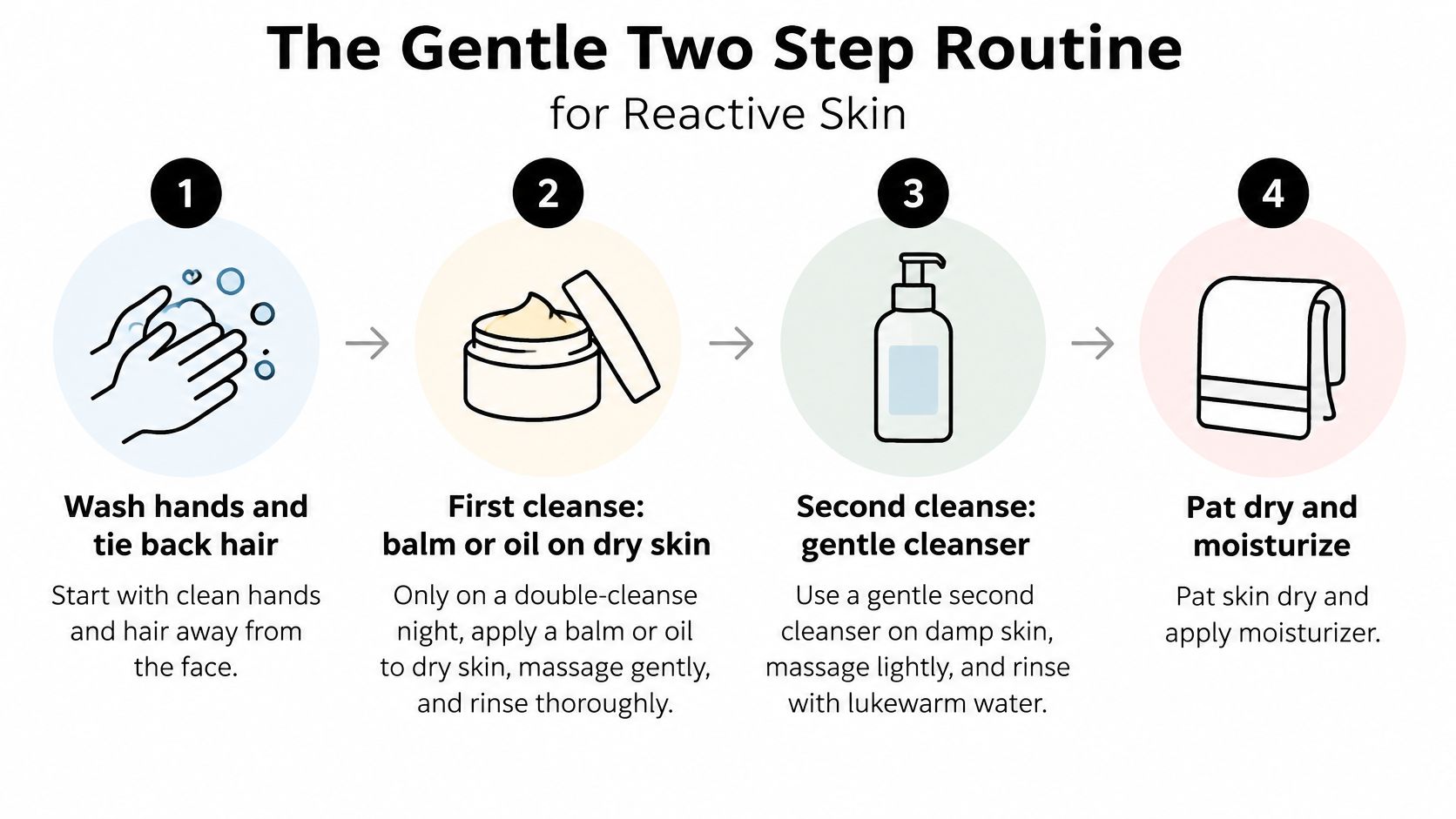
A routine only helps if you can repeat it calmly at the sink, half awake, without checking your phone. Here is the sequence in the order you'll do it.
At the sink, in order
- Wash your hands and tie back your hair. Clean hands stop you from moving dirt back onto your face, and hair out of the way keeps you from scrubbing at the hairline to reach it.
- Use the first cleanser only on a double-cleanse night. Apply a balm or oil to dry skin with your fingertips for 20 to 30 seconds. Dry skin matters here, because water dilutes the oil before it can dissolve sunscreen. No washcloth, no vigorous rubbing.
- Emulsify, then rinse. Add a splash of lukewarm water and keep gliding until the oil turns milky, then rinse until the film is gone. Most leftover residue blamed on the second cleanser is first-step oil that was never rinsed properly.
- Measure a pea-size amount of mild water-based cleanser. Lather it in damp hands and massage for 15 to 20 seconds. Short contact time matters more than lather volume, because it's the time on skin, not the foam, that drives how much you strip.
- Rinse with lukewarm, not hot, water. Include the hairline and along the jaw, where sunscreen collects and where a quick rinse usually misses.
- Pat dry with a clean towel. Rubbing with a towel adds the friction you just spent two steps avoiding.
- Apply a gentle hydrator within a minute, while your skin is still slightly damp, so you seal in water rather than losing it.
Friction, heat, and lingering surfactant do more damage than foam level ever will. A three-week trial that enrolled 153 people with sensitive skin found a gentle foaming cleanser formulated with hydrophobically modified polymers was as well tolerated as a benchmark nonfoaming cleanser, with itching, irritation, and flaking improving from baseline in both groups, according to the published trial results. Texture should follow comfort, not the belief that foam equals clean.
Foam is a texture preference. It has never been a measure of how clean your skin is.
Stop or scale back if burning, tightness, persistent redness, or scaling appears. Double cleansing is unnecessary on any night the first cleanser isn't needed, and skipping it costs you nothing.
How Often to Double Cleanse Without Overwashing
Frequency is a decision you make from what is on your skin that day. Double cleansing is a nighttime strategy for days with water-resistant sunscreen, long-wear makeup, or substantial oil-based buildup, not a twice-daily habit. Think of it as a residue table you consult before you reach for a second cleanser. A week rarely looks the same from one night to the next, so map it before you decide anything is or isn't working.
A weekly double-cleansing rhythm by lifestyle
| Week pattern | First-step nights | Routine | Notes |
|---|---|---|---|
| Indoor work, no makeup, light moisturizer | Rare or none | One gentle cleanse at night | Skip the first step entirely |
| Daily mineral sunscreen, no makeup | Only if the sunscreen is water-resistant | One gentle cleanse; add the oil-first step only for water-resistant formulas | Confirm the water-resistant claim on the bottle before adding the oil step |
| Daily foundation or long-wear SPF | Most evenings | Oil-first step, then mild water-based cleanser | Keep each pass short |
| Cold, dry climate | Makeup nights only | One cleanse most nights | Reduce if flaking appears |
| Humid climate with heavy sunscreen | Most evenings | Oil-first step, then a short second cleanse | Rinse thoroughly |
| Reactive week with visible redness | None | One short, lukewarm cleanse | Pause double cleansing until skin settles |
Say Maya wears a tinted moisturizer three days a week and nothing on the other four. She double cleanses on those three evenings and uses one gentle cleanse the rest of the week, which means her skin gets a break more often than it gets a second step. That break matters. Sensitive skin can react to repeated contact, friction, and heat even when every product is gentle.
Mornings are simpler than most routines suggest. One brief cleanse covers nearly everyone, and some readers do fine with a lukewarm water rinse alone. Nothing water-resistant builds up overnight, so a morning oil step has nothing to dissolve. A cleanser used morning and night should be mild enough to leave skin comfortable, not squeaky. If you want help setting that baseline, this guide on how often to wash your face walks through the same weekly logic.
The adjustment most guides skip
When the rest of your face already feels clean, use the second cleanser only where buildup collects: the hairline, along the jaw, and around the nose. You get the thoroughness you wanted without treating the whole face to a second round of surfactant.
A stop rule overrides the table. If skin feels tight, stings, looks red, or starts flaking, drop the first step for several nights and return to one gentle cleanse. Double cleansing works best as a targeted response, not a badge of diligence.
ALODERMA formulas contain at least 64% fresh organic aloe vera and are made without concentrate or powder, which matters when a cleanser is the product touching your face twice a day. Aloe keeps the focus on comfort while you decide how much cleansing the day calls for.
Troubleshooting Tightness Stinging and Redness
The most common complaint isn't redness. It's the squeak, that tight, polished feeling people mistake for proof the routine worked. Tightness shows up within seconds of rinsing and tells you the second cleanser removed more than the day's residue.
Symptom, cause and fix for a harsh cleansing routine
| What you notice | Likely cause | Fix tonight | Next week |
|---|---|---|---|
| Squeaky, tight finish | Second cleanser too strong or left too long | Rinse 10 seconds sooner and moisturize immediately | Use a cream cleanser as step two |
| Stinging within seconds | Fragrance, a strong essential oil, or water that is too hot | Rinse with lukewarm water and stop the routine | Patch test a new first cleanser |
| Redness after the first step | Too much rubbing or a washcloth | Use fingertips only and no cloth | Switch to milk or micellar water |
| Flaking next morning | Barrier stress from repeated cleansing | Skip the first step for three nights | Cut double cleansing to once a week |
| Residue still visible after two steps | First cleanser was not emulsified | Add water, massage 10 seconds more, and rinse | Choose a balm for waterproof formulas |
| New clogged pores along the jaw | Cleanser residue left behind | Rinse the hairline and jaw carefully | Choose a rinseable oil and review ingredients |
A 2024 four-week study of 85 people with clinically diagnosed sensitive skin found no significant increase in investigator-graded irritation, with significant reductions in stinging, itching, burning, tightness, and overall sensitivity at weeks 2 and 4, as reported in the PubMed record. That's the benchmark: a routine should reduce sensation, not provoke it.
Three things stay off your shelf during a reactive stretch. No scrubs, no cleansing brushes, and no leave-on exfoliating acids or strong retinoids layered onto a face that's already complaining. Don't introduce a new first cleanser and a new second cleanser on the same night either, because you'll never learn which one your skin rejected. If you're testing anything new, learn how to patch test skincare properly first.
Two-product rule: change one variable at a time and give it seven to ten days before you judge it. Two changes at once teach you nothing.
If stinging, tightness, or redness persists through a two-week test, pause the routine and speak with a qualified professional before trying more products.
Your Next Step for a Calmer Cleansing Routine
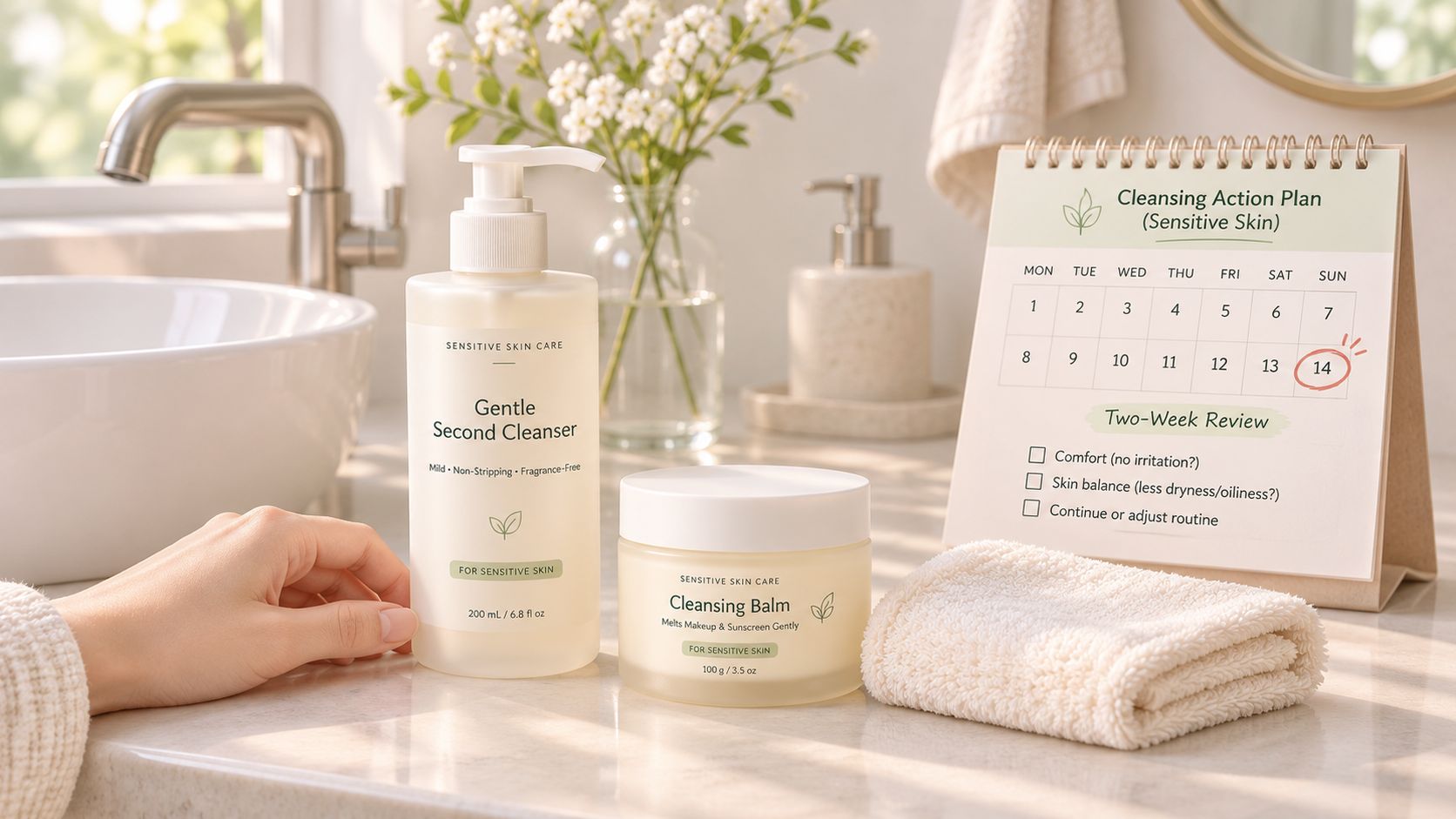
You don't need a new routine. You need three decisions and a calendar note: one gentle second cleanser, one first-step texture for heavy-residue nights, and a two-week review date. Start with a single cleanse on low-residue evenings and add the first step only when sunscreen or makeup calls for it.
For the second step, the Aloe Hydrating Cleanser contains fresh organic aloe juice, which makes it a workable option for the short contact stage. If you'd rather not build a lineup from scratch, the Pure Aloe Soothing Set bundles three pieces, the Aloe Hydrating Cleanser, the Aloe Soothing & Moisturizing Cream, and Aloe Hydrating Facial Sheet Masks. Not sure which collection suits you? Our Skin Care Questionnaire gives personalized recommendations for your specific skin type.
There's a freshness reason to look closer at the labels. ALODERMA is a fully vertically integrated aloe vera company: we grow all of our own organic aloe vera and process it and manufacture onsite within 12 hours of harvest, so the primary ingredient in every product is the most bioactive and effective aloe vera possible. That traceability is worth checking ingredient by ingredient on each product page before you buy.
One sentence to take to the sink tonight: if the routine leaves your skin comfortable, keep it, and if it leaves your skin tight, remove a step.
ALODERMA makes gentle, aloe-first skincare for exactly the reader this guide describes, from the Aloe Hydrating Cleanser used as a brief second step to the three-piece Pure Aloe Soothing Set for a simpler calming lineup. Every formula is built around fresh organic aloe grown on our own farms and processed within 12 hours of harvest, so the primary ingredient stays as bioactive as possible. Visit ALODERMA to read the ingredient list on each product page and let the texture and aloe content tell you whether it belongs on your shelf.