








Wash your face twice a day, once after waking and once before bed, plus after heavy sweating. If your skin is dry or sensitive, one full cleanse a day is often enough.
Extra washes don't buy extra cleanliness. They add cleanser, water, and rubbing, and that stack is what leaves cheeks tight by Thursday. How often to wash face should follow what touched your skin and how it feels afterward. A helmet workout, a full face of long-wear makeup, and a bare face at a desk are three different days. Treat them that way, and keep the evening cleanse as the one you don't skip.
How Often to Wash Face for Your Skin and Routine
Wash twice on a normal day, morning and night, and add a rinse or cleanse after heavy sweating. If your skin runs dry or sensitive, use cleanser once, at night, and rinse with water in the morning.
Find your row and start there this week.
| Skin type or situation | Recommended frequency | Why it works |
|---|---|---|
| Normal to oily skin | Twice daily, morning and night | Clears overnight oil and daytime dirt |
| Oily or blemish-prone skin | Twice daily, plus after sweating | Keeps excess oil from building up |
| Dry or sensitive skin | Once daily at night, water rinse in the morning | Limits stripping and friction |
| After a workout or heavy sweat | Rinse or cleanse within an hour | Removes sweat and salt before they sit on the skin |
| Makeup or water-resistant sunscreen | Once at night, cleanse thoroughly | Removes products that water alone cannot lift |
| Hot, humid or dusty day outdoors | Extra midday rinse with water | Removes sweat and particles without a full second cleanse |
Three notes under the table
Sweat doesn't wait until bedtime. Rinse within an hour of training. If a helmet or hat held sweat against your skin, rinse again when you take it off. Salt and fabric sit in the same places every session, and a later wash doesn't undo that contact.
Makeup and water-resistant sunscreen need a real cleanse, not a splash. Cleveland Clinic describes double cleansing as an oil-based cleanser first, to loosen makeup, sunscreen, and sebum residue, then a water-based cleanser for sweat and dirt. Massage the oil cleanser, rinse with lukewarm water, keep the skin damp, apply the second cleanser, rinse, and pat dry. That second step is for residue. A bare face does not need it. One thorough wash with a gentle cleanser is enough for most nights.
A dusty, humid afternoon is a water rinse, not a third full cleanse. Splash lukewarm water, pat dry, and leave cleanser for morning and night. You remove particles without another round of surfactant.
Say Jordan runs after work in a bike helmet. He rinses at the gym within the hour, skips a second cleanser because he wore no sunscreen that afternoon, and does one full cleanse at home before bed. That schedule matches the sweat row and the evening row without stacking washes.
Oily skin still shouldn't chase every shine with soap. A steady morning and night cleanse, plus the post-sweat rinse, is the pattern in our oily skin care routine.
Practical rule: The table is a starting point. Check how your skin feels after a week. When time is short, the evening cleanse matters most.
Why Twice a Day Works for Most Faces
A kitchen counter collects crumbs all day. One thorough wipe in the morning and one at night keeps it usable. Wiping every hour adds wear without making it cleaner. Your face works the same way.
A wash lifts overnight sebum, sunscreen, makeup, pollution, sweat, and surface microorganisms. That's the job. The cost shows up when you repeat it. Each pass adds cleanser, water, and friction. Together they can strip the outer layer and leave skin tight, even when the cleanser felt mild in the bottle.

A 2023 peer-reviewed review of skin cleansing states that people commonly cleanse their faces twice daily, morning and evening. The American Academy of Dermatology recommends a gentle, non-abrasive, alcohol-free cleanser, lukewarm water, fingertip application, and no scrubbing. The same guidance notes that people with dry or sensitive skin may cleanse only once daily, in the evening.
Wash consistently and gently. Don't wash as often as possible. Product mildness, water temperature, and moisturizer afterward matter as much as the number of washes.
When Once a Day Is Enough
Twice a day is the default for most faces. It is the wrong default if your skin is already dry or easily bothered. For many of those readers, one full cleanse a day is enough.
The swap is simple. Rinse with lukewarm water in the morning. Use a gentle cleanser at night, when makeup, sunscreen, and the day's dust have built up. A second daily cleanse often leaves skin tight because you're removing oil that hadn't been replaced yet. Hot water and rubbing make that worse. Heat thins the surface oil. A washcloth drags across skin that was already asking for less contact.
What to put back on
When indoor air is dry, or your cheeks feel tight by noon, put hydration on face and neck morning and night. We use our cream that way: spread over the face and neck, twice daily, morning and night, when extra hydration or dry air calls for it. It isn't a second cleanse. It's the step that replaces what the evening wash took off.
Maya works in an air-conditioned office and used to cleanse before coffee and again after dinner. By Tuesday her cheeks felt tight under makeup. She switched to a water rinse in the morning and a cleanser only at night. By midweek the tight feeling had eased, and her makeup stopped catching on dry patches along the jaw.
Keep the evening cleanse. Watch how skin feels for a week before you add a morning cleanser back.
If a morning rinse still leaves you greasy by lunch, you're not in this group. Go back to two full cleanses. The test is comfort, not a label on a bottle.
How to Wash Your Face the Right Way
Technique decides whether a sensible schedule still leaves skin tight. Rush the steps and even a mild cleanser feels harsh. Dry and sensitive skin need the same careful method as oily skin, with less friction and a lighter hand.
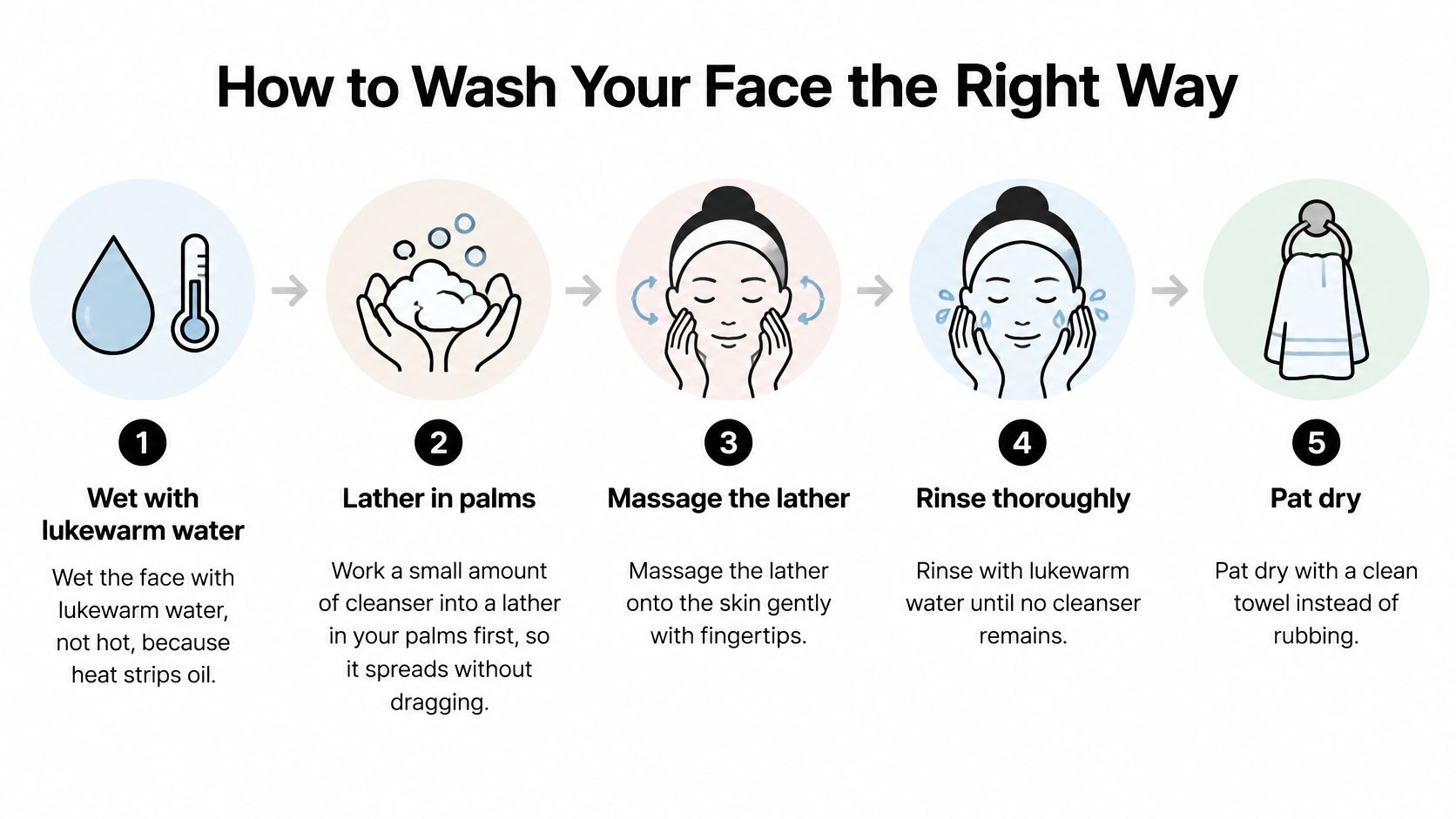
- Wet with lukewarm water. Heat strips oil before the cleanser starts. A steaming tap feels pleasant and leaves skin drier.
- Lather a small amount in your palms first. It spreads without dragging. Cleanser squeezed straight onto dry cheeks sits in patches and takes rubbing to move.
- Massage onto a damp face and neck for 30 to 60 seconds with fingertips. Use light pressure around the nose, chin, and hairline where residue collects. Skip scrubbing tools and washcloths; friction gets defended as deep cleaning and usually causes the trouble.
- Rinse with warm water until nothing feels slippery. Leftover cleanser is a common cause of tightness. Foam disappearing is not the finish line; the film under it is.
- Pat dry with a soft towel. Rubbing undoes the gentle wash. A rough towel does more damage than a slightly longer rinse.
- Apply moisturizer while skin is still slightly damp. That holds water in the surface layers. Wait until the face is fully dry and the water you just added evaporates.
Our cleanser follows that same order: work it into a lather, massage onto a damp face and neck, and rinse with warm water, morning and night on days you cleanse twice. Dry or easily bothered skin should take the mildest formula and keep the massage brief. Oilier skin can use a cleanser built for daytime oil, including one that pairs 76% fresh organic aloe vera with mint and witch hazel. If a label leaves you guessing, our guide to what a gentle cleanser is spells out the texture and finish to expect.
A comfortable face feels soft and calm after drying. Squeaky means you removed too much.
The eye area gets the lightest touch. Skin there is thin, and residue should be lifted rather than pulled; Afterglow's cluster lash cleaning routine applies that same no-tugging standard to delicate lash work.
Signs Your Washing Routine Needs Changing
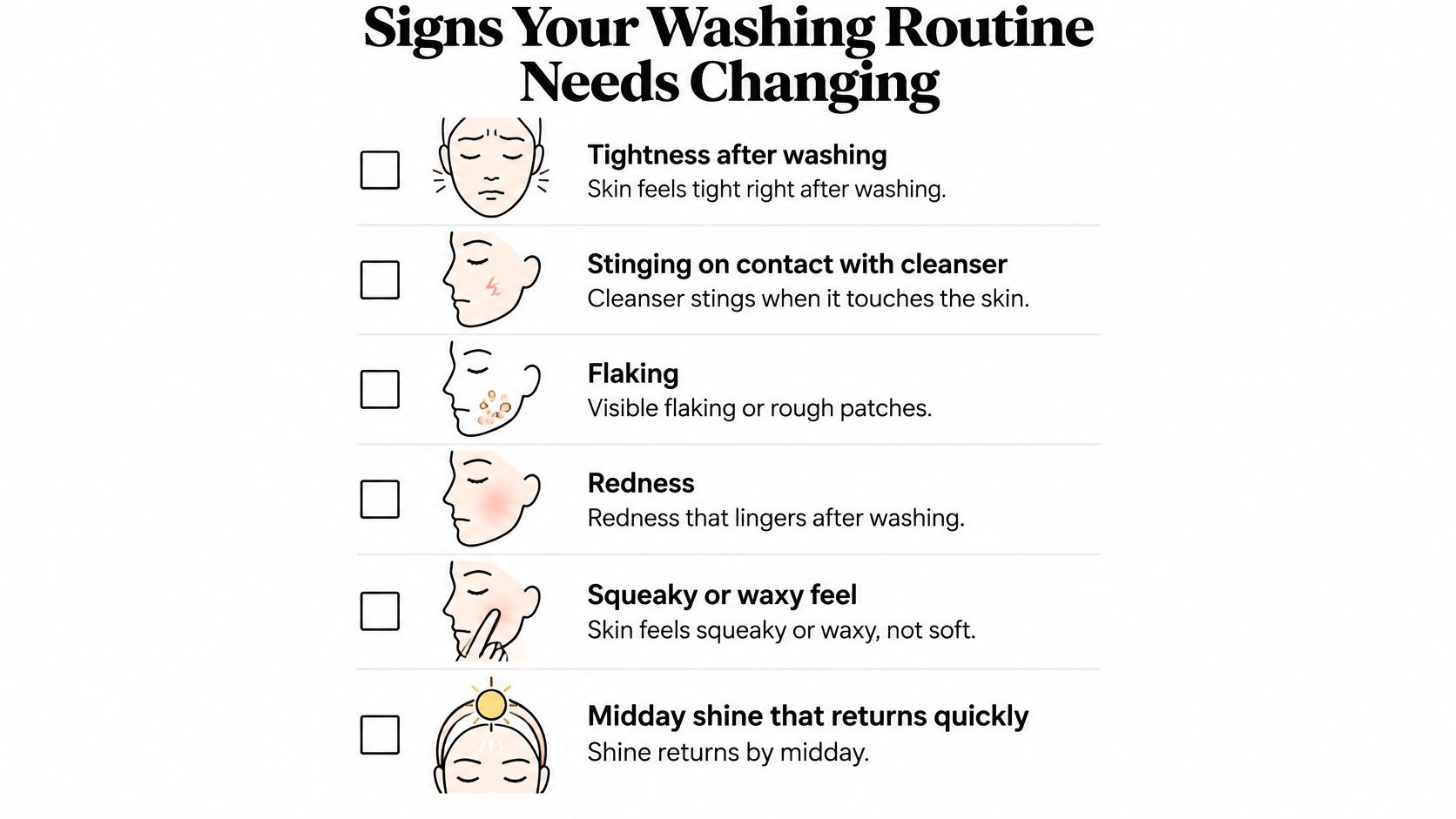
Tightness right after washing is the first signal many notice. It means the cleanser was too strong, the water was too hot, or both. Other signals follow: stinging when cleanser touches skin, flaking, redness that lingers, a squeaky or waxy feel, or shine that returns by midday.
| Symptom | Likely cause | Change to make first |
|---|---|---|
| Tight skin after every wash | Cleanser is too strong or water too hot | Switch to lukewarm water and a gentler cleanser |
| Stinging on contact with cleanser | Cleanser is too strong for the skin's current state | Reduce to one full cleanse a day for two weeks |
| Flaking or dry patches | Cumulative exposure from washing and rubbing | Rinse only in the morning and cleanse at night |
| Redness after washing | Friction or hot water | Stop washcloths and lower the water temperature |
| Midday shine returns quickly | Oil builds up between washes | Add a midday water rinse and keep twice-daily cleansing |
| Makeup sits badly on skin | Residue left from the evening wash | Add a thorough evening cleanse before bed |
Change one variable at a time for two weeks: frequency, cleanser, water temperature, or how much you rub. Swap two things and you won't know which one helped.
Water quality belongs on that list. Hard water can leave skin and scalp feeling itchy even when the cleanser is mild, and a look at shower filters for itchy scalps is a useful next check if tightness tracks with your tap, not your product. If the outer layer already feels worn, pair the gentler wash with steps from our guide on how to improve the skin barrier.
Stinging or redness that does not settle after that one change is a reason to stop experimenting and speak with a qualified professional.
After each week, ask three questions:
- After washing: Does skin feel soft, or tight within minutes?
- By midday: Is there comfort, or a fast return of shine or flakes?
- With makeup: Does it sit evenly, or catch on dry patches and leftover film?
Set Your Washing Schedule This Week
Seven days is enough to test a routine. Pick a schedule, run it unchanged for a week, and let your skin's own feedback decide the next move.
- Pick your row. Match skin type and this week's plans, including workouts, makeup, and time outdoors.
- Set the clock. Two fixed times, morning and night. Dry or sensitive skin gets its own schedule: one evening cleanse, plain water in the morning.
- Track seven days. Note tightness after washing and shine by midday. A note on your phone is enough.
- Change one thing only if those notes show a problem. Leave everything else alone for the next two weeks.
Planning that far ahead is easier when you know the shelf life. A cleanser lasts about 8 weeks, and other skin care products last about 3 to 5 months, depending on use. Subscribing to the Aloe Skin Clearing Set saves 20% if you want the oil-control cleanser, clearing gel, aloe gel with tea tree, and hydrating sheet masks on one schedule.
ALODERMA grows its aloe on its own plantations and processes it on-site within 12 hours of harvest, so the primary ingredient in every product stays fresh and bioactive. Check ingredients and directions on the product pages before you buy the cleanser that matches your row.
The habit to keep is a consistent, gentle routine. The number of washes serves that habit. It doesn't replace it.
ALODERMA builds everyday face care around fresh organic aloe, from a gentle cleanse to hydration when indoor air leaves skin tight. If you're setting a morning-and-night wash, or cutting back to one evening cleanse, start with formulas made for that pace. Visit ALODERMA to compare cleansers, check ingredients, and choose the schedule your skin can keep.