





It's 11 a.m., your forehead's already shiny, and your cheeks still feel tight from washing this morning. You try a mattifying serum and it stings. You try a hydrating one and feel coated by lunchtime. That push and pull is exactly why serums for oily sensitive skin need a different test: don't judge them by midday shine alone. Judge them by how calm, comfortable, and steady your skin feels the next morning.
Match Your Main Skin Goal to the Right Serum
Start with one goal, not five. For most readers, the safest default is a water or gel based serum with humectants for lightweight hydration, because tightness after washing often drives the urge to over-cleanse. If shine is your loudest complaint, start with the shine row instead.
| Main goal | Look for | Texture to expect | Skip if |
|---|---|---|---|
| Shine control through the day | Niacinamide at 2–5% in a water or gel base | Light, fast-absorbing | A heavy oil sits near the top of the ingredient list |
| Tightness after washing | Sodium hyaluronate and glycerin | Light gel, slightly slippery | Fragrance sits high on the list and skin already stings |
| Redness and comfort | Niacinamide at 5% with soothing aloe | Light, lotion-like serum | Several strong exfoliating acids appear in one formula |
| Lightweight daily hydration | Aloe-led formula with humectants | Watery gel | Occlusive oils appear before water or aloe |
| Gentle brightening | Alpha-arbutin in a light fluid | Light fluid | You have not patch tested a new brightening active |
Read the table by frequency. If you blot twice a day but rarely feel tight, shine control wins. If your face feels squeaky after every wash, hydration comes first, even though that sounds backward for oily skin. Our guide to choosing a hydrating serum for oily skin walks through that lighter hydration choice in more detail.
Use the next morning as your tiebreaker. A formula that keeps shine lower at 2 p.m. but leaves your cheeks stinging by bedtime has not solved the trade-off. The better result is calm skin when you wake up: no tightness, no new redness, no heavy film.
You're not an outlier for having both concerns. A 2025 dermatology review puts self-perceived sensitive skin at approximately 60–70% of women and 50–60% of men worldwide.
One-goal rule: Pick the row that matches your most frequent complaint. Add a second goal only after that first serum feels comfortable for two full weeks.
Why Oily and Sensitive Skin Need a Gentler Serum Approach
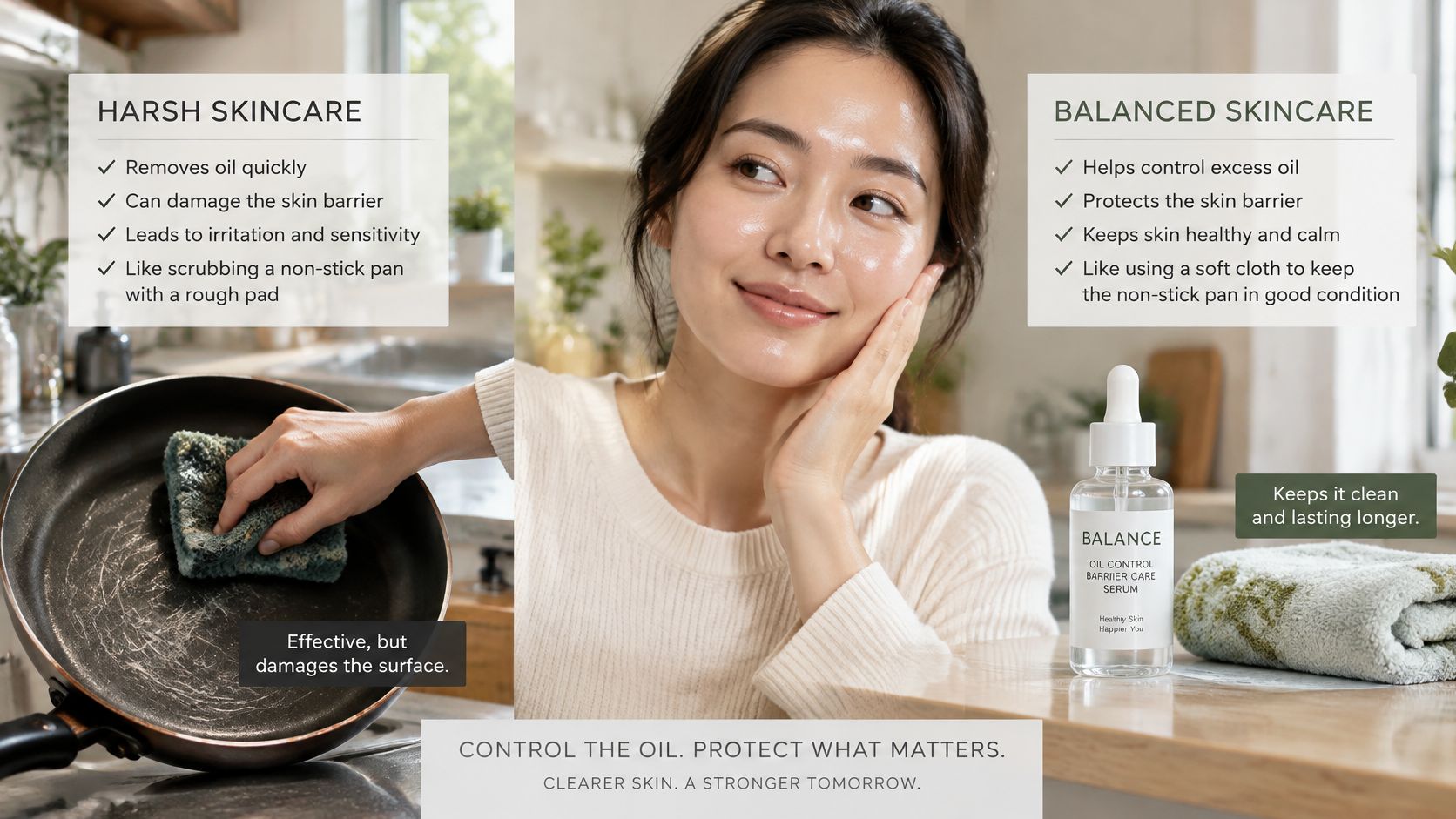
Strong degreasing feels logical. Your skin looks oily, so you strip the oil away. The problem is that stripping also removes the thin protective film that helps skin hold water and tolerate the next product you apply.
Think of scrubbing a non-stick pan with steel wool. The pan looks clean at first, but you've damaged the surface, so everything sticks and burns more easily afterward. Over-cleansed skin behaves in a similar way. Products that felt fine last month start to sting, and tightness returns faster after washing.
Sensitivity Is Mostly Something You Feel
Sensitive skin is largely a sensory experience. Stinging, burning, itching, or tightness can be triggered by products or weather, sometimes without visible signs. That's why a serum can look gentle on paper and still feel wrong on your face within a minute.
Water based formulas are a practical starting point because they add water without a heavy oil layer. Water-based facial serums held a 48.44% share of the global facial serum market in 2023, representing approximately USD 2.66 billion in revenue, according to The Brainy Insights market release. Popularity doesn't prove comfort for you, but the format matches what oily skin usually tolerates best, a light layer that disappears.
Gentle routines work the same way elsewhere in self care. If you're curious how a slower, comfort first ritual is structured, this walkthrough of what happens during a hair washing spa shows the same principle, thorough care without harsh scrubbing.
Say you cleanse morning, midday, and night to fight shine, then wake up tight and uncomfortable. Adding a stronger serum won't fix that cycle. Cutting back cleansing and using one light hydrating layer usually tells you more within a week.
Ingredients That Suit Oily Sensitive Skin
| Ingredient | Typical strength | What it does | Watch for |
|---|---|---|---|
| Niacinamide | 2–5% | Supports sebum balance and barrier comfort | Higher strength is not automatically better; start at the lower end |
| Lactic acid (low-dose hydroxy acid) | Low level, as stated on the label | Gently smooths the surface | Do not combine with other strong exfoliants at first |
| Sodium hyaluronate | Rarely stated on the label | Draws water into the upper skin | Apply to damp skin and seal lightly |
| Glycerin | Rarely stated on the label | Humectant that holds water | Usually well tolerated; check fragrance nearby |
| Aloe vera gel | Often the first ingredient in aloe-led serums | Light, water-rich base with a soothing feel | Confirm aloe leads the list rather than sitting low down |
Niacinamide Deserves Honest Expectations
Niacinamide at 2–5% is the usual starting point, but comfort is a more reliable first expectation than dramatic oil control. A double-blind, placebo-controlled study found 2% niacinamide significantly reduced sebum excretion in Japanese participants after two and four weeks, while a separate study reduced casual surface sebum but not sebum excretion rate, according to the PubMed record for that research. Results varied by population and by how sebum was measured.
A placebo-controlled pilot study of a 5% niacinamide serum found improved hydration and reduced erythema after one month, but no significant reduction in sebum, according to the published pilot study. That's not a failure. If your skin feels calmer and less tight, the serum is doing useful work, even if midday shine looks similar.
Gentle Smoothing Without Stacking
Low-dose lactic acid can smooth rough patches and help a serum spread evenly instead of pooling on flaky spots. Introduce it alone, two or three nights a week at first. Don't pair it on day one with another strong exfoliant, because you won't know which product caused stinging if your skin protests.
Humectants and Aloe Do the Light Lifting
Sodium hyaluronate and glycerin are humectants, ingredients that attract and hold water in the upper skin. They suit oily skin because they hydrate without the coated feeling many people dislike. Aloe vera works as a water-rich base, so an aloe-led serum can feel soothing and light rather than creamy.
Read the first five ingredient names. If water or aloe leads and humectants follow, expect a light serum. If oils and butters lead, expect richness.
No ingredient guarantees results. Give one active four weeks of steady use before you judge it, unless stinging tells you to stop sooner.
Reading Serum Labels for Sensitive Skin
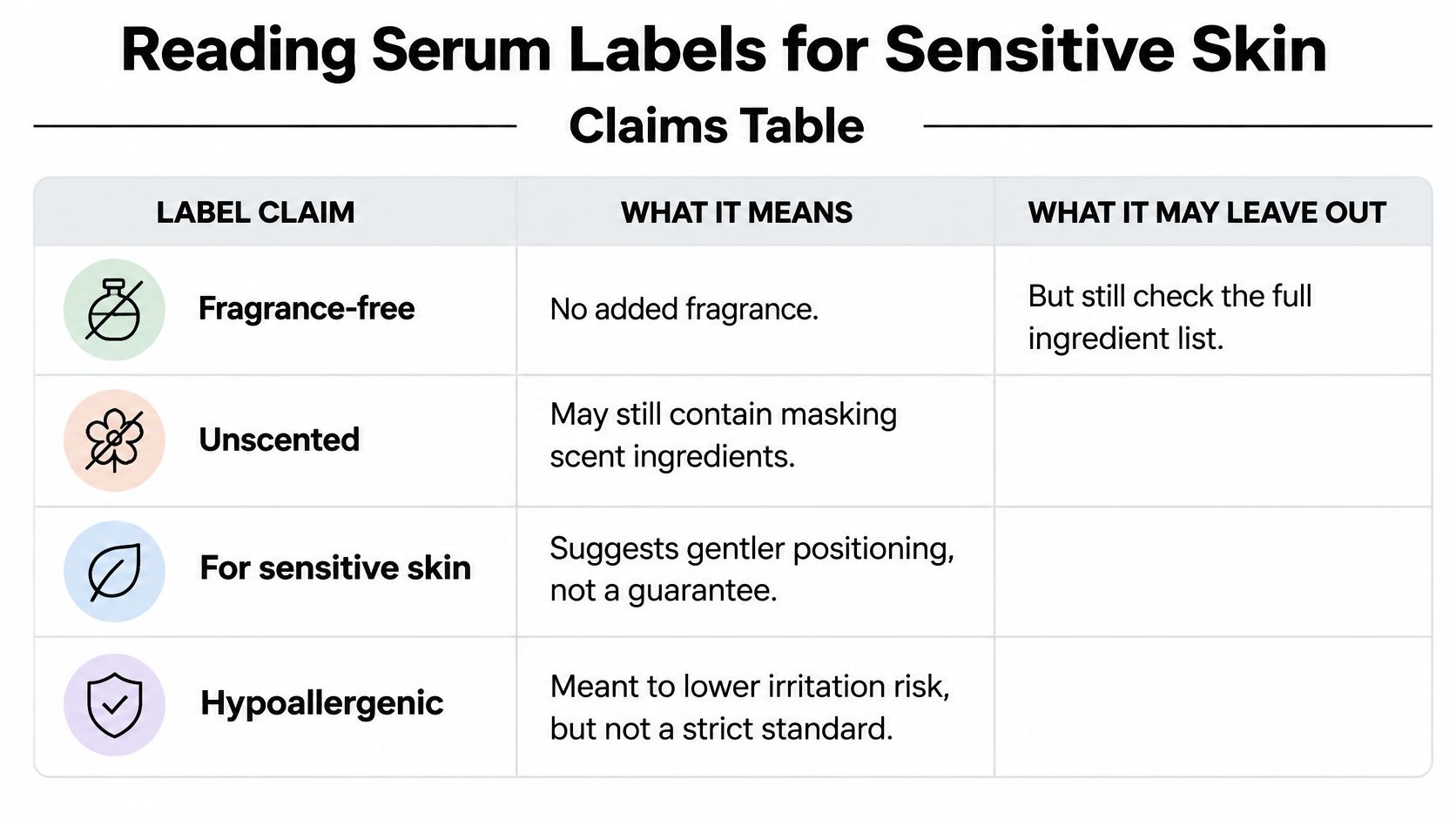
Turn a serum bottle over in the aisle and you meet a wall of small print, half of it chemistry and half of it marketing. The table below translates the claims you will meet most often, so you can tell what each one promises before you spend anything.
| Label claim | What it tells you | What it does not tell you |
|---|---|---|
| Fragrance-free | No fragrance ingredients were added | Whether essential oils or botanical extracts are present |
| Unscented | Fragrance may be masked by other ingredients | That no fragrance is present |
| 95% naturally derived | Share of ingredients from natural sources | Whether the product is hypoallergenic |
| Organic | Origin of the listed ingredients is certified | How strong or effective the serum is |
| Water-based or gel | Lighter, usually non-greasy base | The strength of any active |
| Natural or clean | Plant-derived ingredients are present | That the product is gentler or free of allergens |
| Essential oils | Aromatic plant oils are present | That they are safe for sensitive skin |
Fragrance-free and unscented aren't the same claim. Unscented products can still contain masking fragrance, so read the full list if scent triggers stinging for you. Our explainer on choosing a fragrance free face serum covers that distinction for daily shopping.
Natural origin doesn't equal gentle either. A recent review identifies limonene, linalool, and benzyl alcohol among commonly encountered cosmetic allergens, according to the review of cosmetic allergens. A pleasant botanical scent still deserves a patch test on your jawline before it goes anywhere near your cheeks.
A Worked Example on a Real Label
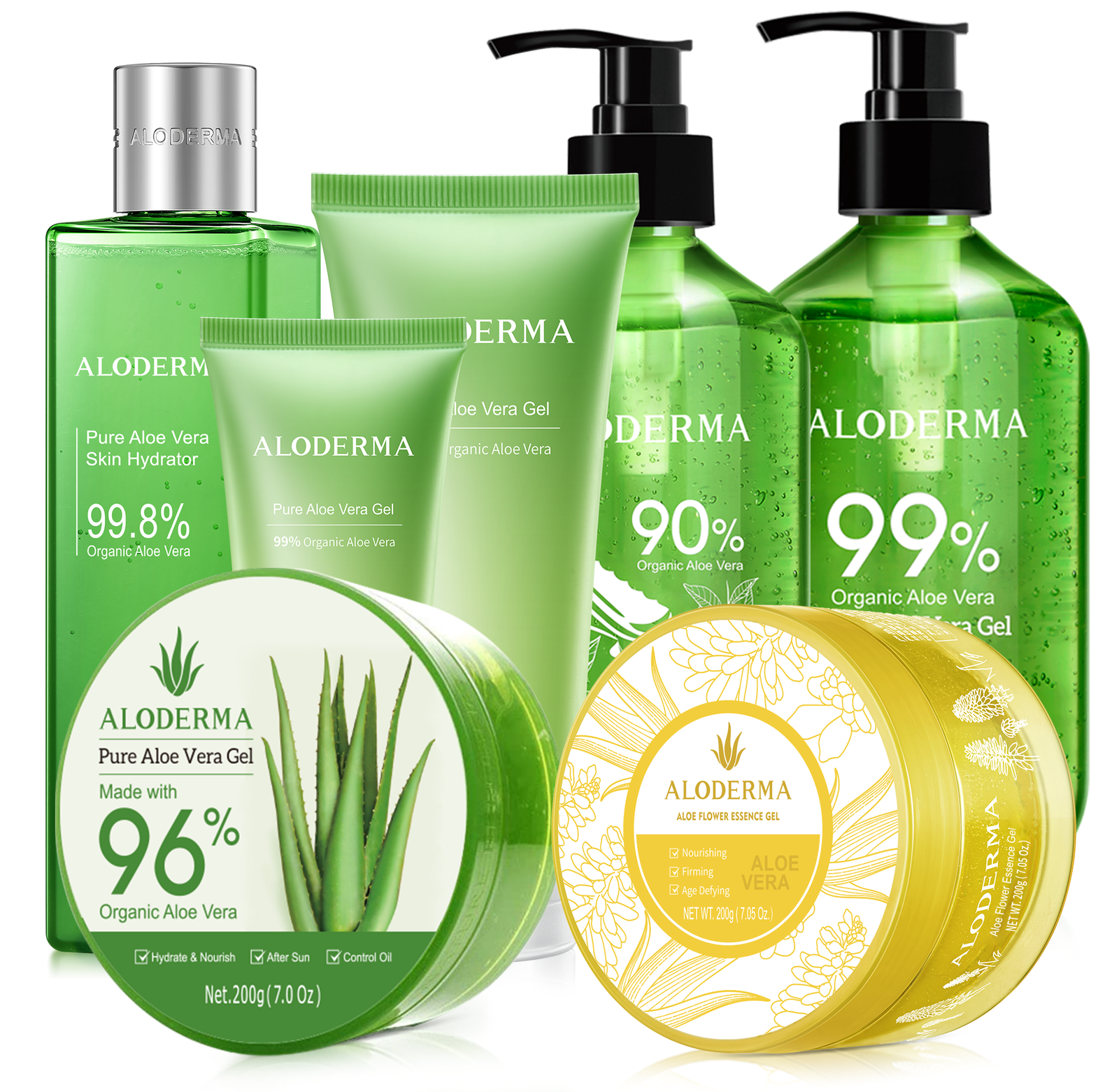
ALODERMA's Aloe Brightening Serum belongs to a serum range whose listed ingredients include niacinamide and sodium hyaluronate, along with tremella mushroom extract and olive leaf extract. Read that as a light formula: niacinamide and hyaluronate both dissolve in water, so they suit a thin base rather than a rich cream, and neither needs an oily carrier to reach skin. For someone who is shiny by midday and stung by strong products, that combination is the useful sort of label reading, because it points to hydration and tone support without a heavy finish.
The plant side deserves the same scrutiny. Botanical extracts carry scent and color as well as function, so a label can read gentle and still sting reactive skin. The honest limit of any label is that it cannot tell you how your skin will respond. Judge the formula by how your face feels the next morning, not by how soothing the ingredient names sound.
Use three questions every time:
- Where does water or aloe sit: First or second suggests a light base, which suits skin that turns shiny by midday.
- Is fragrance present at all: Check for parfum and named aromatic oils, not just the word "unscented".
- What's the stated active strength: A percentage beats a vague brightening promise, because it tells you how much of the active is in the bottle.
How to Layer Serums Without Overloading Skin
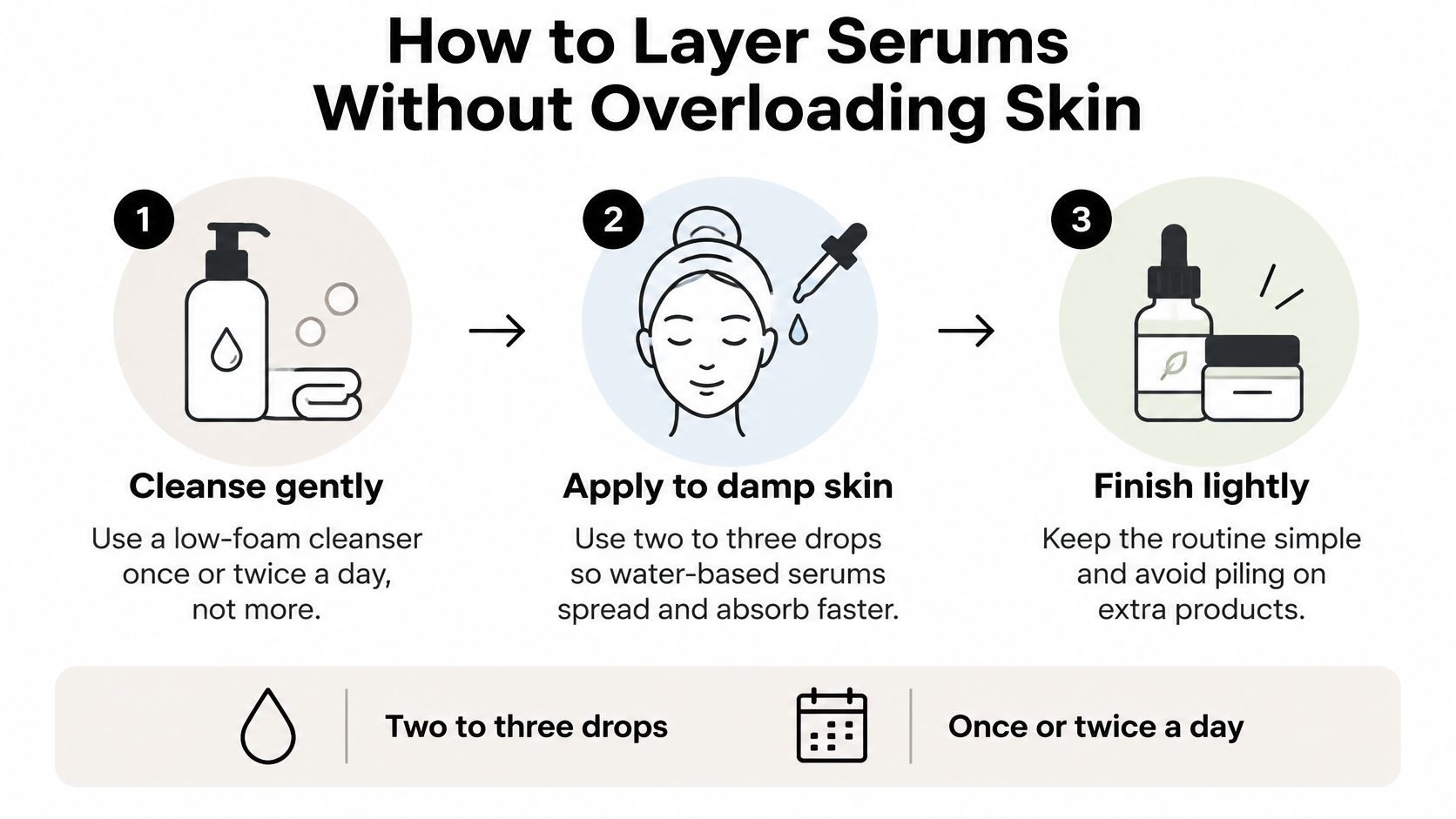
The order matters, but the number of layers matters more. A reactive face handles two thin layers better than five elegant ones. Work thinnest to thickest, and stop while the routine still feels short.
- Cleanse gently once or twice a day. Use a low-foam cleanser and lukewarm water. Cleansing a third time to chase shine usually brings back tightness by evening.
- Apply serum to slightly damp skin. Use two to three drops for your whole face. Damp skin helps a water based serum spread thinly, so you use less and get an even layer.
- Wait about a minute. Let the layer settle until it no longer feels wet. Rushing the next step can cause pilling, those little rolled bits under moisturizer or sunscreen.
- Add a thin layer of light moisturizer. This seals the water your serum brought in. Use a richer cream only if your skin still feels tight by evening for several days in a row.
- Finish mornings with sunscreen. It is always the last step. If sunscreen stings, change the sunscreen, do not skip protection and keep the serum.
- Introduce one new product every one to two weeks. Test it on a small jawline area for 48 hours before full-face use, so you can identify the cause if discomfort starts.
A Damp Skin Example
ALODERMA's Aloe Hydrating Serum is one option for this step. The useful part is the technique: humectants such as glycerin and sodium hyaluronate draw water into the skin when applied to damp skin. A light moisturizer on top seals that water in, which is why the final layer should be thin rather than rich. If a serum contains aromatic oils, the jawline patch test matters even more, because a pleasant scent can still irritate reactive skin.
Signs it's working: No stinging after three days, skin that feels comfortable the next morning rather than tight or greasy, and shine that holds steadier through the day instead of swinging.
Three Real Routines for Shiny, Tight or Reactive Skin
Three people, three complaints, one shared lesson: small adjustments beat product piles.
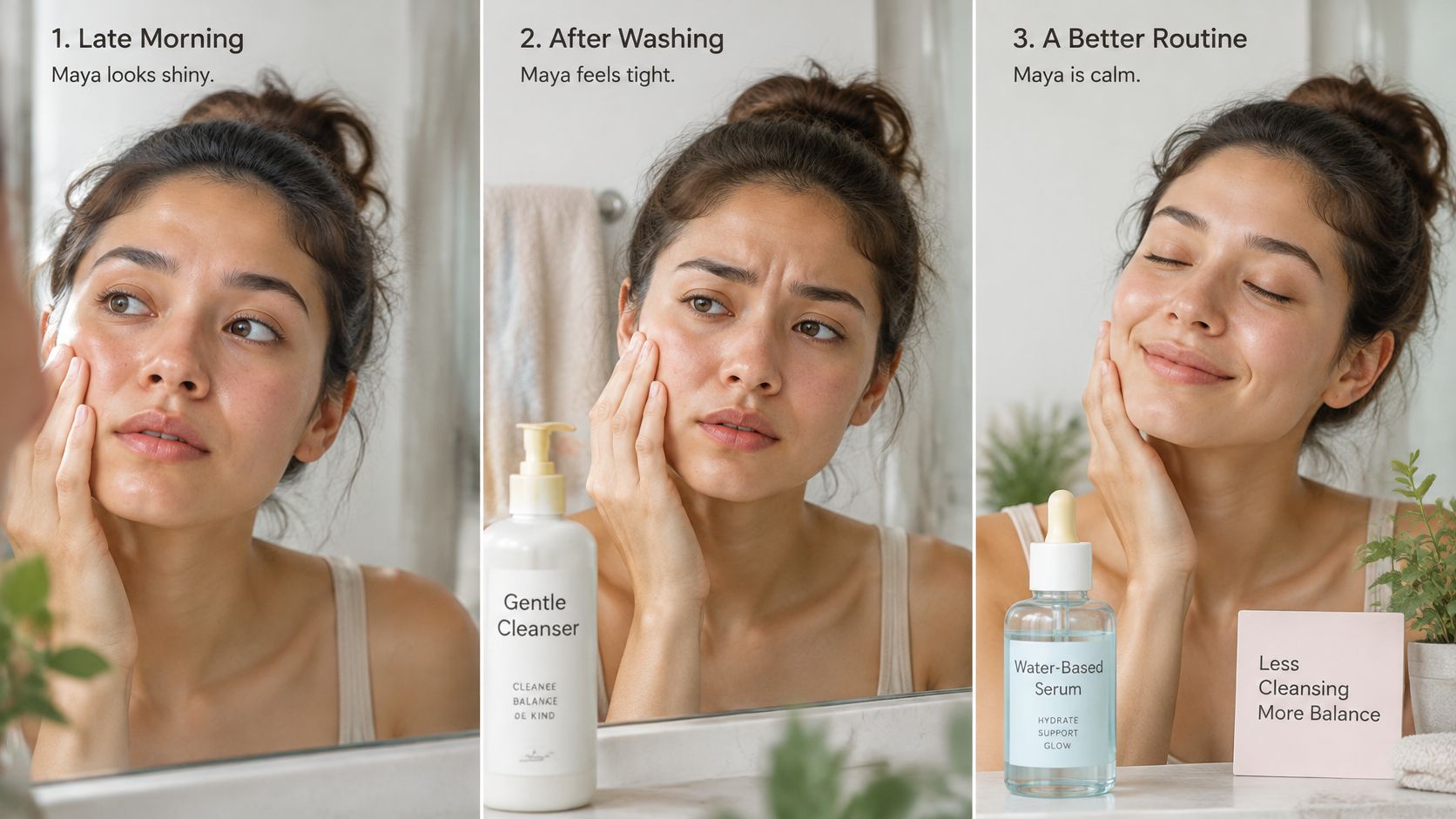
Maya was shiny by late morning and tight after washing, so she cleansed three times a day to compensate. Cutting back to twice daily did more for her than any new bottle. She switched to a water based humectant serum, the lightweight sort described on the Aloe Hydrating Serum page, and pressed it onto damp skin. By the second week her shine arrived later and held steadier, and the tightness after washing eased. Her skin was never short of water. It was short of a chance to hold onto it.
Dev stings whenever a serum carries a strong fragrance. He reads the ingredient list to see where fragrance sits, tests each new bottle on his jawline before using it more widely, and keeps only one unopened product on the shelf at a time. The trade-off is slower shopping and fewer impulse buys. The payoff is that when his skin complains, he knows which bottle to blame instead of guessing across four.
You can watch a simple layering order demonstrated here before building your own version:
Priya gets winter redness and dry patches alongside an oily T-zone. Her routine leans on niacinamide, and twice a week she adds a gentle brightening option such as the Aloe Brightening Serum. She judges the result by comfort and fewer dry patches, not by whether her nose shines at noon. That distinction is the whole point. A serum can calm and hydrate skin while doing nothing about midday shine, and a mattifying product can do the reverse while leaving skin tight by evening.
The aloe in these routines comes from ALODERMA's own plantations and is processed on site within 12 hours of harvest, a harvest-to-formula window also described on the Aloe Firming Serum page. That short window is why aloe functions as the primary ingredient in the brand's formulas rather than as a decorative botanical near the bottom of the list.
Pick One Serum and Patch Test It This Week
Make the decision in order, and write it down so you're not re-deciding every morning.
- Pick one row that matches your most frequent complaint, shine, tightness, redness, hydration, or brightening.
- Run the three-question label check. Confirm where water or aloe sits, whether fragrance is present, and the stated strength of the active.
- Do the 48-hour jawline test, morning and night. Our step-by-step guide on how to patch test skincare shows placement and timing.
- Use it nightly for two weeks if the test is clear. Apply after cleansing on damp skin, then judge by evening comfort, steadier shine, and no stinging the next morning.
- Stop and reset if discomfort continues. Drop the new serum, return to cleanser and light moisturizer for three days, then add products back one at a time.
Our serum range includes the Aloe Firming Serum, Aloe Brightening Serum, and Aloe Hydrating Serum, with the soothing line designed for skin that's easily irritated or red. If you're torn between two rows, our Skin Care Questionnaire gives personalized recommendations for your specific skin type.
Do one thing today: pick your row, check one label, and start the jawline test tonight. Serums support a routine, and they don't replace advice from a qualified professional when your skin keeps reacting.
Ready to try a lighter routine built around fresh aloe? Explore serums for oily sensitive skin made with aloe we grow, process, and manufacture onsite within 12 hours of harvest, then take our Skin Care Questionnaire for a shortlist matched to your main goal. Visit ALODERMA to pick one serum and start your patch test this week.