

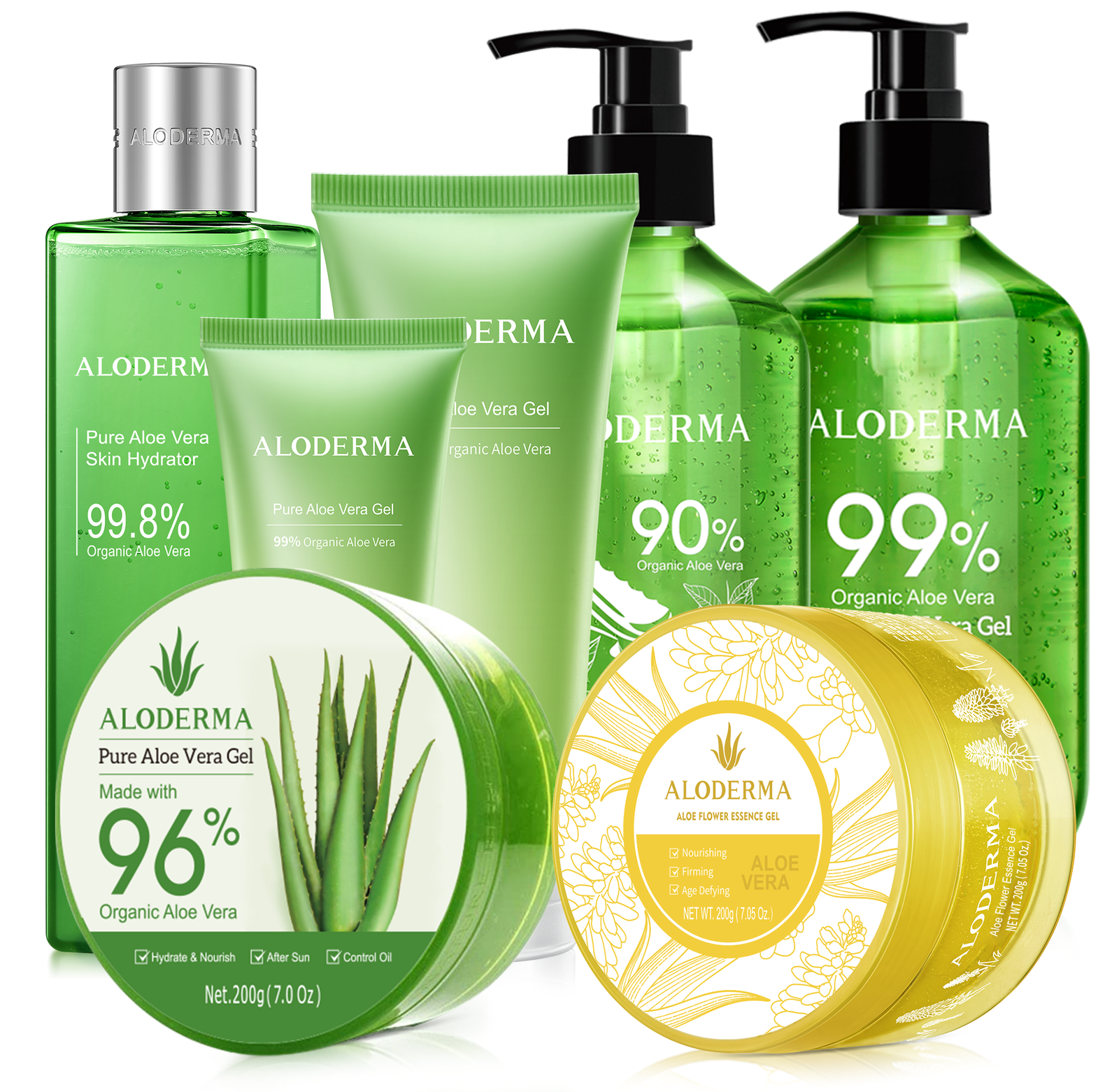


Your bathroom counter probably holds a bottle with aloe and vitamin E printed on the front. Maybe you bought it because the label promised gentle hydration, or because it sat next to the sunscreen at a price that felt reasonable. Three weeks in, your skin feels fine, but you couldn't say what either ingredient did, or whether a different bottle would suit you better.
That's the gap worth closing. Aloe and vitamin E are two of the most common pairings in a moisturizing lotion, and both have real, documentable jobs inside the formula. Neither is magic, and neither makes a product safe for every person who opens it.
So here's the plain version: what each ingredient does, five checks you can run on any label in about two minutes, a fit chart by skin situation, and a clear line between everyday comfort and the moments when you should stop and get help.
Why Aloe and Vitamin E Appear Together in One Lotion
A drugstore shelf can hold four lotions that all print aloe and vitamin E on the front, at four different prices, and nothing on the front explains the gap. The words sell the bottle. What's inside decides how it feels on your skin at 7 a.m. in February.
The pairing makes sense once you separate the two ingredients by what they're made of. Aloe Barbadensis Leaf Juice is a water-based gel, so it forms the water-binding, comforting base of a lotion. Vitamin E is oil-soluble, so it sits in the oil phase, where it acts as an antioxidant and an emollient that leaves skin feeling smoothed rather than tight.
The kitchen comparison that helps most is a salad dressing. Water and oil won't stay together on their own, so an emulsifier holds them in suspension. Aloe brings the water side, vitamin E sits on the oil side, and the emulsion is what you spread across your arm. Neither ingredient switches the other on. They occupy different parts of the same formula.
That's also where supply chain enters the picture. ALODERMA is a fully vertically integrated aloe vera company: we grow our own organic aloe vera, process the harvested leaves, and manufacture onsite within 12 hours of harvest, a timeline built to keep the aloe in the finished product as bioactive as possible. Freshness is a fair reason to read a label closely. It isn't proof that a given bottle will suit a given face.
Rule of thumb: when the front of the bottle promises a result and the ingredient list doesn't support it, believe the list.
Three questions will get you through any label: what each ingredient does, which skin situations suit the pairing, and how to check and patch test before you commit. A sound pairing doesn't guarantee a sound match. Plenty of people with reactive skin have opened a gentle, natural bottle and regretted it within the hour.
What Aloe and Vitamin E Each Do in a Lotion
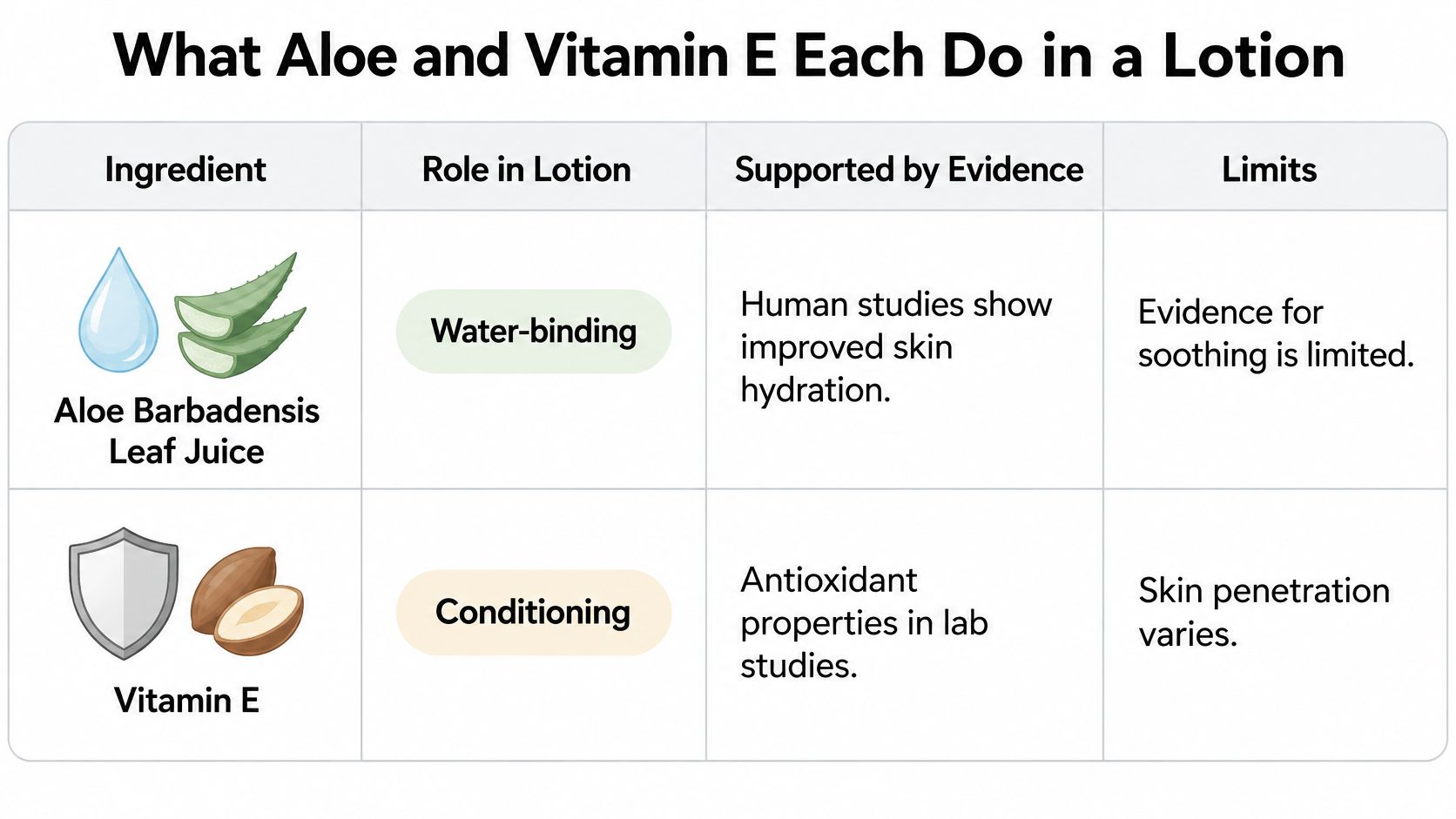
The shortest version of the answer is a table. Each row names the job, the human evidence behind it, and the limit that keeps the claim honest.
| Ingredient | Role in the lotion | What the evidence supports | Limits to keep in mind |
|---|---|---|---|
| Aloe leaf juice | Water binding and comfort | Human studies report higher skin hydration and less water loss | Benefit depends on processing and concentration; not a treatment |
| Vitamin E (natural d-alpha-tocopherol or synthetic d,l-alpha-tocopherol) | Antioxidant and emollient in the oil phase | Controlled UV study: a 2% preparation reduced redness by about 20% | Tests used defined conditions; not sunscreen; synthetic form and higher concentrations are more often implicated in reactions |
Here's the same comparison in visual form, useful if you scan first and read later.
Aloe Leaf Juice Carries the Water Side
An independent review of the human evidence reports that topical aloe-containing preparations increased skin hydration and reduced transepidermal water loss in vivo, which means more water stayed in the outer skin layer and less evaporated out of it (Aloe vera evidence summary). That's a hydration mechanism. It isn't a cure for anything.
The polysaccharide fraction, acemannan included, gives aloe its film-forming and soothing behavior. How much of that survives into your bottle depends on processing, solids content, and how thoroughly the raw material was stripped of the latex-derived compounds that can sting. Two lotions can both list aloe and behave nothing alike.
Vitamin E Works in the Oil Phase
Vitamin E is an antioxidant that helps keep the oils in a formula from turning, and an emollient that conditions the skin's surface. It also has measurable effects under controlled conditions: a peer-reviewed review of cosmeceutical evidence describes human studies in which a 2% topical vitamin E preparation reduced UV-induced redness by roughly 20% (review of cosmeceutical evidence).
Hold that number loosely. Those studies used defined concentrations, controlled exposure, and specialized test conditions, so the 20% belongs to the study, not to a commercial lotion you buy on a Tuesday. What carries over is the direction of the effect and the role vitamin E plays in a formula, not a promise.
What the Combination Has Been Tested For
The closest human data for the pairing itself comes from a 2023 clinical study published in Frontiers in Bioscience-Landmark, which evaluated topical preparations containing plant-derived extracts plus vitamin E and/or aloe vera in 20 healthy female volunteers aged 18 to 78 (Frontiers in Bioscience-Landmark study).
Put the rows together and you get one defensible claim and one that isn't. Hydration and comfort hold up: aloe binds water, vitamin E conditions, and both make a lotion pleasant enough to use twice a day. Sun protection and the correction of a skin problem do not hold up, because nothing in this evidence tested either one.
How to Check a Lotion Label in Five Steps
Two bottles can both say natural and gentle and still be different formulas. The front is written to sell. The ingredient list is written by the people who built the formula, in descending order by weight, which is why the back of the bottle tells you more than the front ever will. Run these five checks before you spend money.
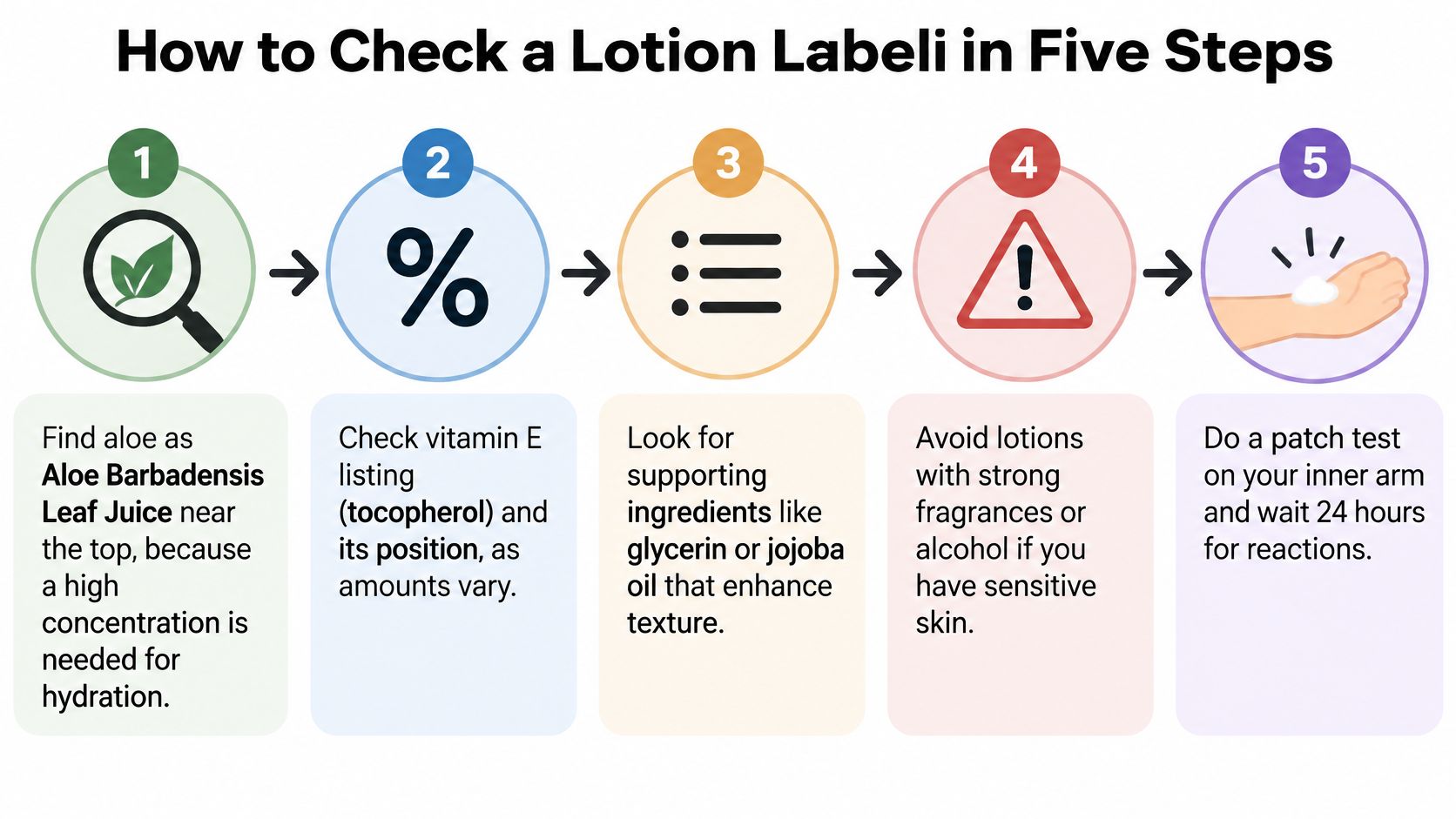
- Find the aloe and see where it sits. Look for Aloe Barbadensis Leaf Juice by name rather than the word "aloe" alone, then check its position, because ingredients are listed by weight (ALODERMA on reading an aloe ingredient list). The list works like a recipe measured in grams: the heaviest ingredient comes first. An entry near the top means aloe is a main part of the formula. The same botanical at the end of a long list means the front label is doing the heavy lifting.
- Confirm vitamin E is named, and which form. You are looking for tocopherol or tocopheryl acetate listed separately. Form matters: natural d-alpha-tocopherol and synthetic d,l-alpha-tocopherol behave differently. A systematic review of vitamin-related contact allergy found vitamin E in 151 of 276 moisturizer samples submitted for allergen testing, with higher-concentration pure vitamin E oils more often implicated and the synthetic form reported as more likely to set off a reaction (systematic review of vitamin-related contact allergy). The ingredient dictionary explains tocopheryl acetate if you want the chemistry in plain terms. A gentle claim on the front does not rule out irritation from the form inside.
- Match the organic word to a category. "100% Organic," "Organic," and "Made with Organic" each carry a defined minimum and are not interchangeable. ALODERMA's explainer sets out the USDA categories and the ECOCERT rule that 95% of plant-based ingredients must be organic (ALODERMA's guide to USDA organic labels). The slip here is trusting a seal without confirming it matches the product in your hand.
| Label category | Minimum certified organic content |
|---|---|
| 100% Organic | All ingredients certified organic |
| Organic | At least 95% certified organic; remaining 5% limited to approved non-organic substances |
| Made with Organic | At least 70% certified organic |
- Scan for fragrance and essential oils. Fragrance is a frequent reason a gentle lotion stings, and parfum, fragrance, or a run of essential oils are easy to miss in a long list. Natural does not mean those oils cannot irritate you. If any of them appear and your skin reacts easily, treat the bottle as a higher-risk choice until it has been patch tested.
- Check freshness claims and the aloe percentage. Processing within 12 hours of harvest is a specific claim you can verify. A percentage printed on the package is better than one implied in a headline. ALODERMA's products are made with at least 65% fresh organic aloe vera juice, so check the percentage printed on your own package, which is the figure that governs (fresh aloe skin care). If a brand will not state a percentage anywhere, assume the aloe is a supporting player.
The Two-Minute Test
Read the ingredient list twice, once for what is there and once for where it sits. First pass: is aloe juice named, and is vitamin E its own line? Second pass: are they near the top, or is fragrance tucked in below them? If aloe does not appear in the first part of the list, the product is a weaker match for its own front label, whatever the seal says.
A short list you can interpret beats a long "clean" list you can't.
Who Suits This Pairing and How a Week Plays Out
Lena keeps her lotion on the nightstand and reaches for it when her cheeks feel tight after a shower. In January the feeling lasts most of the morning. She wants something that makes her face comfortable at night and doesn't pill under makeup at 8 a.m., and she has no idea whether the aloe and vitamin E lotion she picked up is that product or just a bottle with good copy.
Her situation is the one this pairing suits best, and it still comes with conditions.
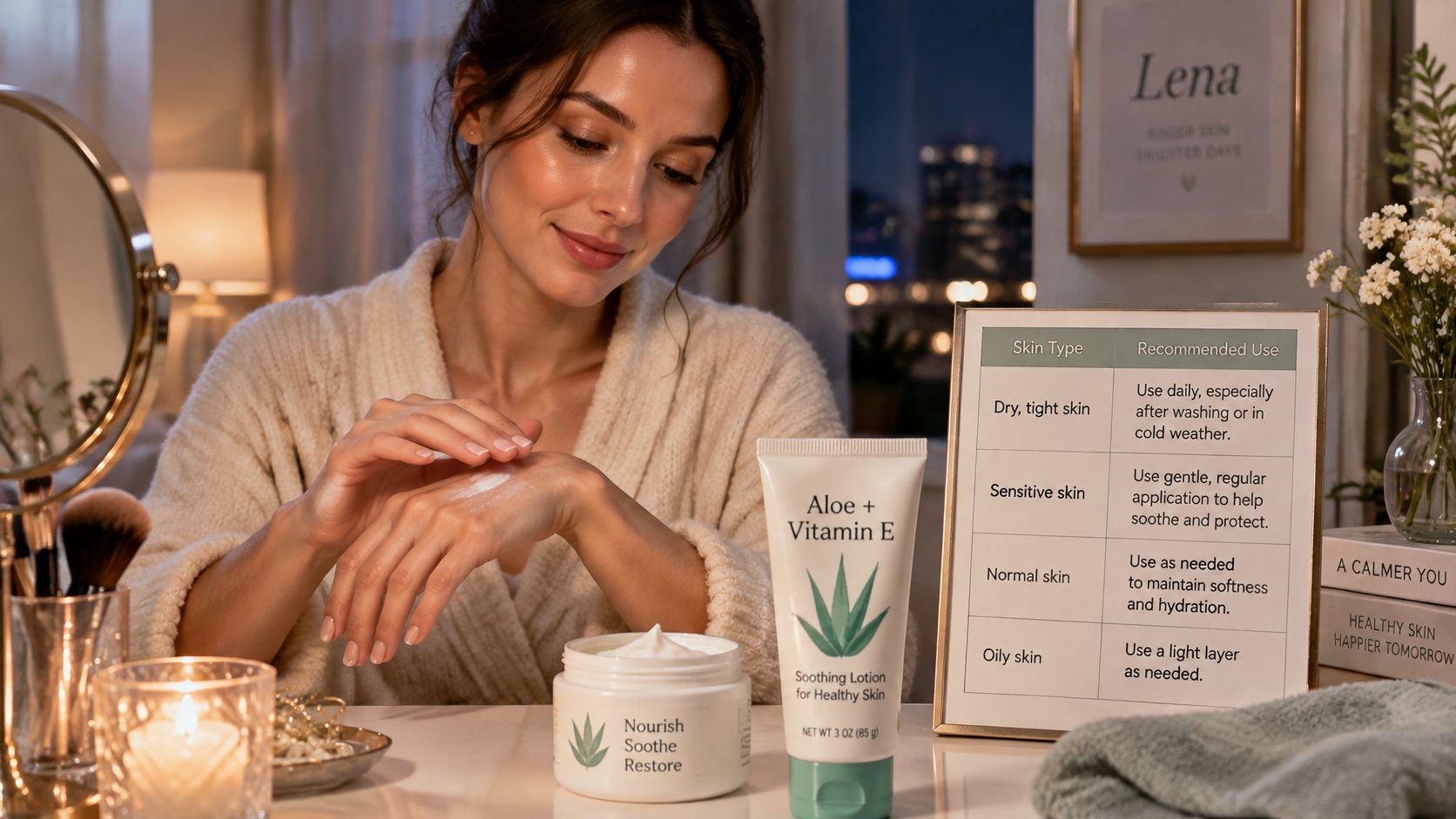
Here's how the pairing lines up across the situations that show up most often.
| Skin situation | Fit for this pairing | What to check first |
|---|---|---|
| Dry skin that feels tight after washing | Good fit: aloe supports water retention and vitamin E conditions | Aloe listed near the top of the ingredient list |
| Sensitive or reactive skin | Test first: any aloe or vitamin E product can sting or cause a reaction | Fragrance-free formula and a patch test before full use |
| Oily or blemish-prone skin | Often suitable when the texture is light and gel-like | Texture and finish stated on the package or product page |
| Sun-exposed skin | Poor fit as protection; a lotion is not sunscreen | Broad-spectrum sunscreen applied before going outside |
| Broken, blistered or very irritated skin | Not a self-care case | Stop use and seek professional advice |
| Shoppers who want verifiable claims | Good fit when certification is confirmed | Organic category and certification seal on the package |
The second row is where gentle language misleads most. Aloe-containing products can sting skin that's already irritated, and vitamin E isn't risk-free either, since it's been associated with allergic contact reactions in susceptible users, particularly in fragranced or complex formulas. "Natural," "organic," and "clean" describe sourcing and marketing. They don't describe tolerance.
Shoppers know this better than the marketing suggests. Recent consumer research found that 85% of U.S. respondents consider cosmetic safety important, yet only 15% fully trust clean-beauty claims, and 36% read the full ingredient list instead of relying on front-label messaging (Personal Care Insights).
Three Weeks, Three Skins
Lena, dry and winter-tight. She patch tests on the inner forearm for two nights, then moves to her face at night only, after cleansing while her skin is still slightly damp. She keeps her morning routine unchanged for the first week, so if something goes wrong she knows exactly what caused it.
Maya, heated office, dry hands and cheeks. She wears broad-spectrum sunscreen in the morning and uses the lotion at night, choosing a texture light enough to disappear under foundation. A lotion that pills or feels tacky is the wrong pick for her no matter how good the ingredient list looks.
Jordan, oily and reactive. He starts with a fragrance-free version after a 48-hour patch test, applies a thin layer, and stops if stinging hasn't settled within a few minutes. He doesn't push through a reaction to finish the bottle.
One confusion worth clearing up: dry and dehydrated aren't the same complaint. Dry skin lacks oil, dehydrated skin lacks water, and some of both can show up by February. That's exactly why an aloe and vitamin E lotion suits so many routines, since aloe brings the water side and vitamin E brings the oil side at the same time.
The right lotion matches the skin situation, not the number of natural words on the front of the bottle.
Sun Exposure, Broken Skin and When to Stop
After a Saturday on a sunny ridge trail, Priya's face feels hot and tight. She reaches for the aloe and vitamin E lotion in her bag. It may comfort dry, tight skin, but it cannot provide the sun protection she needs.
Separate three jobs: hydrating intact skin, comforting skin that feels dry or tight, and protecting skin from the sun. Aloe and vitamin E lotion can help with the first two. Only broad-spectrum sunscreen provides the third. A lotion can be used under sunscreen or at night, but it cannot replace sunscreen. For help reading the label, see this guide to face lotion with SPF.
The Stop Signs
A compromised skin barrier can make skin react to products it tolerated before. Skinsation Aesthetics on resilient skin explains how barrier health relates to skin's ability to cope with products.
- Broken, open or blistered skin. Keep cosmetics off it. Rinse with plain water and ask a pharmacist or doctor for advice.
- Redness or itching that spreads or grows after application. Stop using the lotion. Don't reapply to test it again, and rinse the area with lukewarm water.
- Irritation that persists after stopping. If your skin is still reacting a day or two later, seek professional advice rather than trying another bottle.
Brief stinging that fades within a couple of minutes differs from a reaction that spreads, worsens or persists. Pay attention to how the skin changes, not just whether the lotion feels soothing at first.
Comfort is a legitimate goal. Treating a skin problem is a different job, and a lotion bottle may not be the right tool.
Vitamin E in a lotion does not make it sunscreen or reverse sun exposure. Keep using broad-spectrum sunscreen for protection. If a lotion has irritated your skin, leave it out of your routine for a few days before judging its tolerance. That pause can help you notice whether the reaction settles without adding another product.
Choose and Test Your Lotion This Week
Decide with a shortlist, not a shelf. Pick two or three lotions that survive the label checks, then let your own skin settle the argument over two weeks. That's faster than reading fifty reviews written by people with different skin, a different climate, and a different barrier.
One bottle worth putting on the shortlist is our Aloe Soothing & Moisturizing Cream, which contains fresh organic aloe vera and is enriched with shea butter and natural beta-glucan. It also carries squalane, allantoin, and vitamins C and E, so it does the water-side and oil-side work in a single step. Our formulas skip SD alcohol, aloe powders, parabens, phthalates, and sodium lauryl sulfate, and the full ingredient list sits on the product page at aloderma.com. Confirm the certification seal and percentages on the package you receive, since formulas and certifications can differ by market.
If firmness and texture are also on your list, REVETIX's breakdown of how to pick an anti-aging moisturizer is a useful second opinion on how texture and ingredients trade off.
- Shortlist two or three lotions. Include at least one fragrance-free option, even if you don't think of yourself as sensitive.
- Compare them on one note. Write the aloe position, the vitamin E form, and the organic category for each bottle side by side, so the differences are visible at a glance.
- Patch test for 48 hours. Inner forearm, a thin layer, twice a day. Our guide to patch testing skin care covers what a positive result looks like and how long to wait before trying your face.
- Review after two weeks. Keep a two-line note of what you used and how your skin felt. If stinging, tightness, or redness appeared and didn't settle, the bottle failed regardless of its ingredients.
The best aloe and vitamin E lotion is the one that suits your skin, not the one with the most natural words on the front. A bottle that passes the label checks and two weeks of your own testing has earned its place on the shelf. Everything else is marketing with a nice photograph.
ALODERMA grows its own organic aloe vera, processes the leaves, and makes every product onsite within 12 hours of harvest, so the aloe named on the label is the primary ingredient in the jar rather than an afterthought. Every formula is made with fresh organic aloe vera juice, without SD alcohol, aloe powders, parabens, phthalates, or sodium lauryl sulfate, which makes an aloe and vitamin E lotion an easy place to start if you're building a routine around comfort instead of claims. Browse the range and read the full ingredient lists for yourself at ALODERMA.