







You step out of a steamy shower, reach for a towel, and pull on your clothes. Soon your shins feel tight, your elbows look dull, and the lotion you applied doesn't seem to have helped. It's frustrating when something as ordinary as getting clean leaves your skin less comfortable.
Body skin care starts with understanding what you're trying to support. Once you can picture how skin holds water and protects itself, choosing a cleanser, moisturizer, or aloe gel becomes less like guessing and more like solving a familiar problem.
Why Your Body Skin Deserves More Attention Than You Give It
Your face might get carefully chosen products while your legs get whatever bottle happens to be beside the shower. That's understandable. Body care often happens when you're rushing to work, getting children ready, or trying to get into bed.
But consider how differently you treat different areas. Your shoulders sit in the sun during a walk. Your waist rubs against a waistband. Your hands move between washing, outdoor air, and household tasks. A useful routine responds to those situations rather than treating everything below your chin as one uniform surface.
Start with comfort, not appearance
Try noticing when discomfort begins. Does your skin feel tight immediately after washing? Does a fragranced lotion leave your chest uncomfortable? Do your lower legs feel fine in the morning but rough by bedtime?
Those observations are more useful than deciding you need an entire new collection. They help you identify the habit, texture, or exposure worth changing.
- After bathing: Pay attention to whether your skin feels comfortable before you apply anything.
- After dressing: Notice where seams, straps, or close-fitting fabric feel unpleasant.
- During outdoor time: Check which areas your clothing leaves exposed.
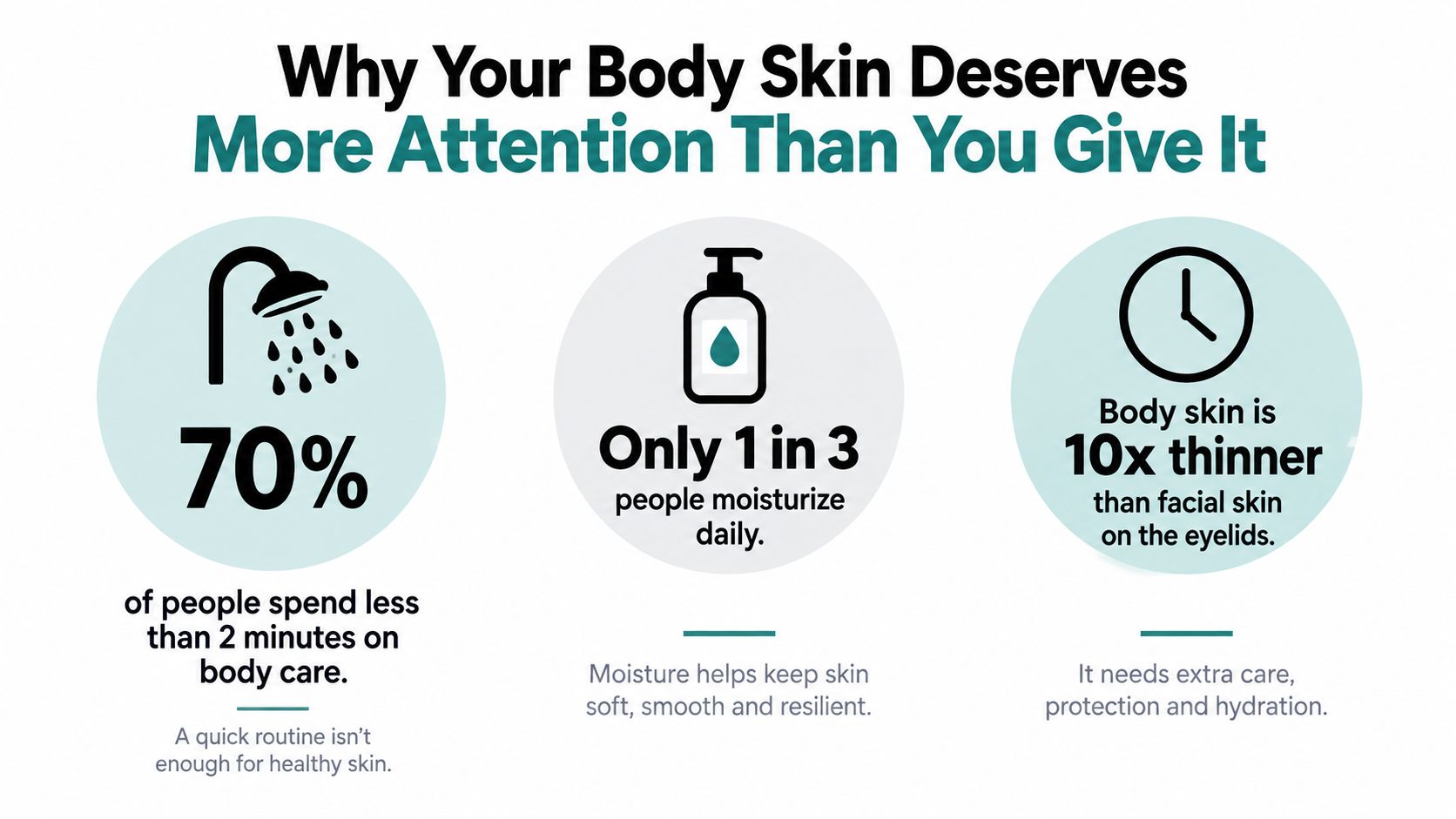
The visual below provides a reminder to give body care deliberate attention. Its numerical claims aren't substantiated by the sources cited here and shouldn't guide your decisions.
Practical rule: Judge your routine by how comfortably you can get through your day, not by how many products you apply.
You don't need to pursue perfectly polished skin. You need a routine that fits ordinary life and leaves your skin feeling cared for rather than continually corrected.
How Your Skin Barrier Actually Works
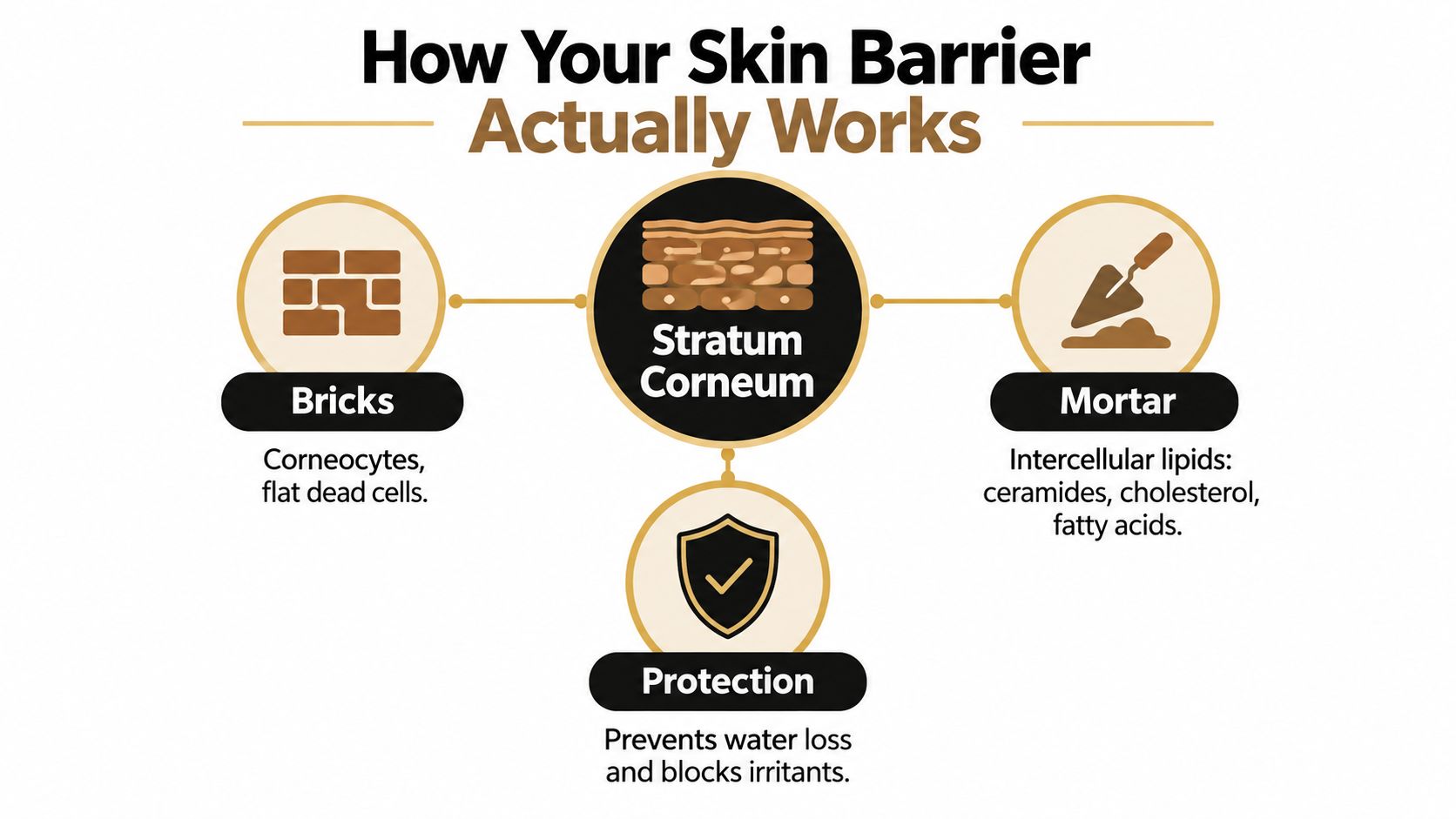
Think of the stratum corneum, your skin's outermost layer, as a brick wall. The cells called corneocytes are the bricks. The intercellular lipids, especially ceramides, are the mortar between them.
That mortar matters because it helps retain water while limiting the entry of irritants. Experimental removal of these lipids reduces the outer layer's water content and increases water loss, demonstrating the connection between lipid depletion and impaired barrier function in this review of skin-barrier lipids and ceramide-containing preparations.
This diagram makes the wall analogy easier to visualize.
Water balance in plain language
Transepidermal water loss, often shortened to TEWL, means water passing through the skin and escaping into the surrounding air. It isn't the same as sweating. For everyday product decisions, think of it as the difference between adding water and helping your skin retain it.
A splash of water can feel refreshing without providing lasting comfort. Likewise, a cooling gel's immediate sensation doesn't tell you everything about how well the complete formula meets your needs.
- Cleansing choices: Avoid making a stripped, squeaky feeling your standard for cleanliness.
- Water temperature: Prefer comfortably warm water rather than excessive heat.
- Moisturizer selection: Consider barrier support, not just a product's watery texture.
For a practical companion to this model, explore how to improve your skin barrier.
Make the model useful
When your legs feel tight after showering, don't automatically conclude that you need stronger exfoliation. Ask whether your cleansing habits are working against the barrier you want to support.
This video offers another visual way to approach the skin-barrier concept.
Keep the wall analogy in mind when reading labels. A good formula isn't wet, rich, or expensive. It should have a clear role in your routine.
The Four Building Blocks of a Daily Body Routine
A sensible routine includes cleansing, optional exfoliation, hydration, and targeted care. These are roles, not a requirement to buy separate bottles. Some products cover more than one role, and exfoliation doesn't belong in every shower.
Clean without turning washing into scrubbing
Use your hands to distribute cleanser rather than assuming you need an abrasive accessory. Give sweat-prone areas appropriate attention, rinse thoroughly, and keep bathing brief. Professional guidance supports warm rather than hot water, gentle drying, and moisturizing while skin remains damp in this practical body-care guidance from the National Community Pharmacists Association.
If facial and body cleanser terminology leaves you confused, ProMD Health Columbia's resource on what is a bio facial cleanser can provide a starting point for questions. Evaluate the actual formula and directions rather than assuming the word “bio” guarantees gentleness.
Exfoliation is a choice, not a cleanliness test. Physical methods use friction; chemical methods use a formulated exfoliating ingredient. Don't combine methods just because both are available, and stop if your skin feels uncomfortable.
Hydrate and address the places you miss
Moisturizing after bathing is easy to forget because that's when you're reaching for clothes. Put your moisturizer beside your towel so the step becomes part of getting dry, not an extra task you remember later.
- Apply gently: Spread lotion or gel with light strokes. Pat rather than rub wherever rubbing feels unpleasant.
- Wait for the finish: Before dressing, let the product settle until your skin no longer feels excessively wet or tacky. Follow the product's directions rather than inventing a universal waiting time.
- Check neglected areas: Give elbows, ankles, heels, and the backs of your hands deliberate attention.
Targeted care can be as simple as using a richer texture on an elbow while leaving your chest with a lighter layer. It doesn't have to mean adding a potent treatment.
You can improve a routine by removing an unnecessary step just as easily as by adding a useful one.
Keep sun protection separate from these cosmetic steps. A moisturizer or botanical gel shouldn't be treated as a substitute for a tested sunscreen.
Adjusting Your Routine for Different Skin Types and Body Areas
Your shins and upper back don't have to receive identical care. Personalization means changing the part of the routine that isn't working, rather than starting over whenever a different area feels uncomfortable.
For dry, itchy-feeling arms, begin with your washing and application habits. Try gentler cleansing and more deliberate moisturizing before reaching for a scrub. If your shins still look flaky after lotion, consider whether the texture leaves them comfortable for long enough.
Familiar situations, different adjustments
- After a workout: Change out of damp clothing and cleanse gently as needed. Don't mistake aggressive scrubbing for thorough hygiene.
- Rough-feeling upper arms: Start with consistent moisturizing. If you explore exfoliation, introduce it cautiously rather than adding a scrub and an acid product together.
- Easily upset skin: Simplify the routine and introduce a new product on a small area before using it widely.
For readers reconsidering their cleansing choices for an oily-feeling back or chest, this guide to body wash for oily skin offers a relevant place to continue learning. Keep your own skin's response central rather than assuming an oily feel requires the strongest cleanser.
Give the chest its own attention
The chest is an area where shoppers often confuse everyday maintenance with professional appearance-focused services. If you're comparing those categories, Spa Black chest rejuvenation is a resource to review separately from your daily washing and moisturizing decisions.
You don't need to escalate ordinary care just because professional services exist. Start with a comfortable routine and clear expectations.
Know your boundary: Persistent discomfort, recurring reactions, or changes you can't explain deserve professional evaluation, not an expanding collection of products.
Changing texture or technique can be a useful first experiment. But don't keep testing products on skin that remains uncomfortable, and don't assume every rough patch needs exfoliation.
Reading Ingredient Lists Like a Formulator
Read a label by asking what job the formula needs to do. A cleanser should help you wash comfortably. A moisturizer should address your water-retention and softness needs. An aloe gel should have a clearly identified aloe ingredient, not merely an aloe picture on the packaging.
Start near the beginning of the ingredient list, then read the whole thing. Don't use position alone to decide whether a cleanser is mild or a moisturizer is effective. The complete formulation matters, and a short list isn't automatically a better list.
Quick Ingredient Reference for Body Care
| Ingredient Type | What It Does | Where It Sits on the Label | Examples |
|---|---|---|---|
| Humectants | Help attract and hold water | Look for them among the formula's moisturizing ingredients | Glycerin |
| Emollients | Help skin feel smoother and softer | Position varies with the texture and formulation | Shea butter, squalane |
| Occlusives | Help limit moisture escape | May appear in creams and protective textures | Dimethicone |
| Barrier lipids | Support the skin's lipid-based barrier | Don't judge usefulness solely by a high position | Ceramides, cholesterol, fatty acids |
| Aloe ingredients | Identify the aloe component of a botanical formula | Check the exact ingredient name and the brand's primary-ingredient statement | Aloe vera juice |
| Surfactants | Provide cleansing | Evaluate the combination, not just one name or position | Cleansing agents in body washes |
A product can combine these roles. That's why a light gel and a rich cream can feel different without either being universally better.
Separate formulation from marketing
Natural, organic, hypoallergenic, and fragrance-free aren't interchangeable promises. A scoping review discussed in Practical Dermatology's clean-beauty review found inconsistent definitions and noted that products carrying these descriptions can still contain sensitizing ingredients.
For someone who dislikes strongly scented products, the practical question is whether the complete formula suits them. Plant-derived fragrance still deserves scrutiny.
If you're comparing professional retail options, browse skin care products at Chernoff with the same questions you'd bring to any shelf. Ask for the complete ingredient list, intended use, and directions. A sales channel doesn't replace formula evaluation.
Why Freshness and Sourcing Change What a Product Can Do
An aloe leaf on a bottle tells you little about how the ingredient reached the formula. A more useful question is whether the company can explain cultivation, harvesting, processing, and manufacturing in concrete terms.
ALODERMA is a fully vertically integrated aloe vera company that grows all of its own organic aloe, processes the aloe, and manufactures onsite within 12 hours of harvest, according to its farm-to-product and organic-certification explanation. The company presents this approach as a way to preserve bioactivity and make the primary ingredient in every product as bioactive and effective as possible, rather than as independently established superiority over other brands.
Follow the leaf through production
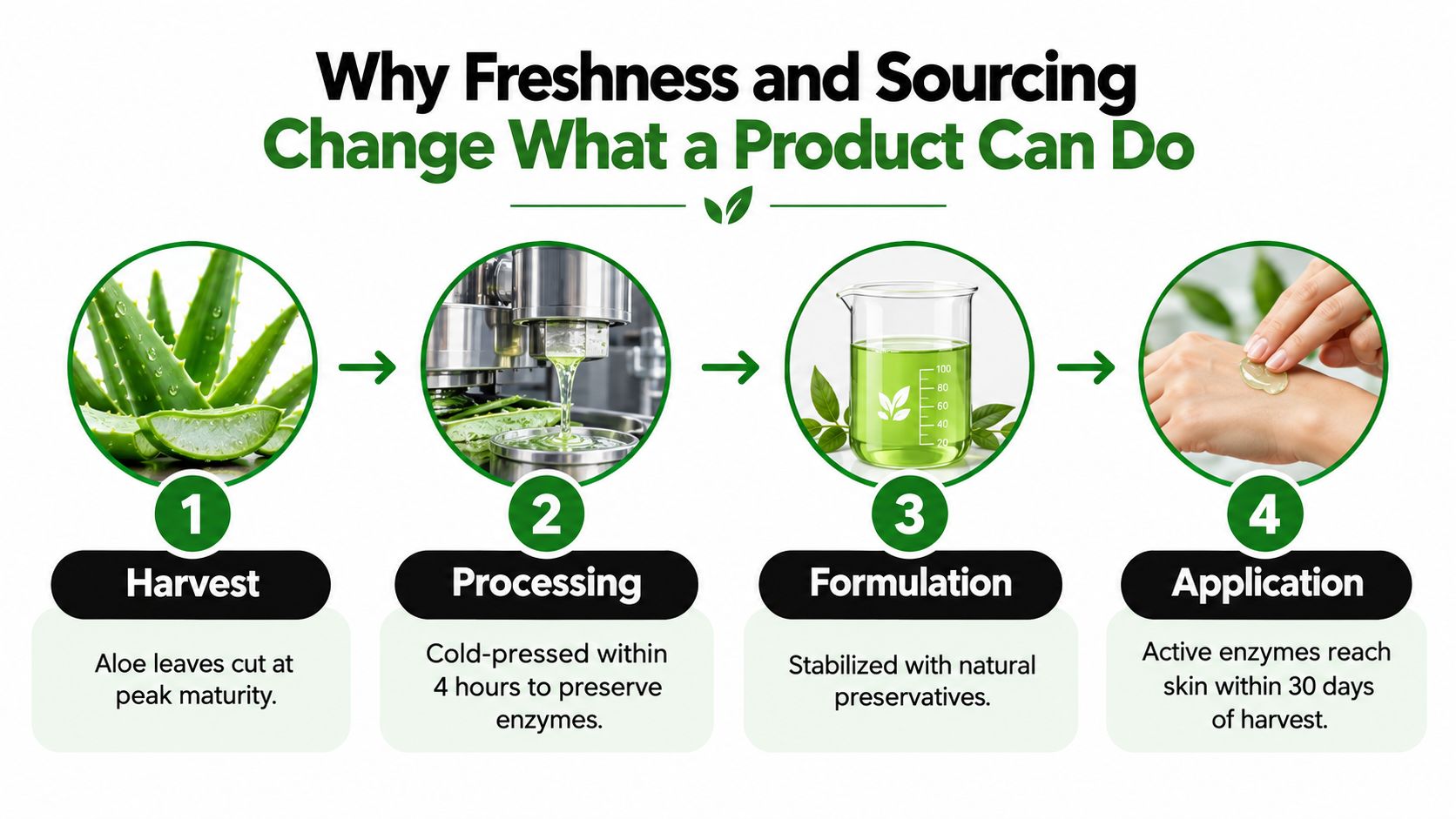
Picture leaves moving from the company's farm to its onsite facility rather than first traveling to a distant manufacturer. The company describes extracting, filtering, and stabilizing its fresh aloe juice onsite in its explanation of fresh aloe vera gel production.
That is a specific sourcing mechanic. It doesn't establish a universal rate at which aloe loses potency or prove how every competing supplier operates.
The following visual illustrates a production sequence. Its additional processing and application timing claims aren't substantiated by the cited company information.
Ask for useful transparency
- Ingredient origin: Who grows the aloe, and who processes it?
- Certification scope: What do the stated ECOCERT and USDA organic certifications cover?
- Finished formula: Can you review the full ingredients and directions before purchasing?
Use the brand's organic body care guide as a shopping starting point for aloe-focused options such as Pure Aloe Vera Gel, Aloe Nourishing Body Wash, and Aloe Hydrating Moisturizer. Confirm current product details before choosing.
Freshness information helps explain production choices. It should complement ingredient review and personal tolerance, not replace them.
Seasonal and Climate Adjustments That Keep Skin Comfortable
The lotion you enjoy under a loose summer shirt might feel insufficient when you're wearing winter layers. Rather than rebuilding your routine every season, adjust the texture, amount, and areas receiving attention.
Use weather changes as a prompt to reassess, not as proof that you need a new purchase. Your skin's comfort is a better guide than the month printed on the calendar.
A practical seasonal checklist
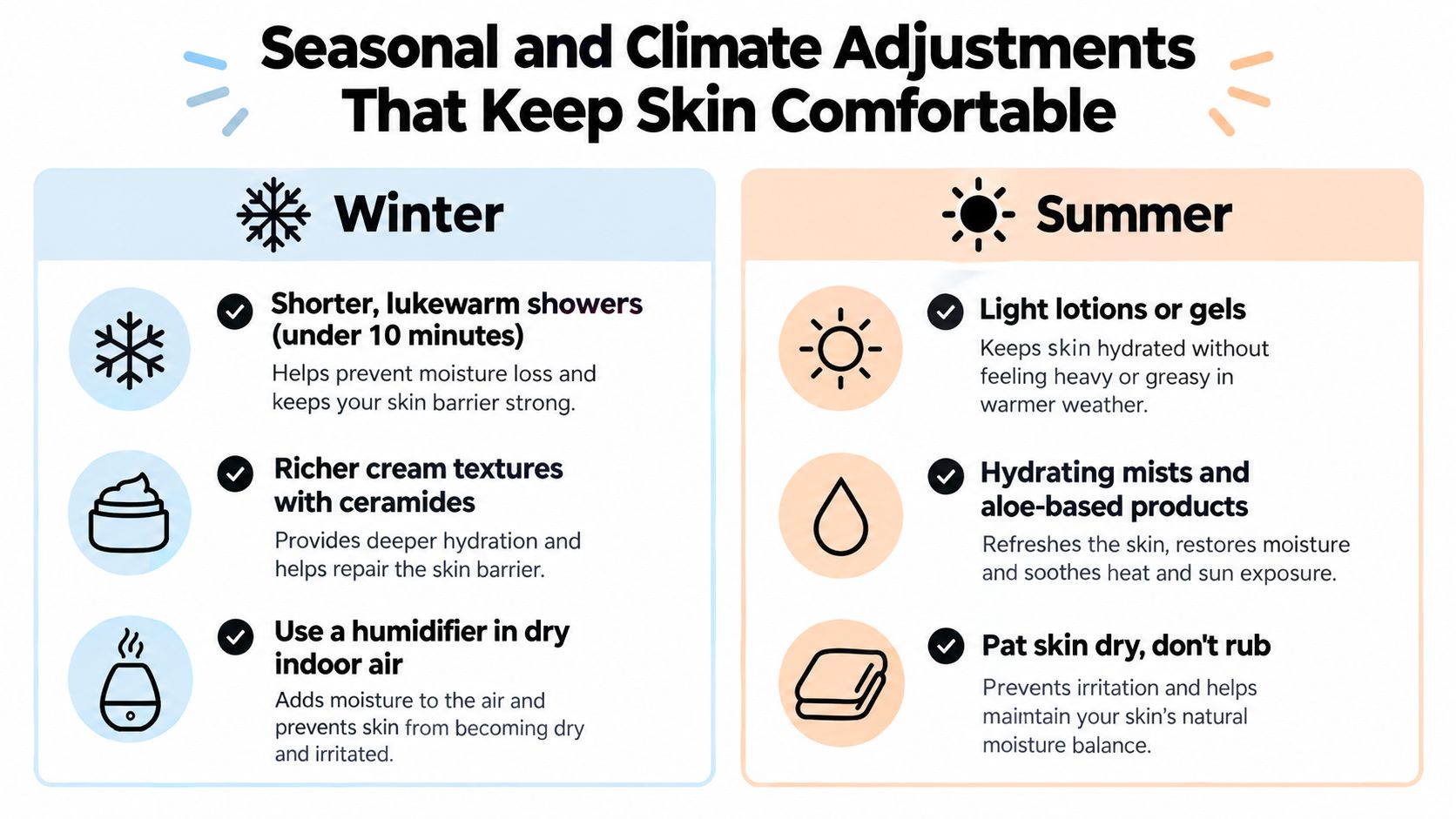
- Winter: Keep showers comfortably warm and brief. Try your richer moisturizer on areas that feel tight, and avoid rubbing those areas with a towel.
- Spring: Reassess before adding exfoliation. If skin already feels comfortable, there's no need for a seasonal “reset.”
- Summer: Choose a lighter texture if you prefer it, cleanse after sweaty activities as needed, and avoid leaving damp clothing against your skin.
- Humid conditions: Apply enough product for comfort without automatically adding heavy layers.
- Dry conditions: Consider whether a moisturizing layer followed by a more protective texture suits your skin.
The visual below summarizes texture and bathing choices. Its precise shower-duration threshold isn't established by the cited guidance.
Give exposed skin tested protection
Choose broad-spectrum SPF 30 or higher for routinely exposed areas, apply generously, and reapply approximately every two hours and after swimming or sweating, following FDA sunscreen guidance. That guidance also explains that water-resistance claims are limited to 40 or 80 minutes, not permanent protection.
Remember shoulders, arms, chest, neck, and hands when your clothes leave them uncovered. A pleasant aloe gel can fit your post-shower routine, but its refreshing feel doesn't make it sun protection.
The important seasonal skill is noticing a mismatch early. If a product feels too heavy, use a lighter option. If you're repeatedly uncomfortable, reconsider your habits instead of layering indefinitely.
Building a Routine You Actually Understand
Pick up each bottle you currently use and finish this sentence: “I use this because…” If the answer is only that you saw it recommended, pause before adding another product.
You should be able to explain your routine without reciting ingredient jargon. “This helps me wash without feeling stripped” is useful. “This gives my legs a more comfortable finish” is useful. A clear purpose makes it easier to recognize when something isn't earning its place.
Keep a small decision framework
- Protect comfort first: Don't chase smoothness at the expense of how your skin feels.
- Choose an identifiable role: Know whether a product cleanses, moisturizes, exfoliates, or provides tested sun protection.
- Prefer specific sourcing information: Look for explanations you can evaluate rather than relying on decorative claims.
- Adjust deliberately: Change the part that isn't working instead of replacing everything at once.
A practical shelf might contain a mild cleanser, a moisturizer suited to your preferred texture, and sunscreen for exposed skin. An aloe-rich gel or occasional exfoliant can fit when it serves a clear purpose. Neither needs to become an automatic extra layer.
Make your next shower a useful experiment
Choose a manageable change: gentler towel drying, less heat, or remembering moisturizer before getting dressed. Notice how your skin feels afterward and later in the day.
Don't judge a product solely by its first refreshing sensation or by how impressive its label sounds. Pay attention to whether you enjoy using it, whether it fits your schedule, and whether your skin remains comfortable.
The most useful body skin care routine isn't the most elaborate. It's the one you understand well enough to maintain, simplify, and adjust without guessing every time the weather or your daily life changes.
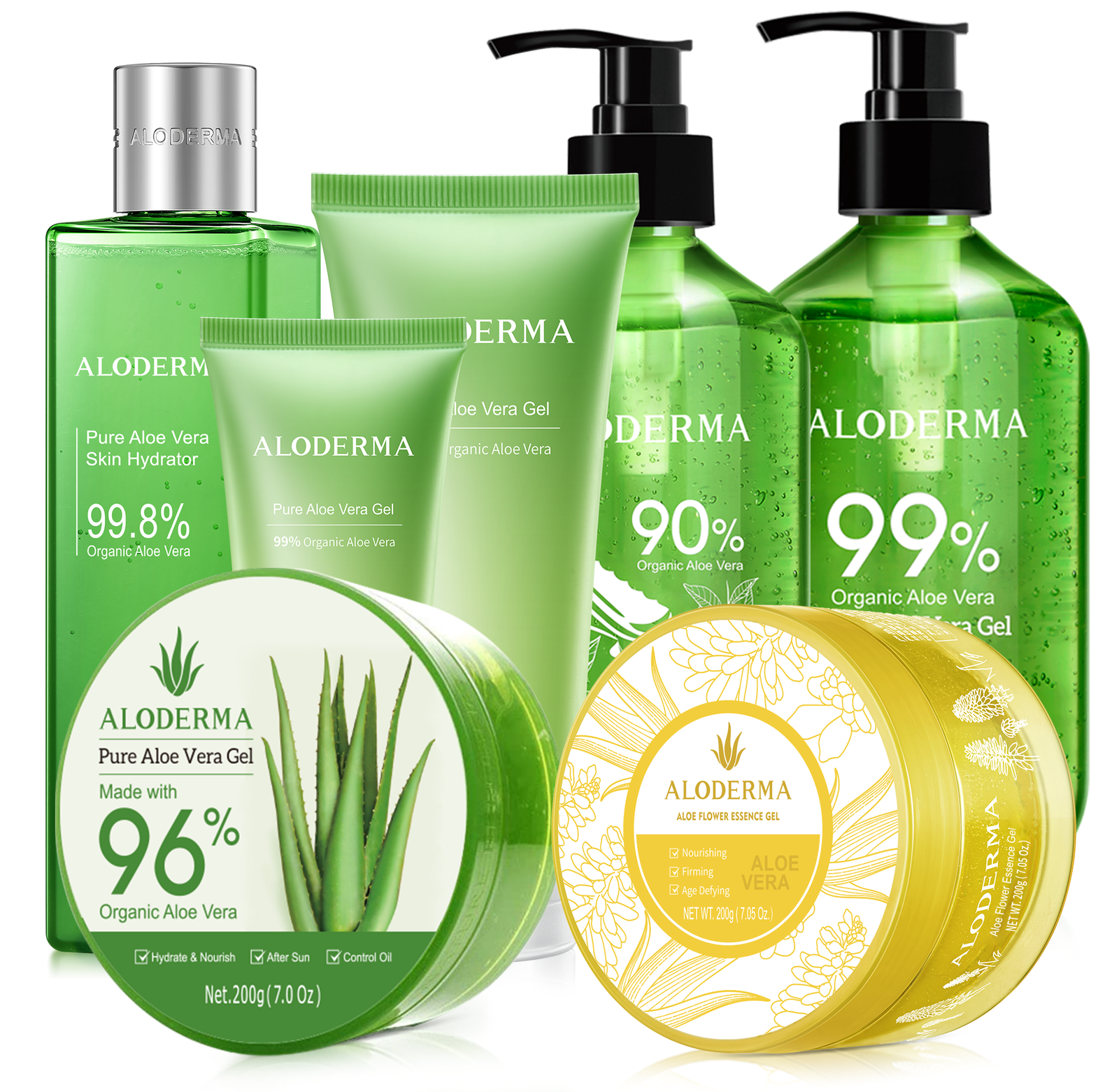
ALODERMA offers aloe-focused gels, moisturizers, and cleansing essentials for building a straightforward body-care routine. Visit ALODERMA to compare current ingredient lists and directions, then choose the product that fills a clear need in your routine rather than adding another unnecessary step.