







The most popular advice about gel cleanser vs foaming cleanser is also the least useful: choose gel for gentleness and foam for a stronger clean. That shortcut confuses the product's texture with the chemistry that touches your skin. A gel can lather, a foam can feel comfortable, and either can leave your face tight if the formula doesn't suit your routine.
The better question is what happens between dispensing and rinsing. Surfactants, pH, contact time and after-feel tell you more than bubbles do. If you've ever washed your face and immediately wanted to put moisturizer on because smiling felt uncomfortable, that distinction matters more than the name on the bottle.
Gel and Foaming Cleansers Side by Side
Gel and foaming cleansers compared
| Feature | Gel cleanser | Foaming cleanser |
|---|---|---|
| Texture | Clear or semi-opaque, cool and cushioned | Creamy or airy, with lather that forms when worked with water or is dispensed by a pump |
| Lather level | Usually low or none; some gels are foaming gels | Visible lather, ranging from light to dense |
| Typical cleansing agents | Surfactant blends, often with humectants or polymers; mildness requires assessment of the complete formula | Surfactants that generate lather, often anionic-based, combined with other cleansing agents |
| Typical after-feel | Often chosen for a soft, less squeaky finish | Fresh and clean, but can feel tight if the cleansing system is too stripping for the user |
| pH | Set by the formula, not the format; look for a stated pH or pH-balanced claim | Set by the formula; a neutral pH alone doesn't guarantee gentleness |
| Best-fit routine | Evening washes after sunscreen or makeup when a soft finish matters and removal is adequate | Morning washes or heavy-load days when a lathered feel is preferred and removal is adequate |
Read these descriptions as shopping clues, not performance guarantees. A gel's cushion tells you how it spreads, not whether it will remove your particular sunscreen. A foam's bubbles tell you that the formula produces lather, not how much oil it removes.
Gel-based cleansers held a 39.45% share of the global face-wash market in 2024, according to Mordor Intelligence. That helps explain why gel is such a familiar shelf category, but popularity isn't evidence that a format suits your face.
What each difference means at the sink
Texture affects application: a gel may feel slippery and cushioned, while a lathering wash spreads through bubbles. Lather level affects the sensory experience, but low foam doesn't mean the cleansing agents aren't working.
Cleansing agents determine how the formula interacts with oil, debris and skin. After-feel is your practical feedback: soft and comfortable is useful; squeaky and pulling isn't a result to chase.
pH requires a label statement or manufacturer information because you can't determine it by looking at the cleanser. Routine fit means checking what you're removing and how your face feels afterward, rather than assigning one texture permanently to one skin type.
Shopping rule: Judge the disclosed formula and the rinse-off experience before trusting gel or foam on the front label.
For example, you might enjoy a foaming morning wash but dislike the same product after a windy, dry day. That doesn't make your preferences inconsistent. It means the washing experience needs to fit your skin's present comfort, not just its usual oil level.
Foam Is a Feeling and Surfactants Do the Lifting
The claim that gel is always gentle and foam is always harsh doesn't survive a close look at finished formulas. Foam is a sensory property, while tolerability involves the surfactant blend, its concentration and how that blend interacts with the skin's outer layer.
In a four-week study involving 85 people with sensitive skin, a foaming gel cleanser using polymeric surfactant technology produced no significant increase in investigator-graded irritation, while stinging, itching, burning and tightness decreased significantly at weeks two and four, according to the published clinical study. That finding supports a narrow but important conclusion: a deliberately engineered foaming formula can be well tolerated. It doesn't establish that every foam is gentle or that this result transfers to every other product.
Why pH doesn't settle the question
A skin-compatible pH is useful, but it isn't a complete mildness test. A neutral-pH cleanser based predominantly on anionic surfactants can produce more dryness and irritation than a comparable neutral-pH system, as discussed in the International Journal of Cosmetic Science.
Formulators therefore look beyond bubbles and pH. They assess hydration, visible redness, perceived tightness and transepidermal water loss, the movement of water through the skin that can help indicate barrier disruption.
You don't need laboratory instruments to notice that a wash isn't working for you. Use these practical observations:
- Immediately after rinsing: Your face should feel comfortable rather than squeaky, burning or pulled.
- During the following hour: Notice whether tightness develops or persists. Don't treat an hour as a safety threshold or endure discomfort to complete a test.
- The next morning: Check whether your skin feels settled or unusually dry and uncomfortable.
Suppose two cleansers both produce generous lather. One leaves your cheeks soft; the other makes the corners of your mouth feel stretched. Their similar foam volume hasn't predicted their different after-feel.
What actually removes the residue
Surfactants have water-loving and oil-attracting portions. Above a particular concentration, they can cluster into micelles, with water-loving portions facing outward and oil-attracting portions directed inward, helping carry oily material into the rinse, as explained in this review of cleanser chemistry.
Bubbles aren't micelles made visible. Foam forms at air-water interfaces, while the cleansing system works within the liquid and at the skin's surface. A low-lather gel can therefore use related cleansing chemistry without producing a sink full of bubbles.
Matching Texture to Your Skin Type and Routine
Your week is a better starting point than a rigid skin-type chart. A humid commute, indoor heating and layered sunscreen create different washing needs, even for the same person.
Choose the experience you can use comfortably rather than the one that promises the biggest sensory change.
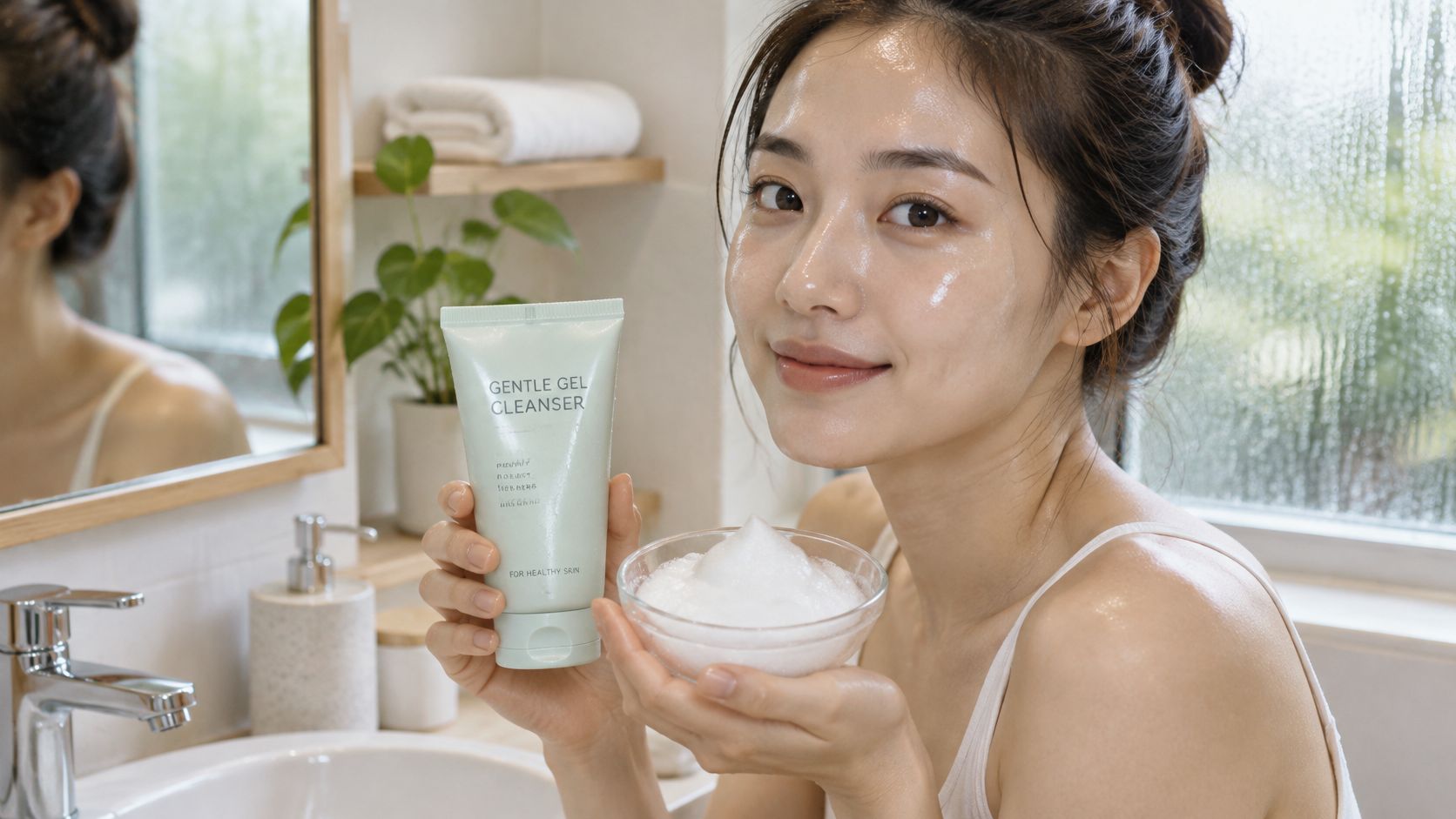
When your face feels shiny but your cheeks feel tight
On a humid day, a lightweight gel or a comfortable lathering formula may provide the finish you enjoy. If your face also feels stretched by midday, don't assume you need stronger oil removal. Review your washing frequency and the product's after-feel instead.
Our guide to choosing a cleanser for sensitive, oily skin addresses that combination of concerns. The goal is to remove surface buildup without making the drier parts of your face pay for a fresh-feeling T-zone.
When comfort is the deciding factor
- After winter heating: Start by comparing a gel or non-foaming cleanser with your current wash. Use lukewarm water and follow with moisturizer rather than expecting the cleanser to supply lasting hydration.
- When heavy lather stings: A low-foam formula is a reasonable alternative to test, but stop using a product that causes discomfort. Courier Pharmacy's guide to a soap-free face wash for reactive skin provides additional context for comparing soap-free options.
- When blemishes are part of your routine: Keep cleansing and targeted care separate. Our Aloe Clearing Gel is a spot treatment used after cleansing and intermittently throughout the day; it contains 91% aloe vera, witch hazel, sugar kelp and purslane, and costs $12.99 USD. Our Aloe Skin Clearing Set is made for sensitive and blemish-prone skin.
For a visual companion to the texture comparison, use the video below.
If you wear substantial makeup or repeatedly apply sunscreen, assess what remains after rinsing, not how impressive the lather looks. A gel isn't automatically inadequate, and foam isn't automatically enough. Use a suitable makeup-removal step when needed rather than repeatedly washing because the first rinse didn't remove a long-wear product.
Pick the scenario that sounds like your actual week. Your most useful choice may be the formula that leaves your cheeks comfortable, not the format usually marketed to your skin type.
How Actives Seasons and Routines Change Your Choice
You apply an exfoliating acid at night, then notice that your usual lathered wash leaves your cheeks pulling. The useful response isn't to add another intensive cleansing step. Reduce the washing burden and assess whether a milder formula restores comfort.
Interest in barrier-support claims and gentle, hydrating cleansing reflects a broader shift toward less demanding routines, described in Croda Beauty's cleansing-trend analysis. For an individual shopper, the important decision is simpler: choose a cleanser that doesn't add avoidable discomfort to the products already in use.
An evening adjustment that makes sense
On nights involving a retinoid or exfoliating acid, compare your current cleanser with a well-formulated low-foam or non-foaming option. Keep other tolerated products steady so you can judge the change rather than replacing the entire routine at once.
You might retain a comfortable foam for mornings and choose a softer-feeling wash in the evening. But if the foam feels good at both times, there's no chemistry-based reason to replace it solely because it lathers.
Match the washing burden to your skin's current tolerance, not to how much effort you've already invested in the routine.
When the weather changes
Dry winter air and indoor heating are practical reasons to reconsider your cleansing experience. A non-foaming gel may be worth testing, alongside lukewarm rinsing and a leave-on moisturizer.
Keep application brief rather than treating the cleanser like a mask. If a product is designed to be lathered in your hands, prepare it there before spreading it gently over damp skin; don't keep working it on your face just to generate more bubbles.
After a professional cosmetic service, use the aftercare directions from the person who performed it before substituting cleansers. The most active part of your routine should influence how conservatively you cleanse, while the day's residue determines what you need to remove.
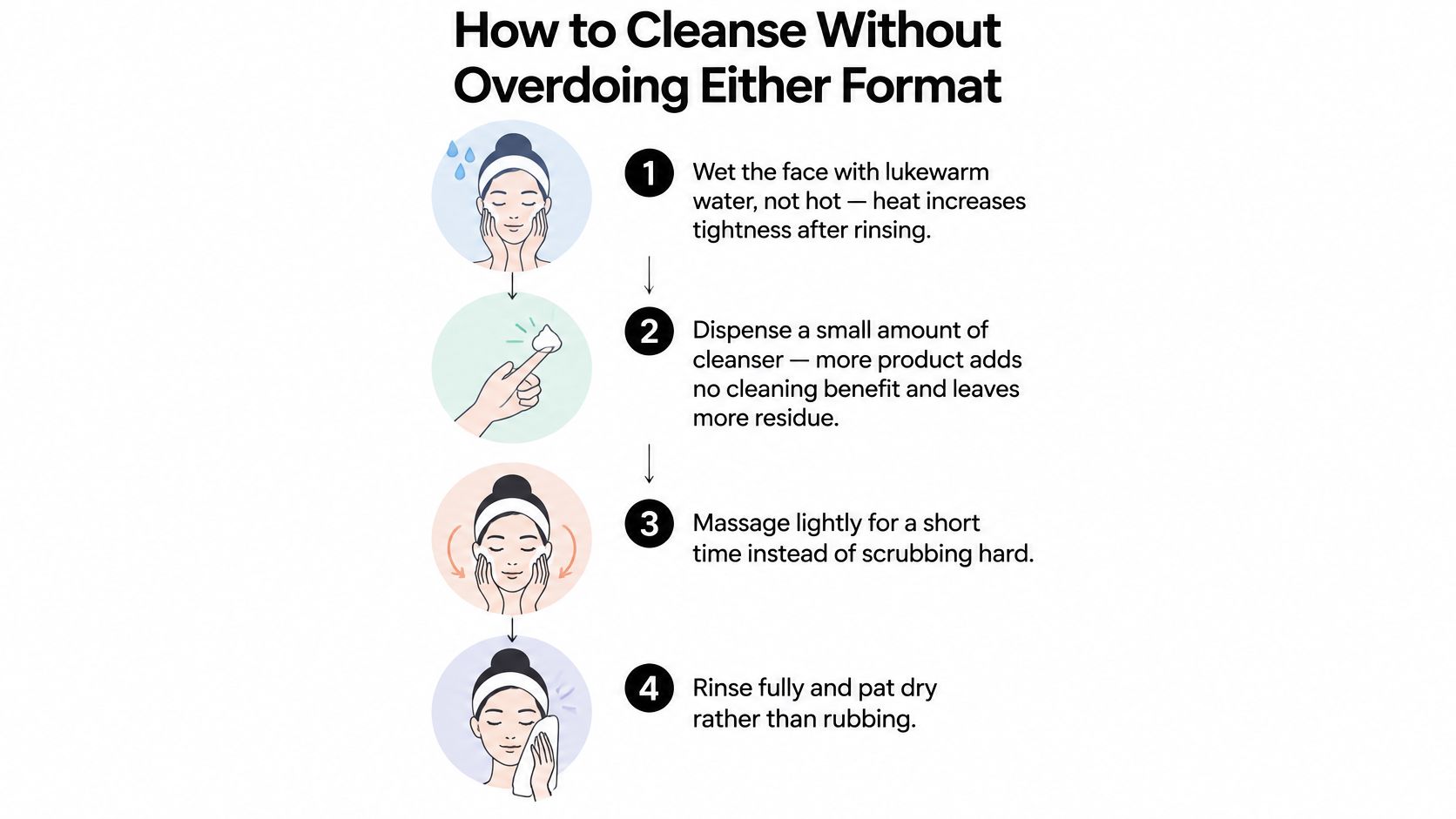
How to Cleanse Without Overdoing Either Format
Technique can make an otherwise suitable cleanser less comfortable. Start with a light touch, enough product to spread easily and a complete rinse, rather than more cleanser or harder rubbing.
The process below keeps the focus on removal without turning washing into another intensive step.
A controlled wash from start to finish
- Wet your face with lukewarm water. Avoid a hot rinse, especially when your face already feels dry. Damp skin also helps you distribute the cleanser without dragging your fingertips across it.
- Dispense a small amount. Use enough to spread over the intended area, not enough to build the largest possible mound of foam. Add product only if you can't distribute it adequately.
- Prepare the formula as intended. For our lathering cleanser, work it into a lather in your hands, then massage onto damp face and neck. Its directions call for use morning and night, followed by rinsing with warm water; don't try to make a non-foaming cleanser behave the same way.
- Massage lightly and briefly. Move your fingertips gently rather than scrubbing or repeatedly passing over a tight-feeling area. There isn't a universal massage duration established for every formula, so don't extend contact just to reach a timer target.
- Rinse thoroughly. Check the hairline, jaw and sides of the nose, where product can be easy to miss. If visible makeup remains, address the removal method instead of rubbing harder.
- Pat dry and add leave-on care. Use a soft towel without dragging it across your face. When extra hydration or dry environmental conditions call for it, our cream is applied over the face and neck morning and night.
Keep rinse-off expectations realistic
A botanical ingredient in a cleanser doesn't perform the same job as a product left on the skin. Our discussion of aloe vera cleansing cream distinguishes evidence about leave-on aloe preparations from what can reasonably be expected of a rinse-off cleanser, and describes the Aloe Soothing Cleanser as non-foaming and pH balanced.
For an evening wash after sunscreen, the practical sequence is straightforward: gentle application, a full rinse and a leave-on hydrator if needed. If you're unsure whether your schedule is excessive, compare it with our guidance on how often to wash your face.
A useful finish: Clean skin should let you move on with your evening, not keep you thinking about how tight your face feels.
The next morning, assess comfort before adding another cleansing step. You're looking for a face that feels settled, not one that requires a more elaborate routine to compensate for washing.
Check Your Cleanser Before You Buy
A cleanser's texture tells you how washing feels, not whether the formula is gentle. Before buying, look at the cleansing agents, any stated pH, and how your skin feels after rinsing. Foam is a sensory signal, not a reliable test of harshness.
- Identify the cleansing agents. Read the first few surfactants on the ingredient list, rather than judging the formula by botanical ingredients or bubbles alone. One ingredient name cannot establish how mild a blend will be; the full formula matters.
- Check for pH information. A stated pH gives more useful context than a texture label. Human skin normally has an acidic surface pH of approximately 4.0–6.0, while synthetic-detergent cleansers are generally formulated around 5.5–7.0, according to Skin Cleansing without or with Compromise.
- Assess the rinse-off feel. If a tester is available for that purpose, spread a small amount on your hand with water, then rinse. Notice slip, fragrance and residue. A hand test can't predict how your face will respond to repeated use.
- Give the cleanser a specific job. Decide whether you need a morning wash, an evening step for sunscreen residue or a cleanser that feels comfortable on dry-feeling days. A clear purpose helps distinguish useful product information from attractive but irrelevant claims.
- Change one cleanser at a time. Keep the rest of your tolerated routine steady and note residue removal, comfort and next-morning feel. Stop using a product if it causes burning or other clear discomfort.
Compare formulas before building a rotation
A morning foam and an evening non-foaming cleanser can serve different preferences, but both aren't required for a complete routine. Add a second format only if it addresses a need the first cleanser doesn't.
ALODERMA's Aloe Hydrating Cleanser contains fresh organic aloe juice. Its Aloe Oil Controlling Cleanser contains fresh organic aloe vera and combines aloe with mint. It is used morning and night. These details help identify what each product contains; they don't establish how much it will foam or whether it will suit every skin type.
| Your priority | Product to inspect | What to assess |
|---|---|---|
| A lathering wash | Aloe Oil Controlling Cleanser | Whether the rinse and after-feel remain comfortable |
| Fresh organic aloe juice | Aloe Hydrating Cleanser | Whether it fits your routine and leaves skin comfortable |
Separate sourcing from cleansing performance
ALODERMA sources aloe from its own plantations and processes it on-site within 12 hours of harvest. The brand describes its formulas as prioritizing bioactive aloe as a primary ingredient. That sourcing information describes how the aloe is handled; it doesn't show that a cleanser will remove residue more effectively or suit every skin type.
For budgeting, a cleanser lasts about 8 weeks, while other skin care products last about 3–5 months, depending on use. Orders of $35 or more receive free shipping and handling. Choose a formula for its role in your routine, rather than adding products only to reach an order threshold.
The verdict depends on your skin's response. If a foaming wash leaves your face feeling tight, try a different formula, whether gel or another texture. If a cleanser rinses clean and feels comfortable afterward, foam alone is no reason to reject it.
Read the named cleansing agents and decide what you want the product to do. Choose based on residue removal and after-feel, not on bubbles as a shortcut for judging mildness.
ALODERMA sells aloe-based cleansers, including the Aloe Hydrating Cleanser and Aloe Oil Controlling Cleanser. Visit ALODERMA to compare the available formulas and choose one that fits your routine.