







You skip moisturizer because your forehead already looks shiny before breakfast. By noon, your cheeks feel tight, your nose still looks oily, and adding anything to your face sounds like the last thing you need. That uncomfortable combination is why learning how to moisturize oily skin starts with judging comfort, not chasing a completely matte finish.
You don't need a heavier routine. You need a small, repeatable one that lets you tell the difference between too much product and too little hydration.
Moisturize Oily Skin in Five Simple Steps
Skipping moisturizer after a shiny morning can leave you reaching for blotting paper while your skin feels increasingly stretched. Instead of washing again, establish a gentle baseline that you can repeat without constantly correcting your face.
The American Academy of Dermatology's oily-skin guidance recommends gentle cleansing, moisturizing, and daily broad-spectrum SPF 30 or higher. The practical challenge is applying enough hydration for comfort without leaving a thick coating.
Keep the application light and deliberate
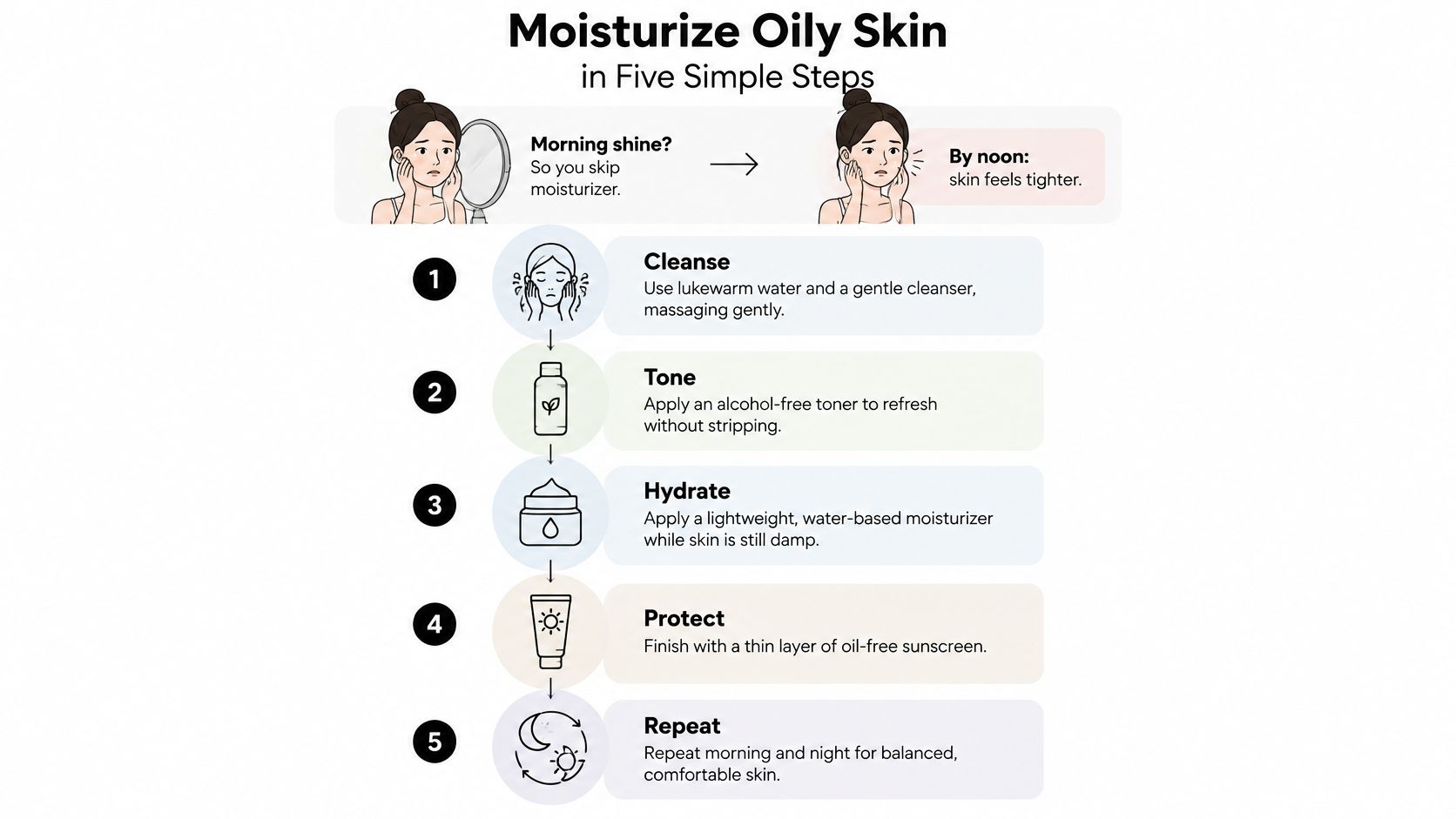
- Cleanse gently. Morning and night, work a gentle cleanser into a lather, then massage it over your damp face and neck before rinsing with comfortably warm, not hot, water. Use your fingertips rather than a scrub or washcloth, and don't keep washing until your skin squeaks.
- Pat with a soft towel, leaving your skin slightly damp rather than completely dry. This makes a small amount of moisturizer easier to spread evenly without repeatedly rubbing the same area.
- Apply a thin layer promptly, ideally within a minute of patting dry. Start with roughly a pea-sized amount of lightweight, non-comedogenic gel or lotion for your face, then use a little more for your neck if needed; extra moisturizer won't stop shine.
- Let the layer settle before adding anything else. If your skin feels coated rather than comfortable, don't keep stacking serum, gel, and cream in the hope that another layer will improve the finish.
- Finish with sunscreen each morning. Apply it as its own even layer rather than mixing it into moisturizer, and use the amount directed on its label.
Keep this visual guide handy while you establish the habit. Its toner step is optional, not another product you need to buy.
Adjust for the room, not just your skin type
A heated office or unusually dry weather can make your usual light layer feel insufficient. When extra hydration calls for it, apply a richer cream over the face and neck morning and night, keeping the application thin rather than automatically adding a heavy coating.
Midday check: Your skin should feel comfortable when you smile, not stretched across your cheeks. A little surface shine doesn't mean the routine failed.
If you're still hesitant to moisturize, our explanation of whether oily skin needs moisturizer addresses that starting point. For help making the habit stick, 3D Aesthetics Leamington Spa's discussion of the benefits of a consistent skincare routine offers useful context: a manageable routine is easier to maintain than a bathroom shelf full of occasional fixes.
Choose a Lightweight Formula That Fits Oily Skin
Moisturizer ingredient types and how they feel on oily skin
| Ingredient type | What it does | Feel on oily skin | Example |
|---|---|---|---|
| Humectant | Attracts and holds water in the outer skin layer | Light, water-like | Glycerin |
| Humectant | Attracts and holds water in the outer skin layer | Light, water-like | Hyaluronic acid |
| Occlusive | Forms a surface film that slows water loss | Heavier, can feel greasy | Dimethicone |
| Emollient | Softens skin by filling gaps between cells | Smooth, medium weight | Squalane |
| Soothing hydrator | Adds moisture and calms the feel of the skin | Light, fast-absorbing | Panthenol |
These are useful shopping categories, not promises about the finished texture. A formula containing dimethicone can still feel lightweight, while a gel can feel sticky if you apply too much.
A Journal of Skin and Sexually Transmitted Diseases review explains the complementary roles of humectants, occlusives, and emollients: attracting water, slowing its escape, and softening the surface. You don't have to eliminate every barrier-supporting ingredient to avoid a greasy finish.
Read the formula, then judge the finish
Use the table's feel column to narrow your options, but make the final decision with the complete product.
- Check the claims. Look for oil-free or non-comedogenic wording when available. Neither replaces a personal tolerability check, and you shouldn't assume a product carries either claim unless its label says so.
- Find the water-binding ingredients. Glycerin or hyaluronic acid near the beginning of the ingredient list can help identify a hydration-focused option. A short list is easier to review, but fewer ingredients don't automatically mean a better formula.
- Test a thin application. The useful question is whether the product leaves your face comfortable without an unwanted film. Judge that before applying makeup or adding several other layers.
A water-based gel or fluid is a sensible starting point if rich creams usually leave you wanting to wash your face again. Our gel moisturizer versus cream moisturizer comparison can help you choose between those textures.
Choose the lightest formula that keeps you comfortable, not the lightest formula you can possibly find.
Say your forehead feels fine with gel but your cheeks remain tight in a heated room. You can adjust the cheek application without coating your entire face more heavily.
Before buying, read each product's full ingredient list on its aloderma.com page. Don't infer the formula from a front-label ingredient, a texture description, or the word natural, especially if fragrance or essential oils have bothered your skin before.
Diagnose and Fix Shine, Tightness and Stinging
A shiny face isn't necessarily a well-hydrated face. Sebum is the oil your glands produce; hydration refers to water held in the outer skin layer. Those are separate characteristics, so you can feel oily across your forehead and uncomfortably dry around your mouth at the same time.
Look beyond the reflection in the bathroom mirror. Notice how your skin feels when you smile, whether small flaky patches appear beside your nose, and whether your usual products suddenly sting after washing.
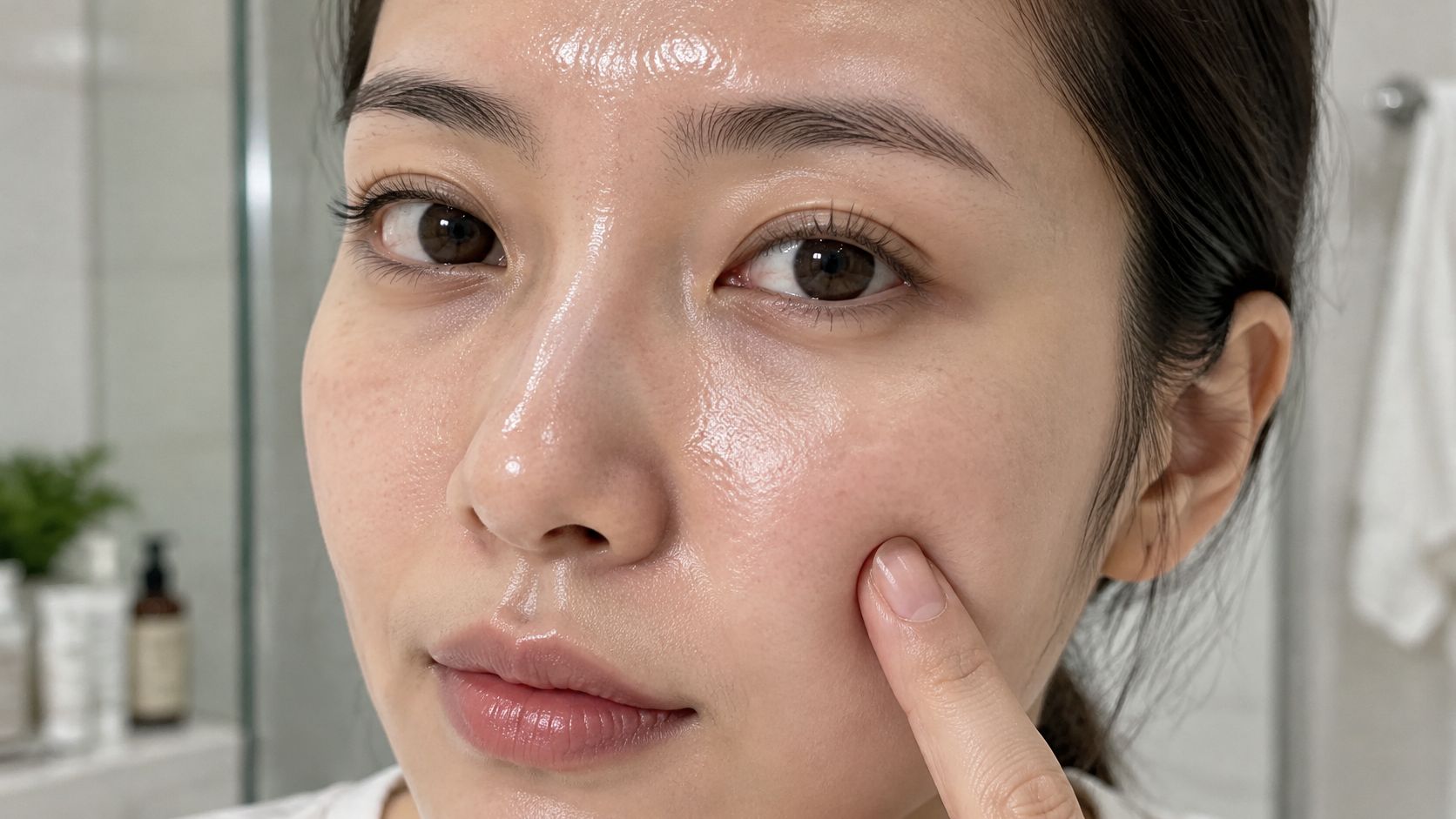
Use comfort and surface texture together when checking your skin.
Match the symptom to one change
The table gives you a starting point, not a definitive explanation for every sensation. Product combinations, application amounts, and cleansing habits can produce similar results.
Oily skin symptoms, likely causes and fixes
| Symptom | Likely cause | Fix |
|---|---|---|
| Shiny by noon but tight | Dehydration rather than oil alone | Add a lightweight humectant gel after cleansing |
| Greasy feel after moisturizing | Heavy occlusive layer | Switch to a water-based gel or lotion |
| Stinging after cleansing | Over-cleansing or a harsh cleanser | Cleanse once or twice daily with lukewarm water |
| Sticky or pilling layers | Too much product | Apply a pea-sized amount to damp skin |
| Redness after a new product | New ingredient reaction | Stop the product and patch test |
Shiny but tight calls for a hydration check, not another round of degreasing. If blotting removes the shine but leaves the stretched feeling unchanged, the oil on the surface wasn't your only concern. Try the lightweight layer after your next gentle cleanse rather than adding a stronger cleanser.
Greasy immediately after moisturizing is a different problem. If your face feels comfortable before application but coated afterward, first reduce the amount. If even a thin layer feels unpleasant, change the texture rather than abandoning moisturizer altogether.
For example, someone who wears makeup may assume their moisturizer is too rich because foundation slides around. Check the finish before makeup goes on: if it feels fine on its own, the combination or application amount may be the issue.
Don't mistake stinging for effectiveness
Stinging after washing is a reason to simplify, not proof that the cleanser worked especially well. Stop scrubbing, avoid hot water, and don't add an exfoliating toner to make your skin feel cleaner.
Persistent burning deserves a firmer response: stop the product rather than trying to push through it. If discomfort continues after you simplify, seek professional advice instead of experimenting with more products.
Troubleshooting rule: Change the part of the routine that matches the problem. Don't replace the cleanser, moisturizer, and sunscreen together.
Sticky residue and pilling also need a measured approach. Start with less moisturizer and let it settle before sunscreen; don't rub harder to force rolled-up product back into your skin. Pilling can involve incompatible layers as well as excess quantity, so a smaller application is a useful test, not a guaranteed fix.
For a visual companion to your routine check, use the video below.
Separate an immediate boost from lasting comfort
A 2024 clinical study in the Journal of Cosmetic Dermatology reported a 125.82% increase in stratum-corneum hydration immediately after treatment with a panthenol-enriched mask. That immediate measurement doesn't establish how long the improvement lasted, and it isn't a prediction for your everyday moisturizer.
A mask can feel gratifying after a dry day, but your daily cleansing and moisturizing habits still need to be comfortable on their own. Don't use an occasional intensive step to compensate for washing that repeatedly leaves your face tight.
If a new product causes redness, stop using it rather than immediately trying it again across your whole face. Our guide to how to patch test skincare explains how to assess a small area first; don't re-test on skin that's still uncomfortable.
You may notice an application problem immediately, such as a thick film or product rolling under your fingers. Other changes need repeated, consistent use to judge. Don't set a deadline that pressures you to tolerate stinging just to finish the experiment.
Track Your Routine Over Four Weeks
Hydration checkpoints across a four-week routine
| Timepoint | Reported hydration change | What to check | Adjust if |
|---|---|---|---|
| 2 weeks | 41% mean improvement | Midday shine compared with tightness | Still tight: add a thin layer after cleansing |
| 4 weeks | 38% mean improvement | Comfort, stinging and residue | Stinging: stop the new product and patch test |
| 8 weeks | 116% mean improvement | Overall balance and comfort | Comfortable and steady: keep the routine |
The figures in this table come from a 2025 moisturizer study published in the Journal of Cosmetic Dermatology, which reported mean skin-hydration improvements of 41% after 2 weeks, 38% after 4 weeks, and 116% after 8 weeks. They're results from one study, not expected outcomes for every moisturizer or every reader.
The later checkpoint extends beyond your initial tracking plan. You don't need a device or a percentage target to decide whether your own routine feels better.
Keep a useful record, not a skincare diary
Each morning, note how your skin feels before cleansing and after applying your products. In the evening, record what happened by midday: shine, tightness, comfort, stinging, and visible residue. A short phone note is enough.
- Record the amount. Note whether you used your usual thin layer or added more, especially on your cheeks.
- Name the changed variable. Write down the product or amount you changed, not that you tried something different.
- Add environmental context. A day beside a heater or in strong air conditioning helps explain why your skin felt different.
A useful entry might read: Forehead shiny at lunch, cheeks comfortable, no stinging, sunscreen rolled near the jaw. That points toward checking layering technique rather than automatically choosing a richer moisturizer.
Make the next decision from comfort
Keep going when your skin feels comfortable. A matte finish isn't the only acceptable result, and a little oil doesn't justify dismantling a routine that feels good.
If tightness remains, adjust the moisturizing amount before changing several products. If stinging or redness appears, stop the new addition rather than waiting for the next checkpoint.
Patch-test a new option on a small area of the jaw before applying it widely, and only introduce it when that area feels settled. Your record should make the next choice clearer, not turn skincare into another daily source of stress.
Start Your Oily-Skin Routine This Week
Gather the essentials: a gentle cleanser, a lightweight non-comedogenic moisturizer, and a broad-spectrum sunscreen. Start with a routine you can repeat on a rushed morning, not one that requires a shelf of extras.
For our cleansing step, the Aloe Oil Controlling Cleanser contains fresh organic aloe vera, combined with mint and witch hazel. Our Pure Aloe Vera Gel + Tea Tree Oil works as an all-over facial moisturizer used twice daily. Review the full ingredient lists before buying, particularly if essential oils haven't suited you previously; don't assume a texture or ingredient automatically guarantees personal compatibility.
Know what you're choosing
We're a fully vertically integrated aloe vera company. We grow all of our own organic aloe vera, process it, and manufacture onsite within 12 hours of harvest to ensure the primary ingredient in every product is the most bioactive and effective aloe vera possible.
For budget planning, our cleanser lasts about 8 weeks, while other skincare products last about 3 to 5 months, depending on use. Actual application habits matter, so don't use more to reach a particular finish.
Commit to the four-week tracking plan this week. Choose one adjustment at a time, and let comfort guide whether you keep it.
ALODERMA offers fresh organic aloe-based cleansers and lightweight facial hydration options for a simple oily-skin routine. Visit ALODERMA to review the Pure Aloe Vera Gel + Tea Tree Oil and Aloe Oil Controlling Cleanser ingredient lists, then choose your starting products and record how your skin feels.