



You've just washed your face, and your cheeks already feel tight. A bottle of pure aloe vera spray sounds like the simplest fix: a light mist, a cool feeling, and no heavy layer before you get on with your day. But the word pure doesn't tell you everything you need to know about what's inside.
A useful aloe spray starts with a readable ingredient list and ends with a routine that keeps skin comfortable. The trick isn't spraying more often. It's choosing a well-made formula, understanding what its label proves, and using it as a hydrating first layer rather than asking it to do a moisturizer's job.
What Pure Aloe Vera Spray Is Made Of
A pure aloe vera spray is a water-based mist built from aloe gel, not a concentrated, water-free extract. Most of what lands on your skin is water, including the water naturally present in the plant. That doesn't make aloe an empty ingredient, but it does change how you should interpret a purity claim.
A systematic review of aloe composition describes the plant as approximately 99–99.5% water, with 0.5–1.0% solid material, and identifies more than 75 potentially active constituents. The same review places the inner pulp at roughly 70–80% of leaf weight and the rind at 20–30%.
Aloe leaf and formula composition
| Component | Share | What It Means for Your Spray |
|---|---|---|
| Water in aloe gel | 99–99.5%, as a plant-composition benchmark | Most of the mist is water, so freshness and preservation matter |
| Solid material | 0.5–1.0% | A small fraction holds vitamins, minerals, enzymes and sugars |
| Active constituents identified | More than 75 | Processing and filtration can change the final profile |
| Inner pulp of leaf | 70–80% of leaf weight | The part most gel-based sprays draw from |
| Leaf rind | 20–30% of leaf weight | Whole-leaf material changes composition, so check the label |
These are raw-plant composition figures, not laboratory results for every finished spray. A manufacturer can add other ingredients or change the concentration during production.
Why the small solid fraction matters
Think of cucumber water in your kitchen. Most of the glass is water, but a relatively small amount of cucumber gives it a recognizable character. Aloe isn't chemically identical to cucumber water, of course, but the comparison helps explain why a small non-water fraction can still matter.
Aloe's solids include polysaccharides, which are chains of sugars, alongside minerals, enzymes, vitamins, phenolic compounds and organic acids. The green outer rind and the clear inner pulp don't have identical compositions, so whole-leaf material isn't interchangeable with inner-leaf gel.
At the shelf, look for Aloe Barbadensis Leaf Juice near the beginning of the ingredient list, ideally first when you want an aloe-led formula. A water-first mist containing aloe extract may still be pleasant, but it's a different formulation from a spray built primarily around aloe juice.
Decoding Label Claims Before You Buy
Turn the bottle around before you trust the front. Pure describes a claim, not a complete quality specification. You still need to know what the manufacturer means by it.
For a product presented as undiluted, fresh aloe, you'd expect inner-leaf juice without added water or reconstituted powder. However, the words 100% pure aloe vera alone don't establish that production method, and aloe appearing first doesn't prove the absence of added water.
Label claims and what to verify
| Label Claim | What It Should Mean | What to Check |
|---|---|---|
| 100% pure aloe vera | Inner-leaf gel with no added water or powder, if that is the claim being made | Aloe listed first, plus an explicit processing statement |
| Stated aloe percentage | Share of aloe in the formula | Number on the label is consistent with the ingredient order |
| Organic | Organically grown aloe inputs | Named certification, such as ECOCERT, USDA Organic or EU Organic |
| Processed within 12 hours | A defined freshness window, with its endpoint made clear | Whether the brand means processing, manufacturing or bottling |
| Preservative system | Helps keep a water-based spray stable | Preservation ingredients and finished-product testing information |
| Fragrance or essential oils | Added scent or aromatic plant oils | Full disclosure; consider fragrance-free if skin reacts to scent |
| Batch testing | Quality checks from one batch to the next | Published results or confirmation of what is tested |
| Expiry and storage | How to store and use the product responsibly | Date code, storage directions and any period-after-opening guidance |
What the label can't prove
An aloe percentage is more useful than a vague phrase such as aloe blend, but it doesn't reveal the condition of the aloe's polysaccharides. Nor does an organic certification prove that a finished spray will suit your skin. Check whether certification covers the agricultural ingredient or the complete cosmetic product.
Preservatives aren't automatically unwanted extras. A water-rich formula needs a validated preservation approach, and a short ingredient list isn't a substitute for microbial testing. The Cosmoderma review of reactions to topical ingredients also supports a useful caution: botanical ingredients aren't automatically reaction-free.
For example, if a bottle says “botanical freshness” but gives no harvest timing, ask what that phrase means. If it says “naturally scented,” read the individual oils rather than assuming the scent is aloe.
Shopping rule: If several important checks are missing, choose the bottle that gives you clearer answers, not the one with the strongest purity slogan.
For additional ingredient-reading context, Skin Perfection's guide can help you find quality aloe juice for skin. Our guide to choosing an aloe vera gel brand offers another way to assess sourcing and formula transparency, even when you're shopping for a mist.
Why Freshness and Processing Decide Quality
Two sprays can list the same aloe percentage and still differ in quality. Harvest timing, extraction, filtration, stabilization and storage all shape what reaches the bottle. Following those steps helps you judge a “pure” claim as a question to verify, rather than a guarantee.
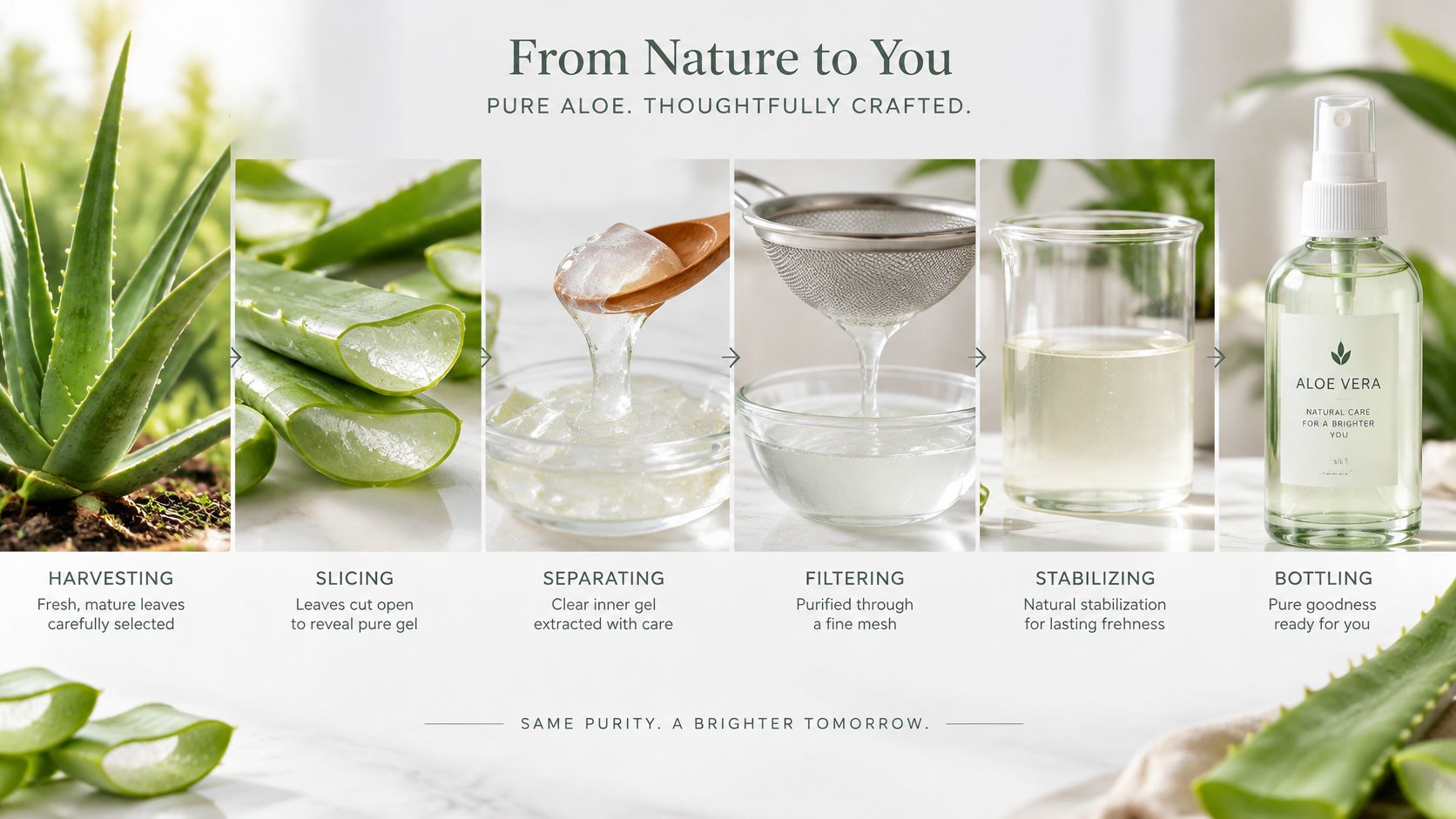
Heat, oxygen exposure, filtration, dilution and prolonged storage can alter aloe's polysaccharide profile. The NCBI Bookshelf chapter on aloe explains why preparation and standardization matter, including the role of acemannan, a polysaccharide associated with aloe's moisturizing and film-forming behavior. A matching percentage on two labels does not tell you whether the aloe was handled the same way or whether the finished sprays will perform alike.
A production promise needs a clear endpoint
ALODERMA grows organic aloe vera on its own plantations and processes its aloe products within 12 hours of harvest. Organic aloe vera is the primary ingredient in every product. The farm-to-skin process description connects cultivation and harvesting with finished-product production, making the timing claim more specific than a general promise of freshness.
ALODERMA's aloe vera juice is never made from concentrate or powder, and no water is added to it. These details tell you about the juice's sourcing and processing, though they do not by themselves establish how every finished formula is preserved or tested.
When comparing producers, ask:
- Who grows the aloe? A traceable source gives you more information than an unnamed botanical supplier.
- What does the timing cover? Harvest-to-extraction may not mean harvest-to-finished-product.
- What gets tested? Look for information about aloe identity, contaminants, microbial quality and preservation effectiveness.
The video below offers another view of the production story.
Freshness isn't a replacement for testing
Latex-derived compounds, including aloin and related hydroxyanthraquinones, need to be controlled during purification. An expert review of aloe safety reports a benchmark of no more than 50 ppm for non-medicinal topical use, while highly purified extracts may contain less than 1 ppm. Ask whether results are checked with an analytical method such as HPLC. Organic sourcing alone does not establish chemical purity.
A spray can feel cool on a hot afternoon, but neither its texture nor its scent reveals contaminant levels. Sensory impressions are not a substitute for testing.
Homemade aloe juice also differs from a preserved commercial spray. Without a validated preservative system, it can spoil quickly, even when prepared with clean tools. Keep commercial products in their original packaging and follow their opening and storage guidance. If you are checking an older bottle, consult this guide to how long aloe vera lasts.
What Aloe Spray Does for Hydration and Comfort
The most realistic reasons to use aloe spray are lightweight hydration, a cooling feel and everyday comfort. Those benefits can be worthwhile without turning the bottle into an all-purpose answer for every skin concern.
A review of aloe's composition and topical use describes gel as approximately 98% moisture, with the remaining fraction containing acemannan, other polysaccharides, sugars, minerals, organic acids and vitamins. Different preparations produce different composition figures, which is another reason not to read a raw-gel measurement as a guarantee about your finished mist. Aloe also has a long history of traditional use, but familiarity isn't proof that every formula performs equally.
Where a light layer fits real life
Consider a commuter whose face feels uncomfortable in dry train air. A light layer before moisturizer and makeup may fit the morning better than adding another rich serum. The useful result is comfortable skin, not a visibly wet face.
For a parent finally washing up after a long day, the appeal may be simpler: a quick, cool step before cream when an elaborate routine feels impossible. A traveller stepping off a flight might want the same manageable reset after cleansing, rather than repeatedly spraying over everything already on their skin.
In each case, the spray supplies a light first layer, while the moisturizer helps limit water loss. Water-heavy mists can evaporate and leave skin feeling tight when used alone, so more frequent spraying isn't necessarily the better solution.
Judge the routine by how your skin feels afterward, not by how refreshing the first few seconds feel.
Aloe spray isn't sunscreen, and it doesn't replace a cleanser or moisturizer. After a week of use, a reasonable thing to assess is whether your routine feels more comfortable and manageable, not whether your appearance has changed dramatically. There's no universal timetable or guaranteed result.
Be thoughtful with sensitive skin
Topical aloe is generally well tolerated, but irritation, burning and itching can occur. Before broad application, test a small amount on your inner forearm and observe it through the following day; this is an initial precaution, not a guarantee against later reactions.
- Choose scent deliberately. Prefer a fragrance-free formula if aromatic ingredients tend to bother your skin.
- Stop rather than push through. Continued redness or stinging means the product isn't comfortable for you.
- Separate daily care from procedure aftercare. After a cosmetic appointment, follow the treating professional's directions.
For procedure-specific context, ProMD Health Bel Air's guidance on soothing prickly skin after laser treatment is a more relevant starting point than assuming your usual facial spray is suitable immediately afterward.
How to Use Aloe Vera Spray Step by Step
Keep the routine light and easy to repeat. You're aiming for a thin, comfortable layer under moisturizer, not a face that stays wet while you wait for the next step.
Before first use, try a small amount on your inner forearm and observe it through the following day. If you experience a reaction, don't move on to a full-face application.
A gentle application routine
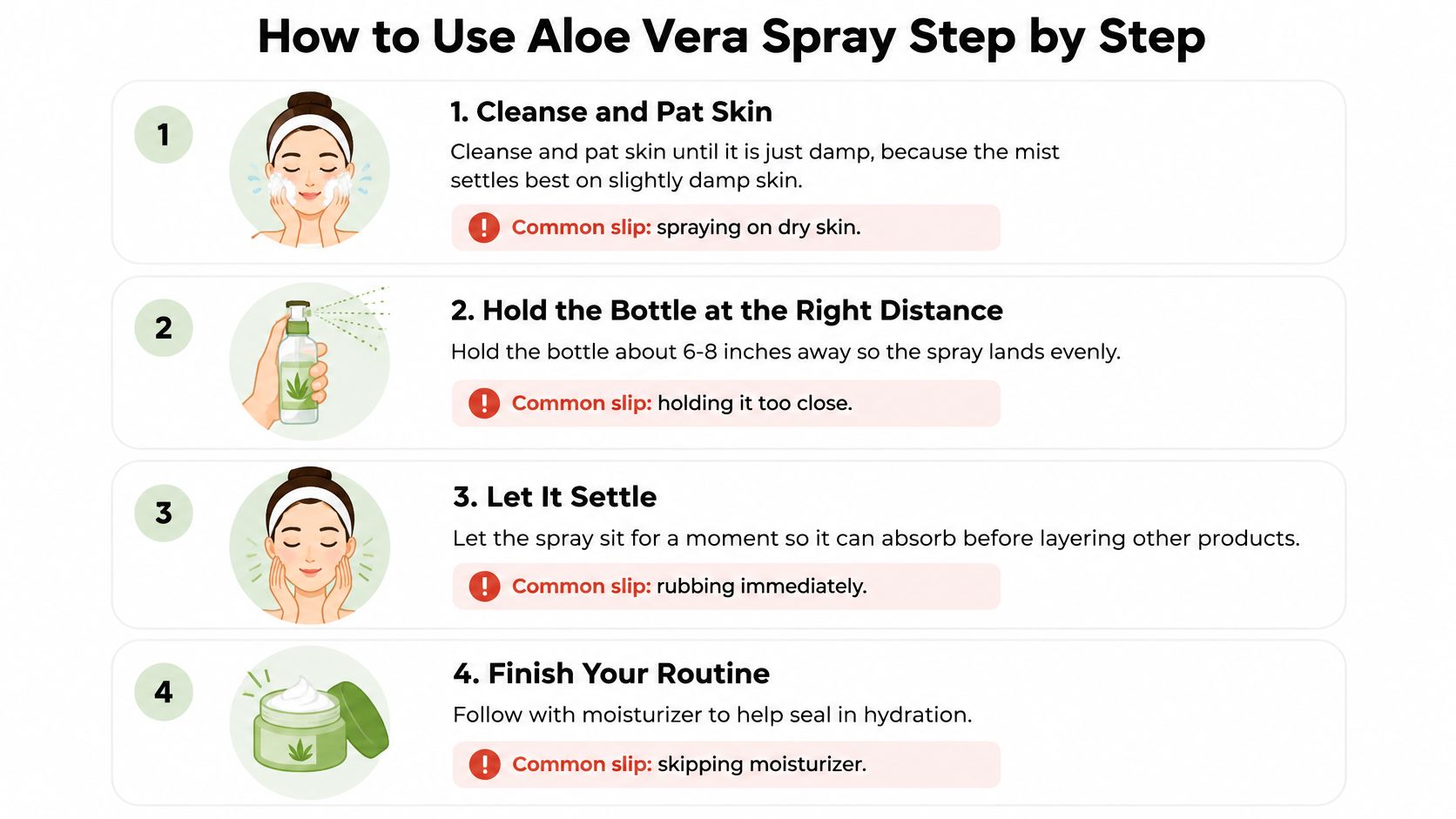
- Cleanse and pat skin until just damp. Remove makeup, sunscreen and everyday buildup with your usual gentle cleanser, then blot rather than scrub with a towel. A common slip is adding spray over an unwashed face and expecting it to cleanse.
- Hold the bottle far enough away for an even mist. Keep it away from your eyes, nose and mouth, close your eyes, and avoid breathing in the spray. Spraying too close creates a concentrated wet patch; for greater control, dispense into clean hands and press onto your face.
- Let the thin layer settle, then pat gently. Use clean fingertips rather than brisk rubbing, especially if your skin already feels delicate after washing. The common slip is treating the mist like a product that needs vigorous massage.
- Apply fragrance-free moisturizer while skin is still slightly damp. Smooth on a comfortable amount without waiting for the aloe layer to dry completely. Skipping this step is the easiest way to turn a pleasant mist into a routine that still leaves your face feeling tight.
- Refresh only when it helps. If you need another application during the day, use a light layer and follow with moisturizer where practical. Constantly misting because the previous layer felt insufficient adds effort without fixing a poorly matched routine.
- Close the cap and put the bottle away. Store it away from direct sunlight and heat, and check its expiry and opening guidance. Leaving it on a sunny windowsill or in a hot car is a common storage mistake.
The visual guide below summarizes the application sequence.
Adjust the amount before adding more steps
If your face feels sticky, try less spray rather than immediately replacing the rest of your routine. If it feels tight, assess whether your moisturizer is substantial enough and whether your cleanser leaves you uncomfortable.
Our guide to using a hydrating facial spray can help you place the mist among products you already own. A comfortable finish should feel cool and supple, not sticky, dripping or tight.
Compare Price and Choose Your Spray
A lower sticker price does not always mean better value. Compare price per ounce by dividing the bottle price by its stated fluid ounces, and keep weight-based comparisons separate. If a label gives weight rather than fluid volume, compare it with other products listed by weight. A gel and a watery spray are different formats, so matching numbers alone does not make them equivalent purchases.
Buy for the routine you actually have
A teacher preparing for a long classroom day may prefer a small bottle that fits beside her moisturizer in a bag. A large size offers little value if it feels awkward to carry and goes unused.
For a gym-goer, storage matters too. A compact bottle may be convenient, but a consistently warm locker is not a suitable place for a product that calls for cool storage.
A household using aloe after cleansing through a dry winter might get more use from a larger bottle. Choose based on whether everyone can use it comfortably within the label's opening guidance, rather than assuming the biggest bottle is the best deal.
Value check: A low price and a short ingredient list do not make up for unclear processing, preservation or storage information.
Compare the actual formulas
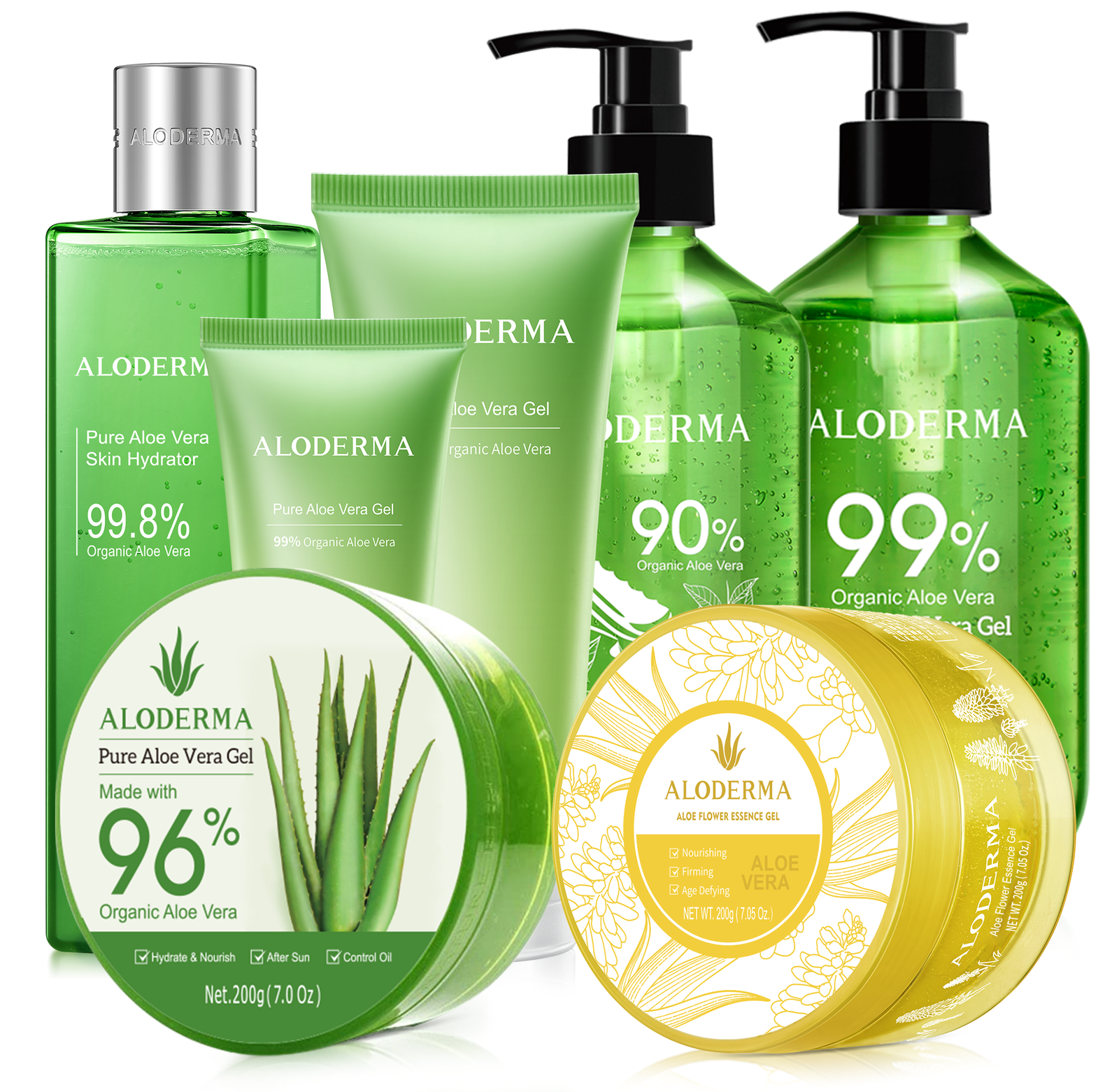
ALODERMA's Pure Aloe Vera Skin Hydrator costs $13.99 USD. Its product ingredient listing identifies it as 99.8% organic aloe. That percentage helps describe the product, but it does not replace checking the full ingredient list and directions for your needs.
The Aloe Botanical Hydrating Mist costs $14.99 USD. Its published mist formula lets you review the formula before choosing. Compare the listed ingredients with your preferences, particularly if you are avoiding particular ingredients.
For a hand-applied texture, ALODERMA's Pure Aloe Vera Gel in the 114g size costs $9.99 USD. Gel is a different format from spray. Do not dilute a preserved product at home and assume it will keep its original shelf life.
Before buying, check the full ingredients, directions and selected size. Compare two candidates by both their price per unit and how well each fits your routine. Then choose a size you are likely to use comfortably. Aloe spray works best as a hydrating first layer sealed in with moisturizer, rather than as repeated misting alone.
ALODERMA offers aloe-led hydrators, mists and gels for a hydration step before moisturizer. Visit ALODERMA to compare available formats and choose one that fits your everyday routine.