





A greener aloe vera gel isn't automatically fresher, purer, or more effective. Color can come from the plant, processing, oxidation, or added pigment, so a vivid green jar tells you only that the formula looks green. The more useful questions are which part of the leaf was used, how quickly it was processed, how the formula was preserved, and whether the label supports the claims.
That distinction matters when you're comparing products for a simple daily routine. Fresh inner-leaf gel is naturally lightweight because it's primarily water, while a processed whole-leaf formula can contain unwanted material from the rind. Certifications and ingredient names also carry more information than phrases such as “natural,” “pure,” or “fresh.”
Why Green Aloe Vera Gel Deserves a Second Look
The popular advice is easy to remember: choose the greenest gel because it looks the most natural. The problem is that appearance isn't a reliable quality test. Aloe products can look different because manufacturers use different leaf parts, filtration methods, processing conditions, preservatives, or colorants. A greener formula may reflect a processing choice rather than a higher level of useful aloe compounds.
If you're holding a bottle and wondering whether its color means anything, your instinct to investigate is sound. Look beyond the front label and ask:
- Leaf source: Does the formula use clarified inner-leaf gel, or does it use whole-leaf extract?
- Processing: Has the yellow latex near the rind been removed and controlled?
- Freshness: How quickly does the leaf move from harvest to processing?
- Formula: Is aloe prominent in the ingredient list, and what else is included?
- Certification: Does “organic” refer to a recognized certification category or only to marketing language?
Fresh green aloe vera gel can be a pleasant, water-rich skincare step, especially when you prefer light textures. A 2019 peer-reviewed review describes aloe vera gel as containing less than 2% total solids, with approximately 78% of those solids made up of acemannan, a polysaccharide associated with the gel's slippery, mucilaginous texture (peer-reviewed aloe vera composition review). That helps explain why inner-leaf gel feels hydrating without behaving like a heavy oil or concentrated extract.
Practical rule: Treat green as a clue to investigate, not a score for quality.
This guide focuses on the decisions that help at the shelf or checkout page. You'll learn how inner-leaf gel differs from whole-leaf material, what green color may signal, why processing time matters, and how to read organic and INCI language without guessing. First, it helps to understand what is physically inside an aloe leaf.
What Green Aloe Vera Gel Is Made Of
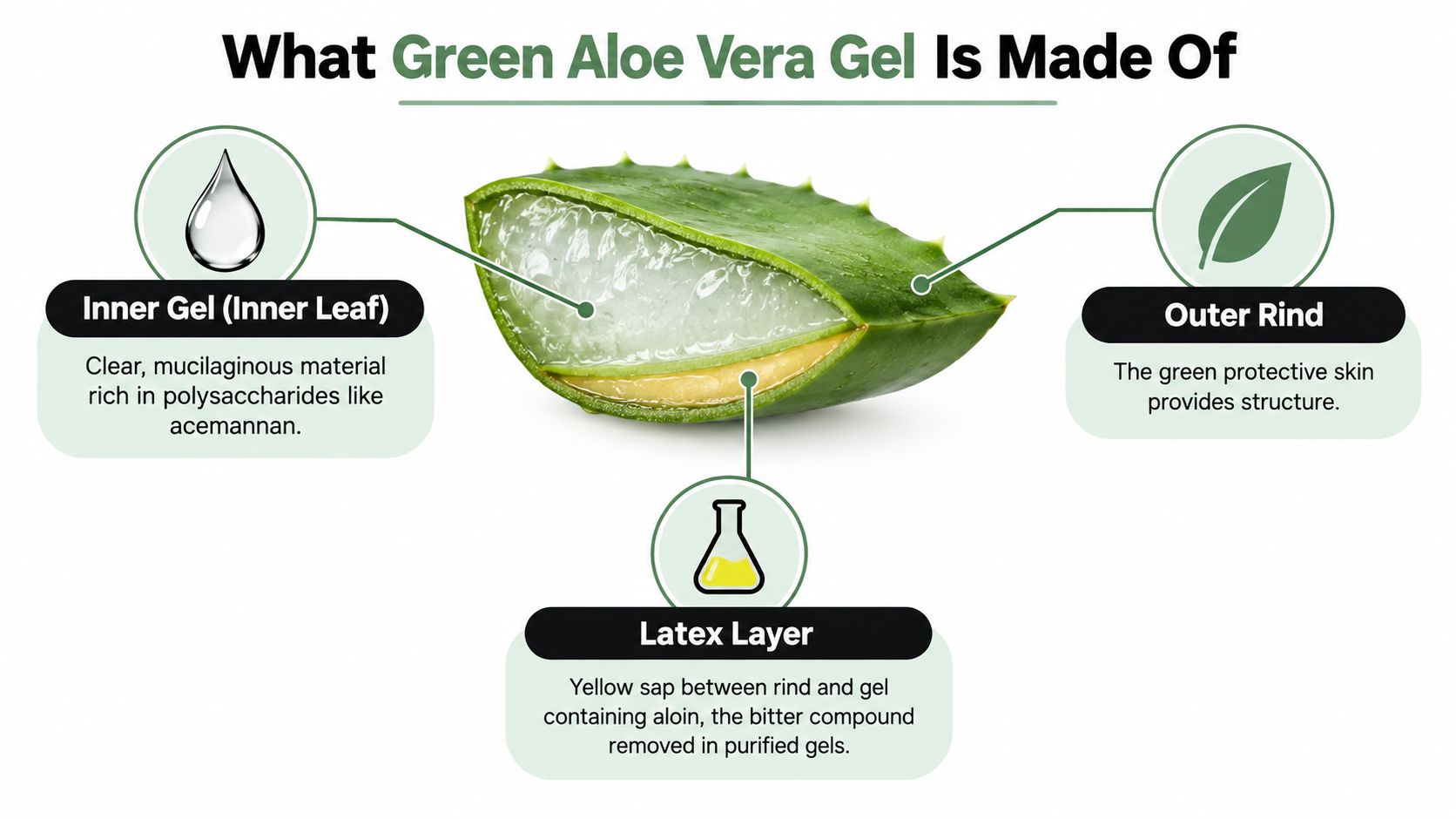
Green color does not tell you which part of the aloe leaf is in the bottle. The useful cosmetic gel is the clear, slippery material at the center. The outer rind protects the leaf, while a yellow latex layer sits close to it and contains compounds manufacturers must control.
The inner gel is mainly water, with a small amount of dissolved solids. Those solids include acemannan, amino acids, carbohydrates, organic acids, and vitamins, so the ingredient behaves more like a light, water-rich matrix than an oil. That structure helps explain its cool, slippery feel and its lack of a rich, occlusive finish.
Inner gel and whole-leaf material
The latex is chemically different from the clear inner gel. It contains anthraquinones, including aloin and related compounds. These substances are linked with aloe's strong laxative activity and can raise safety concerns when rind material remains in a topical preparation. A review of aloe compounds and safety distinguishes topical gel from orally consumed latex or whole-leaf preparations. It also notes that topical aloe is generally tolerated, although burning, itching, and contact dermatitis can occur (review of aloe vera compounds and safety).
Inner-leaf gel and whole-leaf extract shouldn't be treated as interchangeable. A purified inner-leaf formula starts with the part intended for use and limits unwanted material. Decolorization and purification can reduce aloin and other anthraquinones, but the word “gel” cannot confirm that processing took place. Manufacturers should support those claims with analytical testing.
The botanical name can also provide context. Aloe Barbadensis and what the name means explains the naming used for aloe ingredients. On a product label, check whether the manufacturer identifies the leaf part, purification process, microbiological controls, preservation system, and batch stability. These details tell you more about the formula than green color alone.
Where the Green Color Actually Comes From
Green color can have several explanations, and they don't all carry the same meaning. Some formulas retain more natural plant color because they're minimally processed. Others change color through oxidation. Some receive color from an added botanical or synthetic pigment.
A clear formula isn't automatically superior, and a green formula isn't automatically inferior. The practical goal is to identify what produced the appearance and then check whether the formula's sourcing, preservation, and ingredient information make sense.
| Color Source | Typical Look | What It Signals | What to Verify |
|---|---|---|---|
| Natural plant compounds | Pale, muted green or variable green | More plant material or less color removal may remain | Inner-leaf sourcing, filtration, and full INCI list |
| Oxidation or processing change | Color may shift over time, sometimes toward brown | Exposure to air, enzymes, light, or temperature may have affected the gel | Processing speed, packaging, storage guidance, odor, texture, and expiry |
| Added colorant | Uniform or vivid green across batches | The appearance may be designed rather than supplied by aloe | Colorants in the ingredient list and the formula's preservation approach |
A 2025 review emphasizes that color alone doesn't establish skincare efficacy. Aloe products may differ because of leaf-part selection, processing, filtration, oxidation, and added colorants, so shoppers should assess the formula rather than use green as a shortcut (review discussing aloe composition and product safety).
What your senses can and can't tell you
A change in color can be useful as a reason to inspect a product, but it isn't a standalone freshness test. Compare the color with the odor, texture, packaging, preservatives, storage instructions, and expiry information. A product that smells unusual or has separated unexpectedly deserves caution, whether it's clear or green.
You also shouldn't assume that a vivid color means a higher concentration of acemannan or other desirable constituents. The available evidence doesn't establish color as a dependable predictor of cosmetic performance. For a helpful comparison between concentrated powders and fresh gel, read dried aloe versus natural aloe gel.
Green can tell you that a formula has a certain visual character. It can't tell you whether the manufacturer removed latex, controlled oxidation, or preserved the finished product well.
Benefits of Green Aloe Vera Gel in Everyday Skincare
Aloe makes the most sense when you view it as a lightweight hydration and comfort step, not a universal answer to every skin concern. Its water-rich texture can feel refreshing after cleansing, during dry indoor weather, or on days when a rich cream feels uncomfortable.
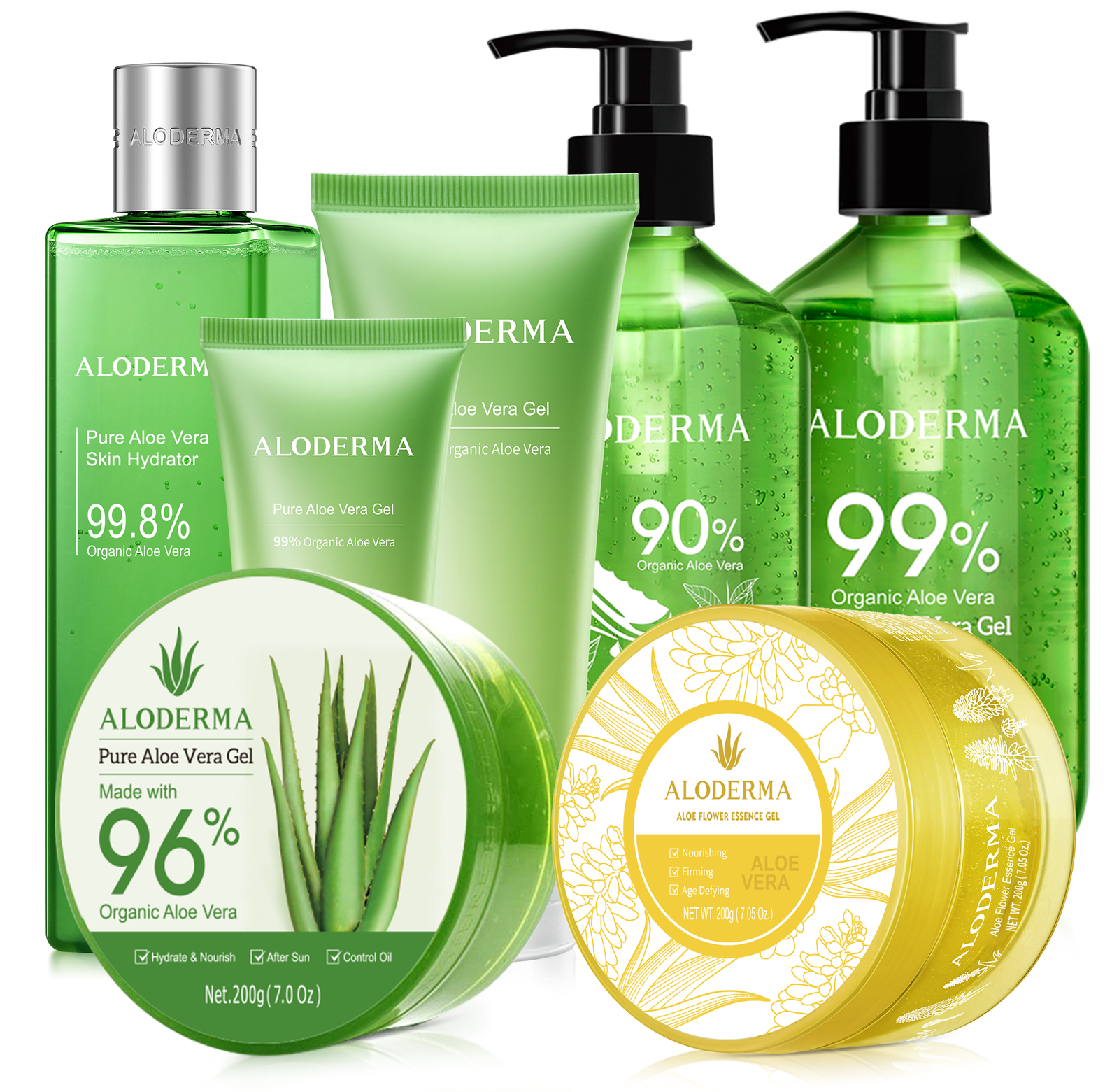
A reader comparing products online might see a green gel, a clear gel, and a spray. Instead of choosing by color, consider the situation. A jar can work well when you want to apply gel to a larger area. A spray may be convenient after outdoor activity, when touching the skin feels inconvenient. ALODERMA's Aloe Vera Gels illustrate those different formats, while the ingredient list still deserves your attention.
Where it fits in a routine
Apply a thin layer after cleansing, then decide whether your skin needs a cream or another moisturizing step. If your skin feels tight as the gel dries, follow with a richer product rather than adding more and more gel. Lightweight layers often work better than a thick application that leaves residue.
For a warm day outdoors, aloe gel may feel pleasant after washing the skin. It doesn't replace sun protection, and it shouldn't be treated as a substitute for professional advice when persistent or severe skin concerns need attention. If you're planning a camping or hiking trip, pair a simple hydration step with practical outdoor protection such as Glow Protect for camping and hiking.
The best experience usually comes from keeping expectations modest. Aloe can leave skin feeling hydrated, soft, and refreshed, but the finished formula matters more than the plant name on the front. Fragrance, essential oils, alcohol, colorants, preservatives, and the position of aloe in the ingredient list can all change how the product feels.
How Freshness Changes the Way Aloe Performs
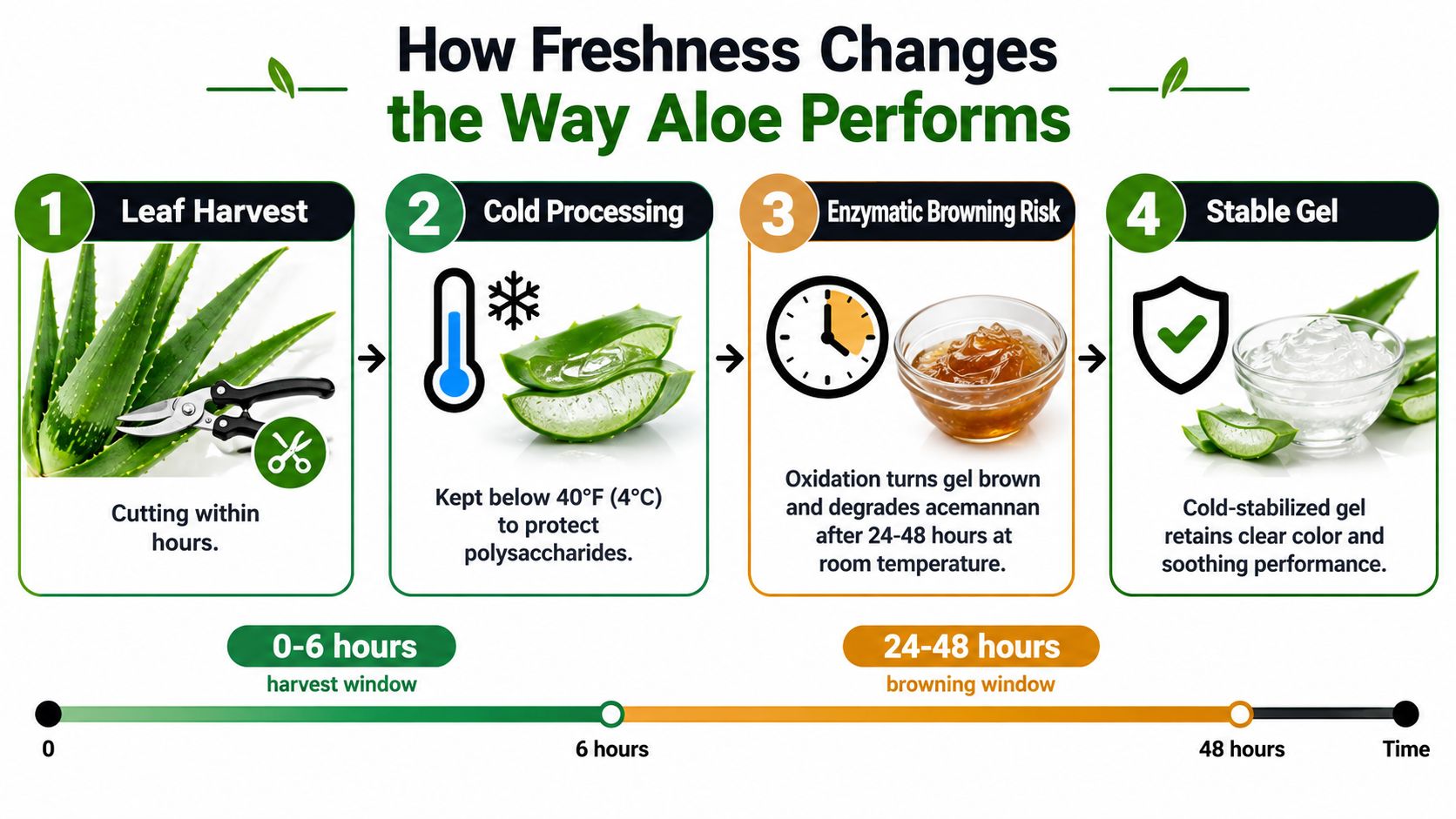
“Fresh” should describe a processing pathway, not just a picture of a green leaf. Aloe gel can undergo enzymatic browning when processing takes too long or temperature control is poor. A peer-reviewed processing review reports that crushing or grinding should be completed within 10 to 20 minutes at approximately 25°C to limit enzymatic browning. It also describes heating at 65°C for less than 15 minutes as a way to preserve activity, followed by flash-cooling to 5°C or below within 15 seconds (aloe vera processing review).
Those details turn freshness into something you can ask about. A leaf that moves quickly from harvest to processing has less opportunity for uncontrolled color change and quality loss than a leaf held in an extended supply chain.
What vertical integration changes
ALODERMA is a fully vertically integrated aloe vera company. It grows its own organic aloe vera, processes the aloe vera, and manufactures products onsite within 12 hours of harvest, with the aim of keeping the primary aloe ingredient as bioactive as possible. That model gives the company direct control over the path from cultivation to finished formula instead of handing every stage to unrelated suppliers.
Vertical integration doesn't remove the need for preservation or testing. A water-rich botanical formula still needs microbiological limits, preservative-effectiveness checks, stability testing, and suitable packaging. It does, however, make the freshness claim more concrete because the company can connect farming, processing, and manufacturing within one operational system.
Ask three simple questions before buying:
- How quickly is the leaf processed after harvest?
- Who controls the stages from cultivation to manufacturing?
- How does the manufacturer manage heat, cooling, light, and storage?
For practical storage guidance and the difference between a fresh botanical ingredient and a finished cosmetic formula, see how long aloe vera lasts. Freshness supports quality, but it works alongside purification, preservation, and transparent labeling.
Reading the Label Like an Ingredient Coach
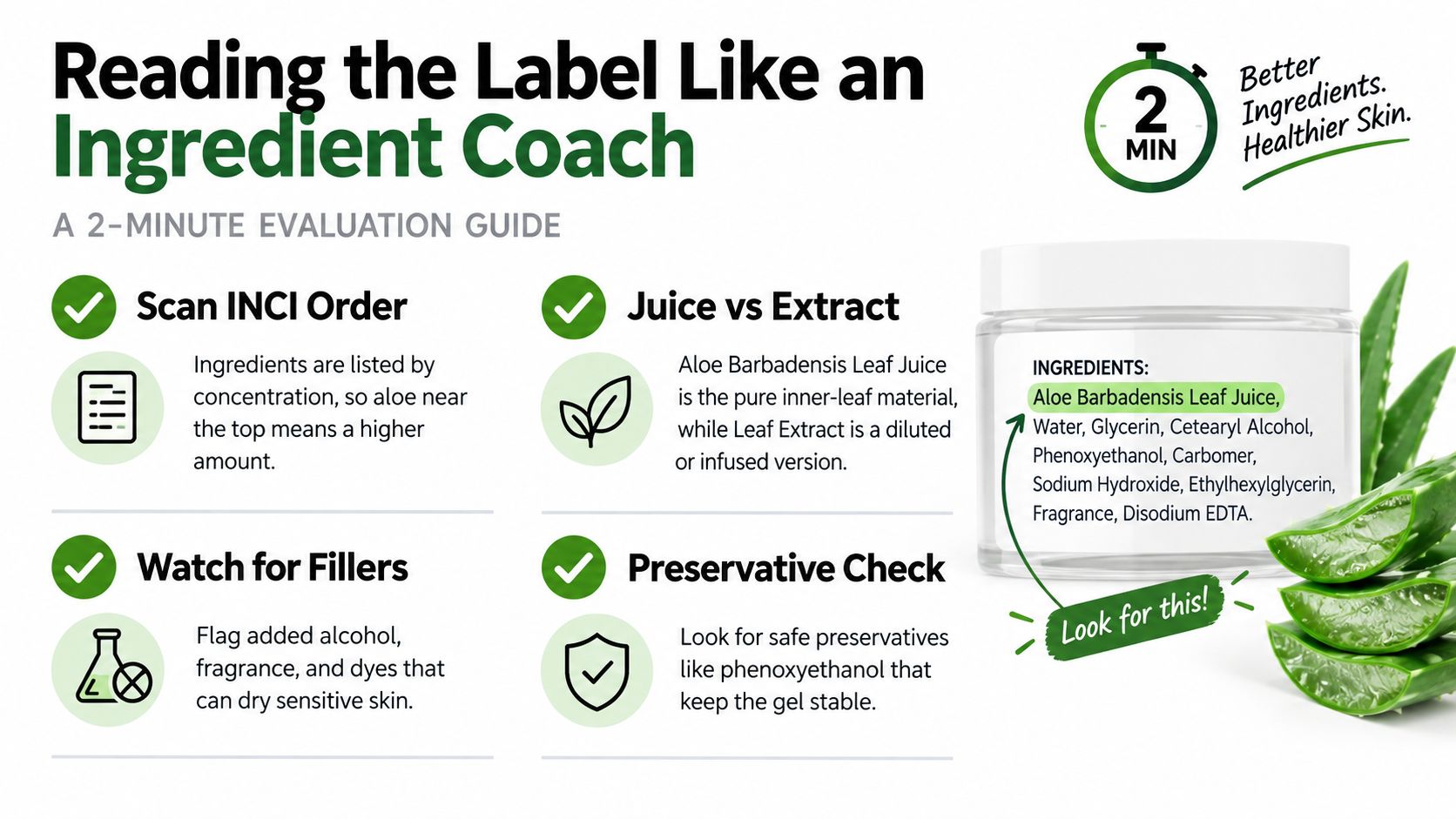
You can evaluate most aloe gels in about two minutes if you read the back before reacting to the front. Start with the full INCI list, then check the aloe name, supporting ingredients, preservation system, and certification language.
Ingredient lists are required in the European Union, and the European Commission explains that cosmetic ingredients are expressed using common names from its glossary, with internationally recognized nomenclature such as INCI used where appropriate (European Commission glossary for cosmetic ingredients). The front label may say “fresh green aloe,” but the INCI list tells you what the manufacturer has declared.
A quick label sequence
- Scan the aloe name: Look for terms such as Aloe Barbadensis Leaf Juice or Aloe Barbadensis Leaf Extract. These names describe different forms and shouldn't be assumed equivalent without more information.
- Check aloe's position: Ingredients are generally listed in descending order by amount until the lower-concentration portion of the formula. Aloe near the top suggests a prominent role, while a small amount near the end tells a different story.
- Notice the supporting formula: Preservatives are important in a water-rich gel. Fragrance, alcohol, essential oils, and dyes may matter if your skin is easily reactive.
- Verify the claim: “Natural” and “plant-based” aren't the same as organic certification. Look for the exact certification wording and the certifier.
- Compare the product page: Check the ingredient panel, format, storage information, and manufacturer details together rather than relying on a single claim.
USDA organic wording in plain English
USDA guidance sets different thresholds for cosmetic labels. The categories below exclude water and salt from the organic-content calculation (USDA cosmetics and personal-care standards).
| Label Claim | Minimum Organic Content | What It Excludes | What Buyers Should Confirm |
|---|---|---|---|
| 100 percent organic | Only organically produced ingredients | Water and salt | The product and responsible operations meet applicable USDA requirements |
| Organic | At least 95% organically produced ingredients | Water and salt | Certification by a USDA-accredited certifying agent |
| Made with organic ingredients | At least 70% organic ingredients | Water and salt | The exact ingredients covered and the certification details |
The farm, handlers, and final manufacturer must meet the relevant certification requirements. If a product uses ECOCERT or another certification, read the seal's own scope rather than assuming every certification has identical rules.
Two-minute checkout test: Find the INCI list, locate the aloe name, inspect the supporting ingredients, verify the exact organic wording, and check the manufacturer's processing information.
Matching Green Aloe Gel to Your Skin and Routine
Aloe works best when you assign it a modest job. Use it as a light hydrator and barrier-support step that can sit between cleansing and a cream, rather than expecting it to replace every other product.
Sensitive skin may appreciate a short, uncomplicated routine, but “natural” doesn't guarantee universal tolerance. Topical aloe is generally well tolerated, yet documented reactions include burning, itching, rash, and eczema according to the U.S. National Center for Complementary and Integrative Health (NCCIH aloe vera safety information). Patch test a new product, especially if your skin reacts easily, and stop using it if stinging, itching, or redness develops.
Build around texture
A water-rich gel can suit oily or blemish-prone routines because it doesn't feel like a heavy balm. Drier skin may prefer aloe under a cream, while combination skin may use it alone in humid conditions and layer a moisturizer where needed. Apply a thin layer after cleansing, let it settle, then add serum, cream, or oil according to your routine and comfort.
A spray format can be more practical when you want quick application to a broad area or don't want to scoop product from a jar. A gel can offer more control for targeted application. Neither format is automatically better, so match the package to how you'll really use it.
Aloe shouldn't be applied around the eyes unless the product is designed for that area. Avoid using an unfamiliar formula on open or visibly damaged skin unless a professional has directed you to do so. Persistent skin changes, ongoing discomfort, or concerns that don't improve with a simple routine deserve professional attention rather than repeated product experiments.
Here's a short demonstration of how a lightweight aloe product can fit into a broader skincare routine:
The goal is comfort and consistency. Choose an inner-leaf formula with clear processing information, patch test it, apply a manageable amount, and seal with a moisturizer when your skin needs more lasting softness.
Your Shortlist and Next Step
The strongest choice isn't necessarily the greenest jar. It's the product whose leaf source, processing pathway, ingredient list, preservation system, and certification language you can understand.
Use this shortlist before checkout:
- Choose the leaf carefully: Prefer clear information about inner-leaf gel, latex removal, and anthraquinone control.
- Question freshness precisely: Look for harvest-to-processing details and temperature controls rather than relying on the word “fresh.”
- Read the complete formula: Check aloe's INCI name and position, then scan preservatives, fragrance, alcohol, essential oils, and colorants.
- Verify organic wording: Distinguish certified claims from general natural or plant-based language.
- Match the format to your life: Select a jar for controlled application or a spray when convenience matters.
- Patch test first: Even a generally well-tolerated botanical can cause irritation in susceptible users.
You can also compare the ingredient information and formats across the Aloderma Aloe Vera Toners, Aloe Vera Serums, and Aloe Vera Face Creams. A simple routine might be cleanser, a thin layer of aloe gel, and moisturizer when needed. Keep the steps repeatable, and let your skin's comfort guide how often you use each product.
The best green aloe vera gel is the one that fits your skin, your values, and your routine. Once you stop treating color as proof and start checking the ingredient journey, shopping becomes much less confusing.
ALODERMA offers fresh, organic aloe-based gels and hydrators made through a vertically integrated process, from its own cultivation to onsite processing and manufacturing within 12 hours of harvest. Visit ALODERMA to compare product formats, review ingredient information, and choose a lightweight aloe step that fits your routine.