





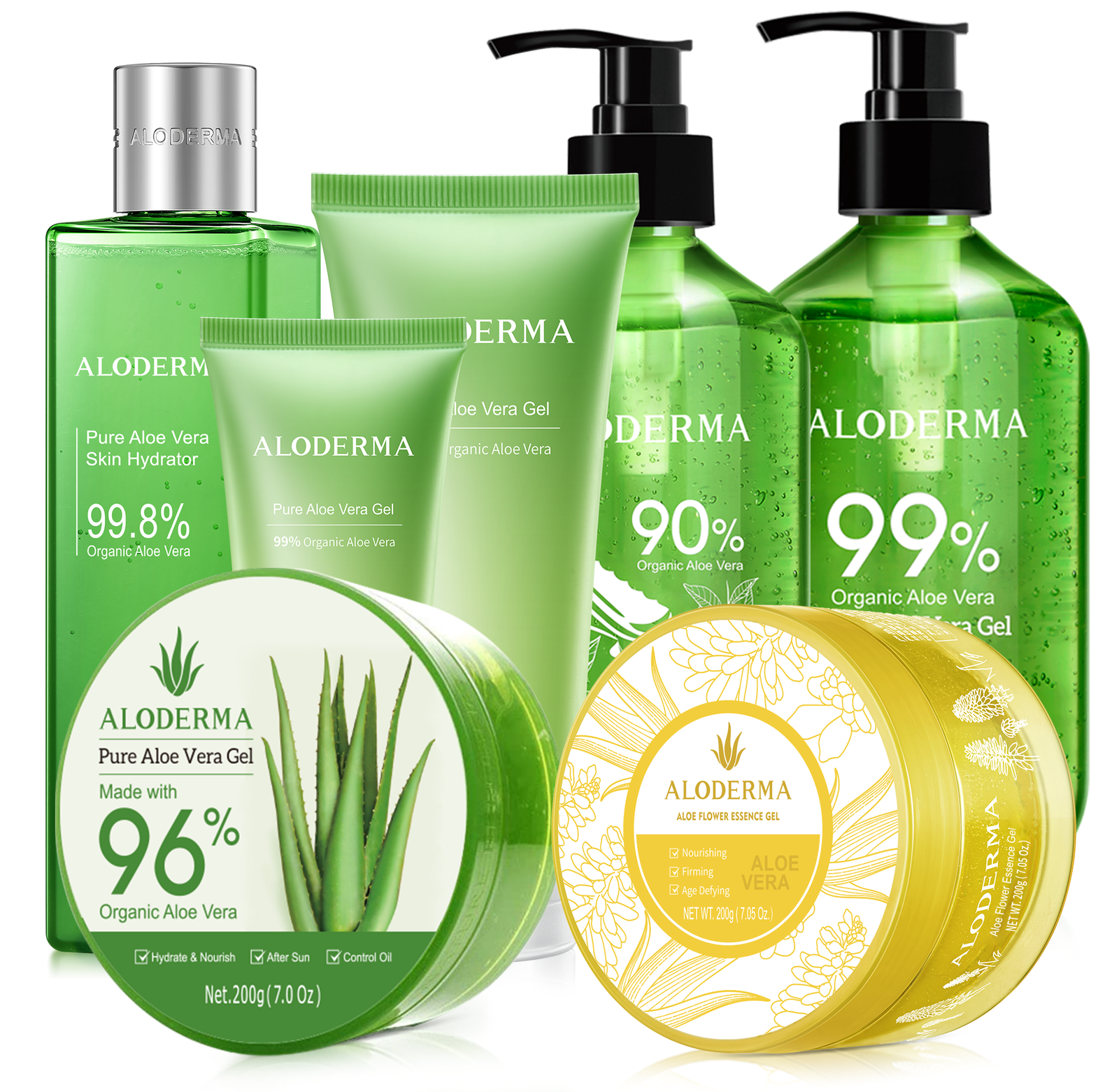


You're standing in the shower, turning a cleanser bottle over in wet hands, looking for a small triangle of arrows. There it is on the base, with a number inside. Nothing on the front tells you whether your city's recycling truck will take it, whether the pump unscrews, or whether the carton it arrived in counts as paper or as trash.
Most of us guess at that moment. We drop the bottle in the bin we hope is right and move on with the day.
That guess is worth fixing, because a recyclable symbol is a material code, not a promise. The pack that gets recycled is the one your local system can collect, sort and reprocess, with a formula behind it that the brand can trace from source to shelf. Sustainable skincare packaging isn't one material or one logo. It's a match between a pack, a product and a waste system.
Packaging Materials Compared for Skincare
Six materials cover most of what sits in a bathroom cabinet. Judged on what happens after you finish the product, they separate quickly.
| Material | Recyclability in practice | Recycled content option | Refill fit | Best fit |
|---|---|---|---|---|
| Glass jar or bottle | High where glass collection exists | Yes, recycled cullet is common | Good for rigid refills | Serums, toners, creams |
| Aluminum tube or tin | High where aluminum is collected | Yes | Limited | Balms, creams, sun products |
| Mono-material PE or PP bottle | Good where bottles are collected | Yes, post-consumer recycled grades | Good for refill pouches | Gels, toners, cleansers |
| PET bottle | Good, widely collected | Yes, post-consumer recycled grades | Limited | Toners, cleansers |
| Multilayer plastic tube | Often fails a 70% recyclability target | Rare, because the layers can't be separated for reprocessing | Poor | Avoid where a mono-material pack is possible |
| Paper carton or board | High with responsibly sourced fiber | Yes, recycled board | Not applicable | Outer sleeves, gift boxes |
Glass is the easiest yes where your area collects it. It doesn't interact with a formula, it can be recycled repeatedly, and it suits serums, toners and creams. The cost is weight, which shows up later in shipping and in breakage.
Aluminum performs well too, in tubes and tins, and it protects light-sensitive products. Fewer households have aluminum collection than glass or bottle collection, so check before you count on it.
Mono-material PE or PP is the workhorse for gels, toners and cleansers. One polymer for the body means recycled content goes in without a compatibility puzzle, and it's the format most refill pouches are built to refill.
PET is the most widely collected bottle resin, which is why toners and cleansers often use it. It takes recycled content well. Its weak point is decoration: a clear bottle with a dark pump and a full-wrap sleeve confuses sorting equipment.
Multilayer tubes are where the comparison turns negative. An assessment of cosmetic packaging published in the journal Cosmetics found that glass and aluminum generally showed high recyclability while multilayer plastic tubes frequently failed a 70% recyclability target, because the incompatible layers can't be separated (Cosmetics, MDPI).
Paper wins for outer cartons and gift boxes when the fiber is responsibly sourced and the box isn't laminated to plastic film. Mills want clean board, so skip the foil stamping and the glued-in foam insert.
The rule that settles most choices
Pick the material your local collection accepts first, then match the format to the product. A cream that needs a wide mouth gets a jar, not a bottle. A toner that needs a controlled pour gets a bottle, not a jar.
Specifying a pack is a system decision, close to the way you would plan an efficient commercial kitchen: the equipment has to fit the workflow and the space it occupies, not just look right in a photograph. Swap one resin for another and the filling line, the label adhesive, the shipping case and the recycling route all shift with it.
Small sizes deserve their own note. A serum in a 1 oz dropper bottle uses less material than a larger pump, but the dropper, bulb and collar have to come apart before the glass has a real chance of being recycled. Treat the table as a starting point. The specific pack in your hand has a material, a weight and a disposal route, and those three things decide more than the category does.
Why Skincare Packaging Waste Adds Up
Count the parts on your shelf. A cleanser with a pump and a cap. A toner in a bottle with a screw top and an inner seal. A serum in a dropper bottle inside a printed box. A cream in a jar with a lid and a plastic disc. A gift set with an outer carton, a molded insert and a wrap.
That shelf is one household, and it's roughly a dozen separate pieces of packaging before anything is empty. Multiply it across a street and the numbers stop feeling small. The UN Environment Programme reports that the world generates approximately 353 million tonnes of plastic waste each year, and the packaging sector accounts for 36% of all plastic produced. About 85% of single-use plastic bottles, containers and packaging end up in landfill or are mismanaged, and 22% of plastic waste is mismanaged and becomes litter.
The useful question: not "is this bottle recyclable?" but "will this bottle, with this pump, in this city, actually be collected and reprocessed?"
Skincare is a packaging-heavy category because one routine multiplies small components. Pumps are usually a different plastic from the bottle. Caps hide a liner. Labels use adhesives that don't wash off in the recycling stream. A pack built from inseparable materials can be technically recyclable and still be impossible to sort at scale.
Here's how those components move through a materials recovery facility once they leave your bin:
Interest in getting this right isn't niche. In 2024, 35% of U.S. beauty shoppers said recyclable packaging was important when buying beauty products, according to Explorer Research's survey of 520 adults.
So judge the whole pack, not just the formula inside it, and not just the symbol on the base. Material, weight, refillability, local recyclability and end of life all pull on the outcome at once.
Recyclable in Practice, Not Just on Paper
Recyclable is a claim about infrastructure as much as about material. A pack earns the word only when collection, sorting and reprocessing are demonstrated in real systems at meaningful scale. The Ellen MacArthur Foundation's Global Commitment definitions put a number on it: a 30% recycling rate at country level for that plastic packaging format.
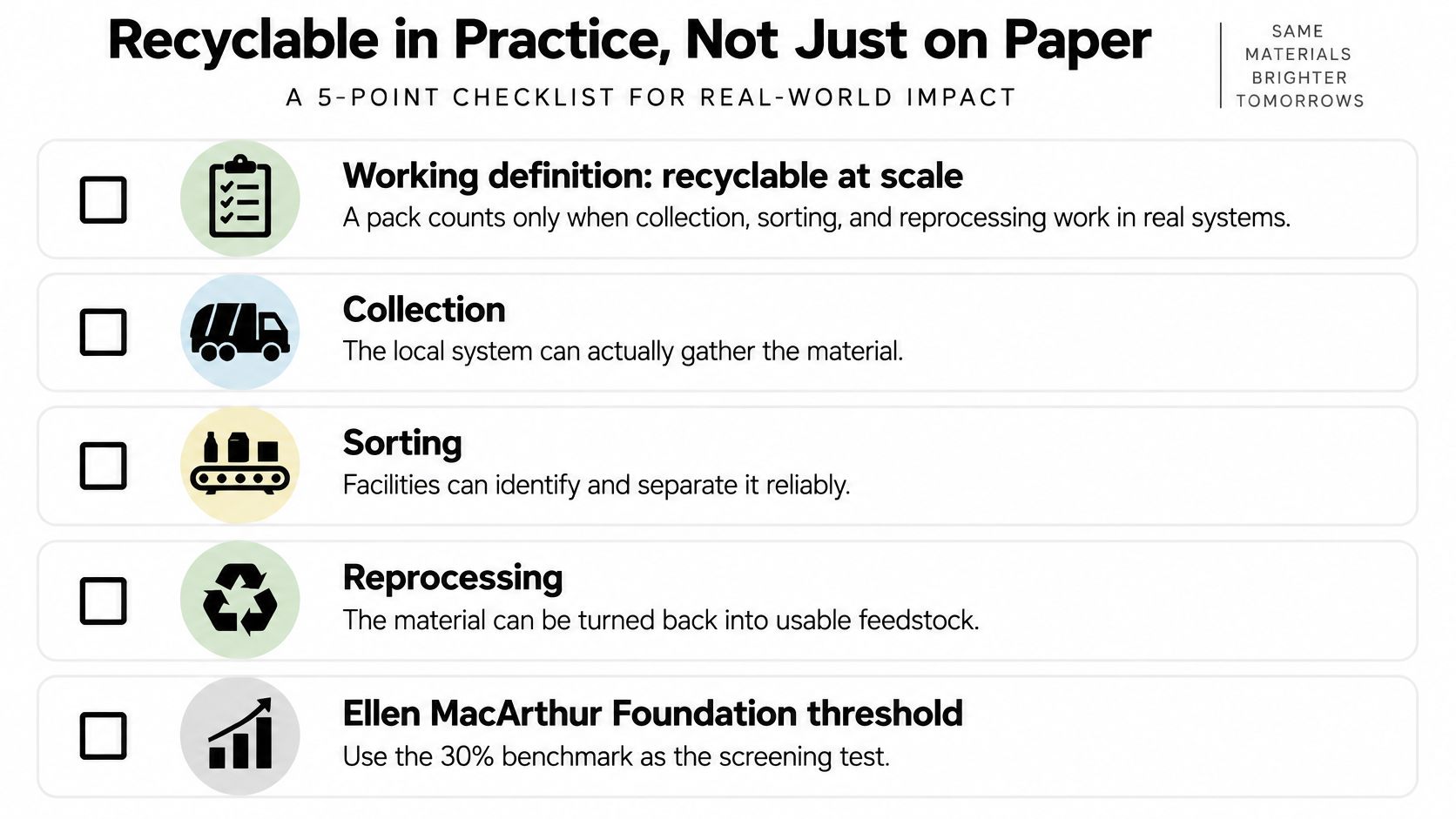
Six checks that decide whether a pack survives sorting
- One polymer for the body. A single widely accepted resin gives the container a route through a sorting line, while a mixed body has none. Check the base for a single number, not a layered laminate.
- No carbon black pigment. Carbon black absorbs the near-infrared light optical sorters read, so a black cap or bottle can be invisible to the machine. Look at the closure and any dark decoration.
- Closures that separate or match. A cap in the same polymer as the body travels with it, while a pump with a metal spring does not. Twist the closure and see whether it comes off cleanly.
- Labels, inks and adhesives inside design guidance. Full-wrap labels and stubborn adhesives leave residue that spoils a bale of otherwise good plastic. Try peeling a corner.
- A size a sorting screen can catch. Small cosmetic packs slip through screens built for bigger items, and dark colors and elastomer parts make it worse. Compare a mini with a full-size bottle.
- Fitness for the destination market. A laboratory result doesn't travel; the rules of the market where the pack is sold do. Search your council's accepted materials list for the exact item.
That list explains why a small, dark, pump-topped jar can carry a recycling symbol and still go to landfill. The container is technically recyclable. The assembly isn't recoverable.
What to do at the sink
Empty and rinse the bottle where local guidance permits, because residue contaminates a bale. Separate everything that comes apart: pump, cap, dropper, inner disc. Check municipal instructions instead of trusting the symbol. Where curbside won't take pumps, look for a take-back route.
Beauty-specific programs fill part of that gap. Pact Collective collected more than 227,000 pounds of beauty packaging through its programs in 2024, according to Recycling Today's report on its impact data. That's a genuine service and a small number next to the volume in circulation.
Keep two phrases apart. Designed for recycling means the pack was built with recovery in mind. Recyclable in practice means your system takes it. Only the second one changes what happens to the bottle in your hand.
Certifications and Labels Worth Checking
Every mark on a pack verifies one thing. The mistake shoppers make is assuming a mark for the formula also applies to the bottle, the pump or the carton.
| Label or certificate | What it verifies | What it does not cover |
|---|---|---|
| FSC | Paper and board fiber from responsibly managed forests | Plastic components or recyclability |
| Global Recycled Standard | Recycled content traced through the supply chain | Whether the finished pack is recyclable locally |
| How2Recycle | Disposal guidance for each component | Whether local collection exists |
| Mobius loop with a percentage | Stated recycled content of the material | A plain loop without a percentage does not guarantee recyclability |
| USDA Organic, EU Organic | Organic status of the listed ingredients | Packaging materials |
Read the marks this way and most confusion disappears. FSC answers a paper question. The Global Recycled Standard answers a content question. How2Recycle answers a disposal question. A Mobius loop with a percentage answers a content question too, and a plain loop with no percentage answers almost nothing.
Partial use is the norm across the industry, not the exception. In 2024, Good On You assessed 239 beauty brands and found 40% used recycled materials in some consumer packaging, while fewer than 5% used recycled-material packaging for most of their products (Good On You beauty scorecard). One recycled pack in a range is a start. It isn't a packaging strategy.
We can show you the ingredient side of our own traceability in detail. Our farms hold Certified Eco-Origin Products designation, and our aloe vera is ECOCERT certified USDA and EU Organic. Because we're vertically integrated, we grow our own organic aloe vera, process it and manufacture onsite within 12 hours of harvest, so the primary ingredient in every product stays as bioactive and effective as fresh aloe can be.
None of that assures you the bottle contains recycled material. Traceability covers the aloe, not the jar. For the packaging evidence, open the product page for the item you're buying on aloderma.com and check the body material, the recycled content percentage and the disposal instructions.
A label earns trust when it names the component it covers. A credible claim names the component and the percentage, together.
Refill, PCR and Glass Trade-offs by Product
Choosing by product format works better than choosing by slogan. The table pairs common product types with the pack that usually suits them, the trade-off you're accepting and the question worth asking before you pay.
| Product type | Usually suits | Main trade-off | Ask the brand |
|---|---|---|---|
| Aloe gel or toner | Glass or mono-material PE bottle | Water-rich formulas need tested closures and preservation | Is the bottle post-consumer recycled or mono-material? |
| Cream or balm | Glass jar or aluminum tin | Glass is heavier, while both are strong for recycling | Is there a refill or a recyclable tin? |
| Serum | Glass dropper bottle | The dropper assembly must separate for recycling | Can the dropper be removed for sorting? |
| Cleanser | Refill pouch or mono-material pump | Impact depends on how often the container is reused | What is the refill breakeven data? |
| Gift set | Paper carton with a rigid inner pack | Extra secondary packaging adds weight | Are the inserts recyclable and fiber-based? |
Three trade-offs worth naming
Refill only wins after the container has been reused enough times. A refillable system beats single-use when the durable container is reused many times and the refill is lighter per use. Public breakeven figures, showing how many refills a system needs before it outperforms conventional packaging, are hard to find for beauty, so published reuse targets matter more than the refill logo. Demand is real: in 2024, 43% of surveyed consumers said they tried to avoid single-use plastics, according to Explorer Research's sustainable beauty research.
Glass is recyclable and heavy at the same time. Its recyclability is high where collection exists, and its weight adds shipping emissions and breakage risk. For a product you replace every few weeks, that weight is spread over little use. For a jar that sits on a shelf for months, weight per use drops.
Recycled plastic is a real material with real requirements. The EU regulation sets minimum post-consumer recycled content for plastic packaging, with a stated baseline of 10% for contact-sensitive packaging made from plastics other than PET, as the EUR-Lex legislative summary sets out. Meeting it isn't a straight swap. Recycled resin has to be assessed for contaminants, odor, color, migration and product-contact safety, which matters most for water-rich formulas such as aloe gels, toners and serums.
A virgin-resin functional barrier can protect a sensitive formula, but a barrier that introduces an incompatible layer can make the pack harder to recycle. Validate the finished pack, not the certificate: accelerated aging, closure compatibility, stress-cracking resistance and preservative performance in the actual container.
Refillable is a design strategy, not proof of lower impact.
If reuse habits interest you, our guide to zero waste skincare walks through the routine-level decisions.
Picture two products. An aloe gel in a 150 ml mono-material bottle you finish in about three months, then rinse and recycle. A cream in a glass jar refilled from a pouch every six weeks. Which one you keep depends on whether the refill is available near you, whether the pouch is collected, and whether you'll still be refilling in a year. Choose the format you can recycle or refill, then let the rest follow.
Lifecycle, Carbon and Compostable Claims
A pack's impact isn't decided at the bin. It starts with raw material extraction, runs through manufacturing and the weight shipped, continues through transport and daily use, and ends with disposal or recovery. Read one stage and you get a misleading answer.
Why weight and recovery have to be read together
Lighter packs usually cut transport emissions, and a mono-material pouch ships far more product per kilo than a glass jar. A light pack that no system collects still becomes waste, so weight and recovery have to be judged as a pair. Glass is fully recyclable where collection exists, yet its weight adds shipping emissions and breakage risk. The same product can score differently in a glass jar and in a lightweight pouch, and neither result travels everywhere.
Ask for the method: a carbon figure without a stated boundary, pack only or pack plus formula, tells you very little.
Where compostable claims go wrong
Compostable is a disposal instruction, not a material upgrade. Most compostable plastics break down only in industrial facilities that reach sustained high temperatures, and home-compostable claims need their own certification. A compostable pack dropped into household waste usually ends in landfill.
In Europe, look for a named standard such as EN 13432 on the pack, then confirm your local facility accepts the item. If your city composts food scraps but not packaging, the claim doesn't apply to your bin.
Frequency of use matters as much as material. A serum bottle replaced every few weeks generates far more packaging across a year than a refillable format used daily, even when the refillable container is heavier. Count how often you replace a pack, not just what it's made from.
Regulation Timeline Brands Must Meet
Europe has turned packaging from a preference into a legal requirement, and the dates are public. The EU's Packaging and Packaging Waste Regulation (EU) 2025/40 entered into force on 11 February 2025 and generally applies from 12 August 2026, according to the regulation text on EUR-Lex. The same regulation explains why packaging is the target: packaging consumes about 40% of the plastics and 50% of the paper used in the Union, and accounts for 36% of municipal solid waste.
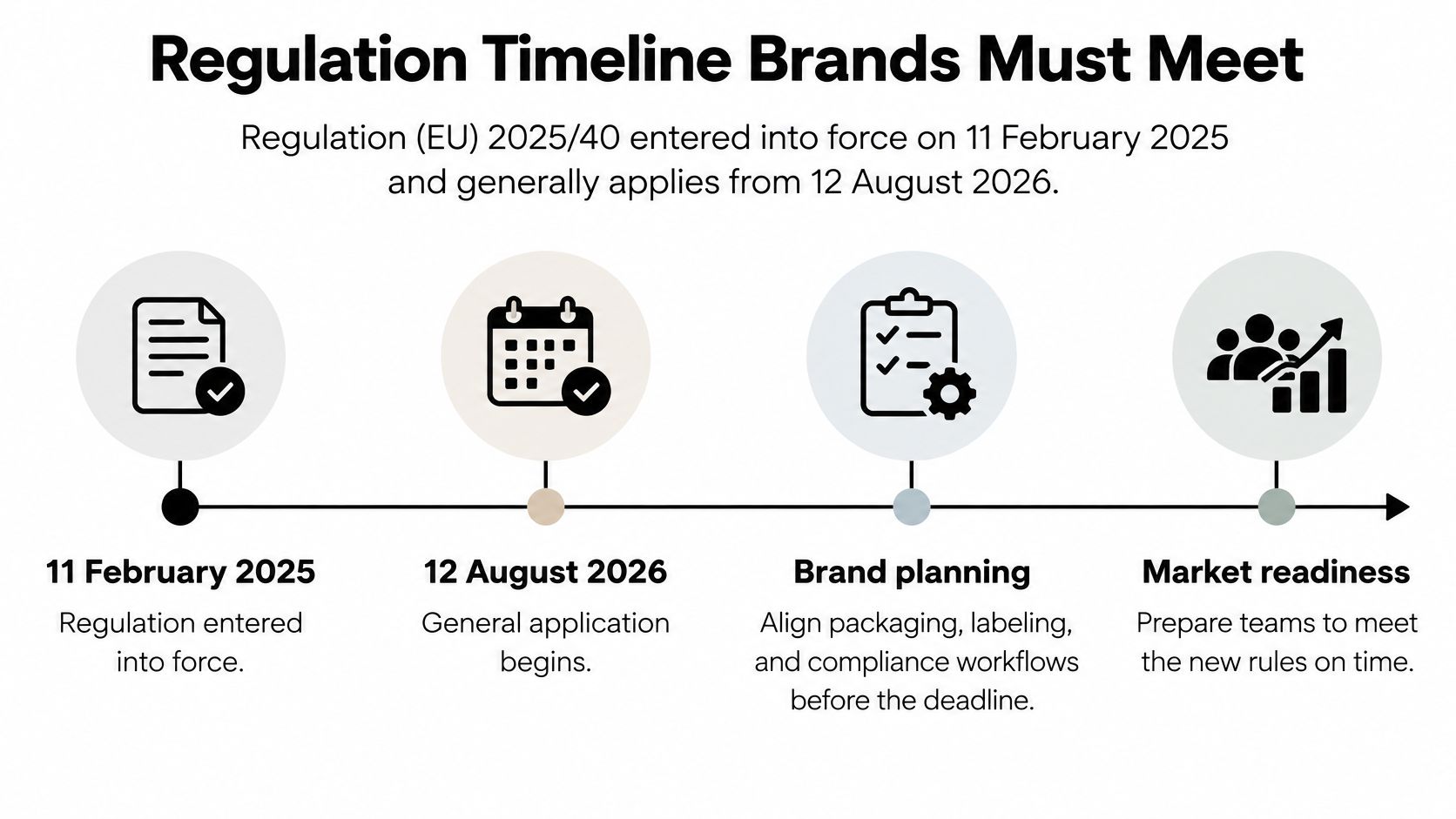
| Date | Requirement | What changes for you |
|---|---|---|
| 11 February 2025 | Regulation (EU) 2025/40 enters into force | Brands begin adjusting packaging specifications |
| 12 August 2026 | General application date | Packaging placed on the EU market follows the regulation |
| 2030 | Design-for-recycling criteria, recyclability performance grades and minimum recycled-content requirements for plastic packaging | Pack designs and recycled-content documentation change |
| 2035 | Packaging must be recyclable at scale, meaning collected, sorted and recycled through working systems | Recyclable claims need proof of local collection and sorting |
| 2038 | Stricter recyclability obligations apply | Further design tightening across packaging formats |
For a brand, each date is a documentation task: material composition, recycled content evidence, recyclability testing, labeling and records that hold up in an audit. Design choices made today are read against rules that arrive later, which is why a simple, separable pack is the cheaper bet over a decade.
For a shopper, the practical effect is movement. Pack designs and labels will keep changing, so a check you make today is a snapshot rather than a permanent verdict on a brand. A bottle that fails your local system this year may be replaced by a refillable or mono-material version before the decade is out.
Confirm These Three Points Before You Buy
Three checks cover almost every pack on a shelf, and they take about a minute.
- Find the body material. A mono-material PE or PP bottle or a glass jar sorts more easily than a multilayer tube. Look at the base or the product page, not the front label.
- Look for a stated recycled percentage or a certificate that covers packaging. A formula certificate isn't packaging evidence. If the number is missing, treat the claim as unfinished.
- Confirm disposal for the pump, cap and carton. Then rinse and separate the parts the way your local guidance allows.
We build our own supply chain to that same standard of proof. As a fully vertically integrated aloe vera company, we grow all of our own organic aloe vera, process it and manufacture onsite within 12 hours of harvest, so the primary ingredient found in every one of our products is the most bioactive and effective aloe vera possible. Since 2022, all new products have at least 95% naturally derived ingredients.
That farm-to-bottle story is strong and it's verifiable. It still doesn't answer the packaging question for you. Before you buy or reorder, search the ingredients and packaging details on the product page at aloderma.com for the item in your routine. If you're assembling a set, our organic skincare gift sets show how the formats compare side by side.
Finish with one action. Pick the product you use fastest, run it through the three checks, and keep the format you can recycle or refill where you live. That choice, repeated across a year, does more than any symbol printed on a base.
Every ALODERMA formula begins with organic aloe vera we grow ourselves, process onsite and turn into finished products within 12 hours of harvest, so the ingredient at the top of the list is as fresh as we can make it. We publish the ingredient and packaging details for each item, so you can check the body material, the recycled content and the disposal route before you commit. Visit ALODERMA to compare the aloe gels, toners, serums and creams, and build a routine around the formats you can recycle or refill.